[Asia Economy Reporter Minji Lee] Domestic investors investing in overseas stocks (Seohak Gaemi) have been expanding their investments in U.S. technology stocks this month, while continuously selling off Chinese stocks. This is due to the significant decline in investment attractiveness caused by the Chinese government's regulatory policies on domestic companies.
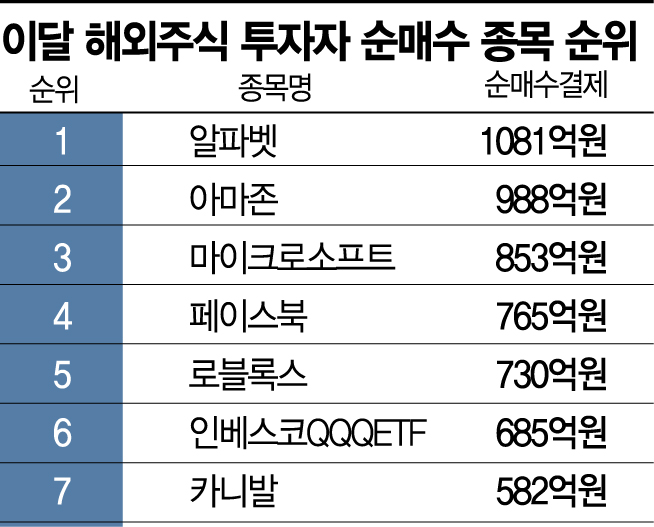
According to the Korea Securities Depository's SEIBRO on the 28th, the net purchase rankings of domestic overseas stock investors this month include Alphabet (108.1 billion KRW), Amazon (98.8 billion KRW), Microsoft (85.3 billion KRW), Facebook (76.5 billion KRW), Roblox (73.0 billion KRW), and Invesco QQQ ETF tracking the Nasdaq index (68.5 billion KRW), representing U.S. technology stocks. Last month, metaverse-related stock Roblox (94.0 billion KRW) led the list, followed by Airbnb (89.8 billion KRW), SPDR ETF tracking the S&P 500 (61.6 billion KRW), and AMC (52.5 billion KRW), which sparked the 'meme' stock craze. However, this month, leading technology stocks have taken top positions, confirming improved investor sentiment toward tech stocks.
The strength in technology stocks is interpreted as influenced by reduced concerns over economic slowdown due to the spread of the Delta variant and increased preference for risk assets. Expectations for earnings improvement also seem to be reflected. Ji-young Han, a researcher at Kiwoom Securities, said, “Considering that economic normalization is progressing effectively, the earnings improvement trend of large technology stocks such as Apple, Amazon, and Microsoft is unlikely to be easily damaged,” adding, “There are also forecasts that the Federal Reserve (Fed) may change the pace of tapering based on the spread of the Delta variant.”
Conversely, Seohak Gaemi have increased net selling of Chinese stocks centered on technology stocks. This is because regulatory risks on large technology companies, which have suppressed Chinese companies' stock prices since last year, have expanded further this month. The Shanghai Composite Index of the Chinese mainland stock market has fallen 6.24% over the past month, and Chinese representative technology companies Alibaba and Tencent have plunged 18% and 25%, respectively.
Accordingly, domestic investors have expanded net selling of BAT (Baidu, Alibaba, Tencent), which had been heavily purchased enough to rank high in portfolios until last month. This month, domestic investors sold 51.7 billion KRW worth of Alibaba stocks, more than the previous month’s 35.9 billion KRW, and also increased sales of Tencent (26.5 billion KRW), Baidu (43.0 billion KRW), and Nio (79.8 billion KRW). Capital outflows also occurred in related exchange-traded funds (ETFs); the Mirae Asset Global X China Electric Vehicle & Battery ETF, which invests in Chinese stocks, saw sales of 108.3 billion KRW, and the China AMC CSI 300 INDEX ETF, which invests in mainland Chinese stocks, also experienced significant capital outflows of 63.8 billion KRW.
In the securities industry, it is expected that regulatory issues by the Chinese government may continue until the second half of the year, so investment proportions should be reduced. Jaehwan Heo, a researcher at Eugene Investment & Securities, explained, “Considering that China's corporate regulations will continue, a long-term decoupling adjustment between the U.S. and China (a phenomenon where the economic flows of countries become desynchronized) may occur,” adding, “Due to tightening issues and manufacturing economic conditions being worse than in the U.S., it will be difficult for the stock market situation to reverse in the second half of the year.”
© The Asia Business Daily(www.asiae.co.kr). All rights reserved.

















