Including 'High School' in Education Office Affairs, School Support Functions Specified
School Curriculum Organization and Operation Also Stated in the 'Elementary and Secondary Education Act'
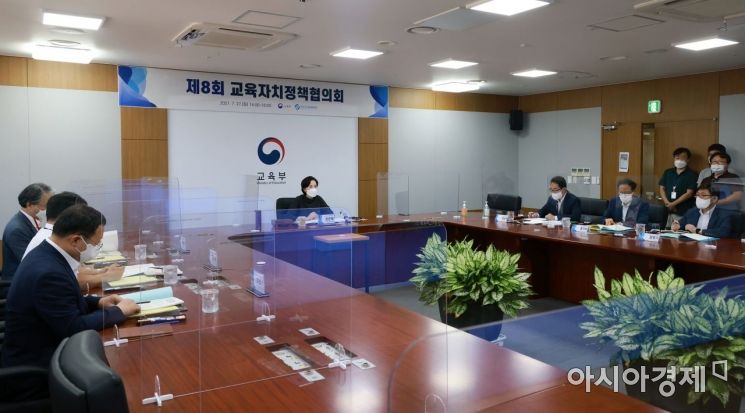 The Ministry of Education held the 8th Educational Autonomy Policy Council on the 27th in collaboration with the National Council of Superintendents of Education.
[Asia Economy Reporter Han Jinju] Provincial and metropolitan offices of education are promoting institutional improvements to strengthen educational autonomy, enabling education tailored to regional characteristics. Education support offices will take full charge of supporting high schools, and the authority to approve textbooks will be transferred to the superintendents of education.
The Ministry of Education announced on the 28th that it held the 8th Educational Autonomy Policy Council on the 27th with the National Association of Provincial and Metropolitan Superintendents of Education, where two agenda items for legal revisions to strengthen educational autonomy and expand educational autonomy were reviewed and approved.
The council decided to pursue amendments to seven laws that promote educational decentralization. To guarantee the independence of education and realize education suited to regional characteristics, amendments to the "Local Education Autonomy Act" will also be pursued.
The scope of duties for education superintendents will include "matters related to high schools," and the school support function will be specified to strengthen the role of education support offices in supporting schools. The Education Autonomy Council, which has been operated by directive, will be codified under the "Local Education Autonomy Act."
Furthermore, legal revisions will be promoted to clearly stipulate matters related to the organization and operation of school curricula in the "Elementary and Secondary Education Act" to flexibly respond to demands from the school field. The authority to approve textbooks will be transferred to the superintendents of education, enabling the development of customized textbooks tailored to regions and individual schools.
The Expert Committee on Educational Autonomy Legal Revisions will continue to operate until August next year to continuously pursue improvement plans for legislative amendment tasks. A joint consultative body among the Ministry of Education, the National Education Council, and the National Association of Provincial and Metropolitan Superintendents of Education will also continue to operate until the National Education Commission is launched in July next year.
Co-chair Yoo Eun-hye emphasized, "Over the past four years, the Education Autonomy Council has played a key role and function in educational decentralization and autonomy, and its significance remains very important as a crucial educational cooperation system (governance) for collaborative preparation of future education."
Co-chair Choi Kyo-jin urged, "This is a time when serious discussions about the direction of future education after COVID-19 are necessary, and let us work together to establish a policy foundation so that true educational autonomy can be realized at the school level."
© The Asia Business Daily(www.asiae.co.kr). All rights reserved.
![Clutching a Stolen Dior Bag, Saying "I Hate Being Poor but Real"... The Grotesque Con of a "Human Knockoff" [Slate]](https://cwcontent.asiae.co.kr/asiaresize/183/2026021902243444107_1771435474.jpg)















