5th Disaster Relief Fund, 'Bottom 80% Income' Health Insurance Premium Criteria Confirmed
Citizens "Paying Taxes as Usual..." Complaints
President Moon "Those with Means, Please Understand"
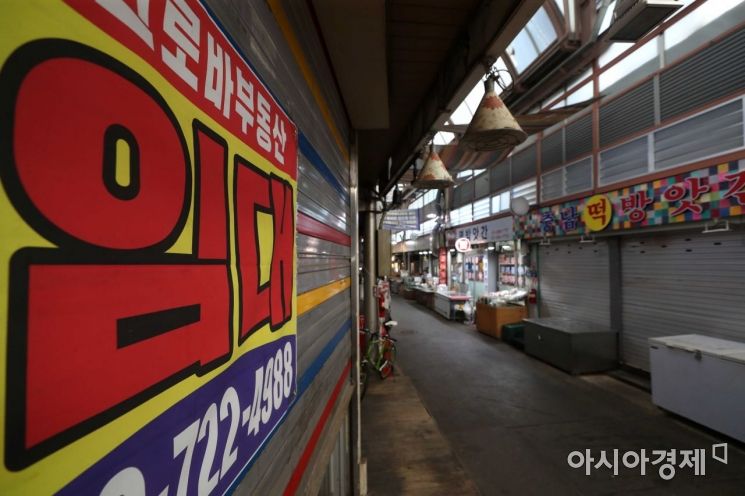 On the 27th, when the dual hardships of the COVID-19 surge and heatwave were rampant, Tongin Market in Jongno-gu, Seoul was quiet. Photo by Mun Ho-nam munonam@
[Asia Economy Reporter Heo Midam] "Wouldn't it be better to give disaster relief funds to all citizens rather than only to 88% of the population?"
The government has decided to provide 250,000 KRW per person in disaster relief funds to 88% of the population, excluding high-income earners, sparking controversy over fairness. Initially, the government considered supporting the bottom 70% income group, but during negotiations with the ruling party, which advocated for universal payments, various figures such as 80%, 84%, 90%, and 100% were discussed, ultimately settling on the bottom 88% income group as a compromise.
However, since the criteria are ambiguous and considering that higher-income individuals pay more taxes, there are arguments that distributing the funds to all citizens would be more appropriate.
On the 26th, the government finalized the criteria for the 5th round of disaster relief payments. Based on the June health insurance premium (health insurance fee), support will be provided to households in the bottom 80% income bracket, with relaxed criteria applied to single-person households and dual-income families. According to these criteria, it is estimated that a total of 20.34 million households (44.72 million people) will receive the support funds.
However, high-asset individuals are excluded from receiving the funds. If the total taxable standard for property tax of family members exceeds 900 million KRW (housing assessed value 1.5 billion KRW, market value 2 to 2.2 billion KRW) or if the total financial income exceeds 20 million KRW annually, they will not be eligible.
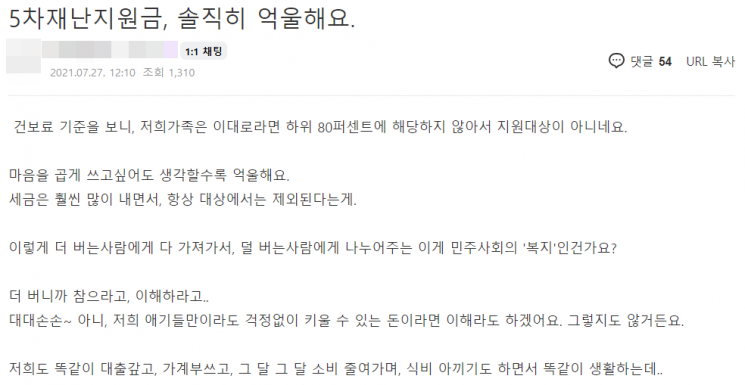
There has been strong backlash from citizens who are excluded from receiving the funds under the government's criteria. One netizen, who stated they were not eligible, said, "It feels increasingly unfair to always be excluded from the support despite paying much more in taxes," expressing frustration by asking, "Is taking from those who earn more in taxes to give to those who earn less really the 'welfare' of a democratic society?"
They continued, "'Understand because you earn more,' they say. I would understand if it were money to raise our children without worry, but that's not the case. We also repay loans, keep household accounts, reduce monthly spending, and save on food expenses, living the same way," lamenting, "It would be less unfair if the benefits went to those who really need welfare."
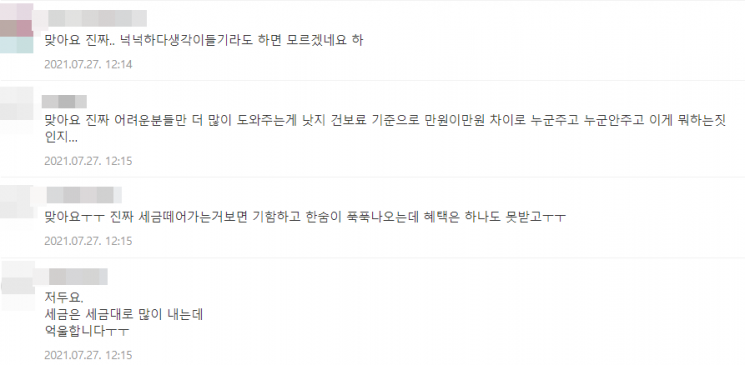
Other netizens also responded critically to the post, saying things like, "I pay a lot in taxes and feel unfair," "I understand helping those in real need, but it's strange to divide benefits with odd criteria where someone better off or similar to me gets benefits while we pay taxes and feel unfair," and "If you want to give support, give it to everyone; dividing people is strange."
For single-income households with workplace health insurance, the June health insurance premium must be below △191,100 KRW for two-person households △247,000 KRW for three-person households △308,300 KRW for four-person households to be eligible.
However, when two households have similar incomes, there can be a "income reversal" phenomenon where one receives 1 million KRW in support (for a family of four) and the other does not.
For example, a four-person household that paid 308,000 KRW in health insurance premiums last month would receive 1 million KRW in support, but a four-person household with a combined premium of 309,000 KRW would not. This means that a difference of just a few hundred KRW in income can result in not receiving the support.
As a result, some argue that disaster relief funds should be provided to all citizens. A 20-something office worker, Mr. A, said, "I don't understand what the bottom 88% income group means. It's not the bottom 20%, so what kind of selective payment is 88%? It would be better to reduce the amount slightly and give 250,000 KRW per person to everyone nationwide."
Local government heads nationwide also expressed regret over the decision to provide disaster relief funds only to the bottom 88% income group.
The National Association of Mayors, County Governors, and District Heads (Chairman Hwang Myeongseon, Mayor of Nonsan) stated in a press release, "The health insurance premium selection criteria are ambiguous, causing fairness controversies, and the selection process requires significant administrative costs, with local government officials burdened by excessive work and complaints," adding, "It is questionable whether the fiscal effect of excluding 12% will offset these issues."
Meanwhile, President Moon Jae-in said at a senior secretaries' meeting held at the Blue House that day regarding the selective payment of support funds, "Although it is not universal support, most citizens are going through difficult times, and many are struggling with their livelihoods. We ask for understanding from those who are relatively better off."
© The Asia Business Daily(www.asiae.co.kr). All rights reserved.
![Clutching a Stolen Dior Bag, Saying "I Hate Being Poor but Real"... The Grotesque Con of a "Human Knockoff" [Slate]](https://cwcontent.asiae.co.kr/asiaresize/183/2026021902243444107_1771435474.jpg)

















