Opening This December, to House Works by World-Renowned Master the Late Nam June Paik
Successful Acquisition of 'Turtle', 'Sistine Chapel', 'Cage's Forest, Revelation of the Forest'
Dynamic Future City Identity Symbolizing Bangudae Petroglyp
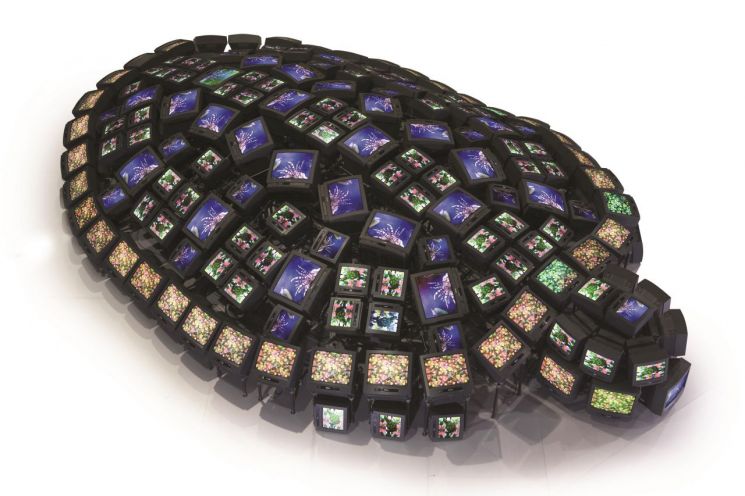
[Asia Economy Yeongnam Reporting Headquarters Reporter Kim Yong-woo] The first collection item of Ulsan Museum of Art has been decided as the media art piece "Geobuk" (Turtle), and all of the first, second, and third collection items have been selected as works by Nam June Paik.
Ulsan City announced on the 27th that it has succeeded in acquiring works by the world-renowned master artist Nam June Paik as the representative collection items for the Ulsan Museum of Art, which is scheduled to open in December.
Ulsan City has been promoting the collection of works by Nam June Paik, a globally recognized Korean artist, avant-garde artist, and pioneer of video art, with the goal of establishing the Ulsan Museum of Art as a "future-oriented museum centered on media art."
After carefully selecting works that clearly reflect Nam June Paik's unique style while symbolizing "Ulsan's identity," the city decided to acquire a total of three works: "Geobuk" (1993), "Sistine Chapel" (1993), and "Cage’s Forest, Revelation of the Forest" (1992?1994).
Among these, the first collection item of the Ulsan Museum of Art is the work "Geobuk" (Turtle).
Nam June Paik's "Geobuk" is a large-scale video sculpture (10m×6m×1.5m) made from 166 televisions arranged in the shape of a turtle, created in Germany in 1993.
It is a representative work that showcases Nam June Paik's distinctive aesthetics combining nature and technology, as well as Eastern spirit and Western culture.
"Geobuk" well reflects the long history of the Korean Peninsula, and Ulsan City regards the placement of this work in Ulsan?a city represented by the Bangudae Petroglyphs?as highly meaningful.
The name "Bangudae" (盤龜臺) was given because the terrain around the petroglyphs has long been said to resemble a turtle lying down.
Having embraced the prehistoric Bangudae Petroglyphs, successfully led South Korea’s industrialization, and now pioneering the Fourth Industrial Revolution era with future new industries, Ulsan’s identity is well symbolized by the work "Geobuk."
The second collection item of the Ulsan Museum of Art, "Sistine Chapel," is a work of great art historical value, often called the "Creation of the World in the 20th Century."
Nam June Paik won the Golden Lion, the highest award at the 1993 Venice Biennale, with this work.
The third collection item, "Cage’s Forest, Revelation of the Forest," is a work that combines the themes of nature and ecology with video art. Nam June Paik expressed his artistic reverence for avant-garde musician John Cage (1912?1992), who greatly influenced him, by using a birdcage that shares the same pronunciation as Cage’s name to realize his artistic world.
To maximize the meaning and value of Nam June Paik’s works, the Ulsan Museum of Art plans to hold an external exhibition in addition to a special exhibition for the museum’s opening.
The exhibition venue will utilize the former Ulsan Education Training Center located within Daewangam Park, a representative landmark of Ulsan.
Currently, construction of the Ulsan Museum of Art is progressing smoothly with a target completion date in November, and the project is 80% complete.
© The Asia Business Daily(www.asiae.co.kr). All rights reserved.
![Clutching a Stolen Dior Bag, Saying "I Hate Being Poor but Real"... The Grotesque Con of a "Human Knockoff" [Slate]](https://cwcontent.asiae.co.kr/asiaresize/183/2026021902243444107_1771435474.jpg)















