Net Profit Exceeds 9 Trillion Won in First Half
Growth Trend Expected to Continue in Second Half
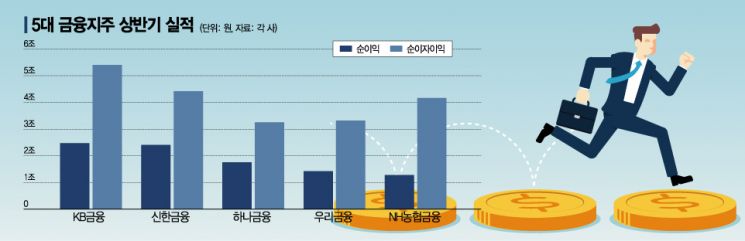
[Asia Economy Reporters Kwangho Lee, Kiho Sung] Domestic financial holding companies, which recorded record-breaking earnings in the first half of this year, are also forecasting a strong performance in the second half. This is based on expectations that loan interest rates will rise and interest income will increase further as the Bank of Korea signals a possible rate hike within the year. However, the ongoing spread of COVID-19, despite elevated social distancing measures, remains a variable.
Net Profit Exceeds 9 Trillion Won in First Half... Strong Earnings Expected in Second Half
According to the financial sector on the 27th, the combined net income of the five major financial holding companies?KB, Shinhan, Hana, Woori, and NH Nonghyup?reached 9.3729 trillion won in the first half, nearly a 50% increase compared to the same period last year. All five financial holding companies posted record-high earnings.
The significant increase in net profit is mainly due to a surge in interest income centered on banks. Additionally, the activation of the stock market has strengthened the profitability of affiliated securities firms, and other fee income has also increased.
The interest income of the five banks?KB Kookmin, Shinhan, Hana, Woori, and NH Nonghyup?reached 20.4494 trillion won in the first half, surpassing 20 trillion won for the first time ever. This improvement in net interest margin resulted from a continuous rise in market interest rates and a sharp increase in low-cost demand deposits.
The net interest margin (NIM) of KB Kookmin, Shinhan, Hana, and Woori banks rose by 0.03 to 0.04 percentage points year-on-year to between 1.37% and 1.56%. NH Nonghyup Bank was the only exception, with a 0.06 percentage point decline to 1.61% compared to the same period last year.
This upward trend is expected to continue into the second half. The Bank of Korea is likely to raise the base rate as early as August or by October at the latest. Woori Bank anticipates an increase in interest income of about 175 billion won if the Bank of Korea raises the base rate by 0.25 percentage points. The profits of larger asset holders such as KB Financial, Shinhan Financial, and Hana Financial are expected to be even greater.
The surge in securities firms' fee income due to the stock investment boom and increased card company fee income from recovering private consumption also drove strong earnings. Shinhan Financial's net fee income in the first half rose sharply by 24.3% year-on-year to 1.404 trillion won. Of this, securities business fee income increased by 40.6% to 261.7 billion won, and credit card fee income rose by 4.8% to 181.5 billion won. KB Financial's net fee income increased by 32.7% (1.8326 trillion won), Hana Financial by 16.7% (1.2613 trillion won), Woori Financial by 46.4% (729 billion won), and Nonghyup Financial by 28.5% (983.7 billion won) compared to the same period last year.
With record-breaking earnings, all five major financial holding companies are expected to pay quarterly and interim dividends for the first time ever. Shinhan Financial plans to pay equal quarterly dividends to shareholders as of the end of June, considering last year's dividend per share. This will be decided at the board meeting scheduled for next month. KB Financial has resolved an interim dividend of 750 won per share, Hana Financial 700 won, and Woori Financial 150 won. Nonghyup Financial is also positively considering it.
Variable is COVID-19 Spread... Concerns Over ‘Political Bills’
The key variable is how quickly the spread of COVID-19 can be contained. The fourth wave continues, with an average of about 1,500 new cases per day over the past week. Financial holding companies claim they have secured sufficient loss absorption capacity, but if the fourth wave prolongs, they may need to set aside large provisions again. Last year, financial holding companies increased their loan loss provisions by 52.6% compared to the previous year to strengthen their loss absorption capacity.
A financial sector official said, "If the current trend continues, record-breaking earnings are expected in the second half as well, but the key is how much shock from the fourth wave of COVID-19 can be absorbed," adding, "Ultimately, the development of the COVID-19 situation will be the variable."
Along with next year's presidential election, various ‘populist bills’ from the political sphere are also pressuring financial holding companies. The most controversial bill and pledge recently in the financial sector is Gyeonggi Province Governor Lee Jae-myung's ‘Basic Series.’ The ‘Basic Loan’ pledge offers low-interest loans of up to 10 million won at 3% annual interest to young people aged 19 to 34. The amendments to the Microfinance Act and the Regional Credit Guarantee Foundation Act have already been submitted to the National Assembly.
There are currently five bills proposing to lower the maximum interest rate to 10-15%, and the ‘Bank Debt Relief Act,’ which forgives bank loans during disaster situations, is also under review by the Standing Committee on Political Affairs.
Experts express concern that political demands are exceeding the public interest role and regulatory scope of banks. Professor Ji-yong Seo of Sangmyung University's Department of Business Administration pointed out, "The government and political circles tend to think of banks' money as petty cash, but the money belongs to shareholders and depositors," adding, "We should not consider banks making money as something evil."
© The Asia Business Daily(www.asiae.co.kr). All rights reserved.
![Clutching a Stolen Dior Bag, Saying "I Hate Being Poor but Real"... The Grotesque Con of a "Human Knockoff" [Slate]](https://cwcontent.asiae.co.kr/asiaresize/183/2026021902243444107_1771435474.jpg)
















