Lowered NPL Ratios of 5 Major Banks
"Corporate Restructuring Must Be Done Now to Mitigate Economic Shock"
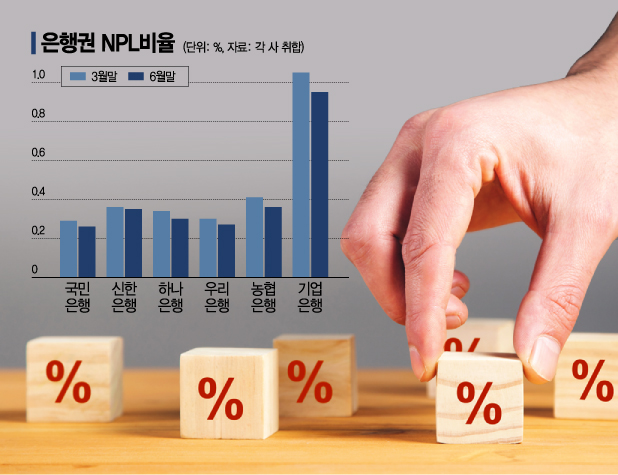
[Asia Economy Reporter Sunmi Park] Due to the extension of COVID-19 financial support, the non-performing loan (NPL) ratio in the banking sector is expected to set a new record low by the end of June this year. Among experts, there is a growing consensus that now, when banks' asset soundness is strong, is the right time to push for restructuring of insolvent companies.
According to the financial industry on the 29th, the asset soundness of the five major commercial banks?KB Kookmin, Shinhan, Hana, Woori, NH Nonghyup?and IBK Industrial Bank of Korea as of the end of June showed a common trend of improvement compared to the previous quarter. The NPL ratios as of the end of June were 0.26% for Kookmin, 0.35% for Shinhan, 0.30% for Hana, 0.27% for Woori, 0.36% for Nonghyup, and 0.95% for IBK, decreasing by as little as 0.01 percentage points and up to 0.1 percentage points compared to the end of March.
Delinquency rates also fell by up to 0.04 percentage points compared to the end of March, with Kookmin at 0.14%, Shinhan at 0.25%, Hana at 0.20%, Woori at 0.23%, Nonghyup at 0.23%, and IBK at 0.31%.
Given the significant decline in NPL ratios and delinquency rates among the five major banks and IBK, which hold a large market share, it is highly likely that the overall NPL ratio for all domestic banks, to be announced later, will break below the previous record low of 0.62% recorded at the end of March. This is interpreted as a false improvement in asset soundness due to the COVID-19 financial policy support that simultaneously deferred principal and interest repayments.
Since the COVID-19 outbreak began in February last year, banks have extended loan principal maturities and deferred interest payments for small and medium-sized enterprises and small business owners in accordance with the government's COVID-19 financial support policy. As of the 22nd of this month, the total amount of principal and interest payment deferrals by the five major banks exceeds 108 trillion won.
The financial authorities plan to decide on whether to extend the maturity extension and payment deferral support program for COVID-19 loans, which is scheduled to end at the end of September, after monitoring the COVID-19 quarantine situation further. If the fourth wave does not subside, there is growing weight toward additional extensions beyond September, leaving open the possibility that the false improvement in banks' asset soundness due to COVID-19 financial support will continue into the second half of the year.
Accordingly, voices are gaining strength that restructuring of insolvent companies should be carried out while banks' asset soundness is strong to mitigate potential economic shocks caused by restructuring in the future.
Senior Research Fellow Gu Jeong-han of the Korea Institute of Finance said, "The number of companies subject to detailed evaluation that potentially show signs of insolvency increased from 3,307 in 2019 to 3,508 in 2020 due to COVID-19, raising the likelihood of an increase in companies showing signs of insolvency," and advised, "To reduce the economic shock from future corporate restructuring, restructuring should be promoted while banks' asset soundness is strong."
Gu added, "Rather than conducting corporate credit risk assessments excluding temporary impacts from COVID-19 as was done last year to reduce the number of companies subject to restructuring, it is necessary to conduct corporate credit risk assessments that prioritize restructuring for companies with long-term insufficient financial condition improvements even before the COVID-19 crisis."
© The Asia Business Daily(www.asiae.co.kr). All rights reserved.
![Clutching a Stolen Dior Bag, Saying "I Hate Being Poor but Real"... The Grotesque Con of a "Human Knockoff" [Slate]](https://cwcontent.asiae.co.kr/asiaresize/183/2026021902243444107_1771435474.jpg)















