National Disaster Safety Research Institute's Analysis on Climate Change Response Using Big Data
Analyzed 320,000 Safety News Articles and Over 60 Papers and Books to Identify 7 Fields and 32 Factors
[Asia Economy Reporter Lim Cheol-young] The National Disaster Safety Research Institute under the Ministry of the Interior and Safety has released a comprehensive analysis of the efforts needed to minimize the impacts of climate change using big data.
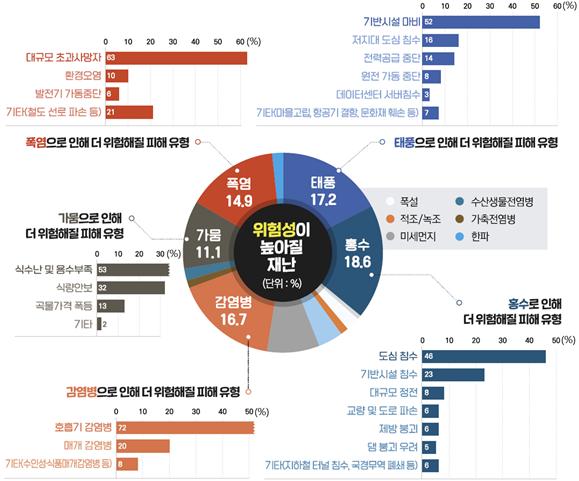
On the 27th, the National Disaster Safety Research Institute analyzed 320,000 climate change-related news articles and over 60 papers and books using big data, and together with 150 experts from universities and research institutions, identified 32 factors across 7 fields that influence climate change and its response.
The seven fields affecting climate change response were identified as international cooperation, systems and policies, public awareness, governance, society, economy, and science and technology. Key factors included 32 items such as "excessive national self-prioritization," "bystander effect of not acting first," and "consumption behaviors causing climate change."
Among the 150 experts participating in the study, 60% expected future climate change to proceed according to a negative scenario, while 40% anticipated a positive scenario. The types of future disasters and damages expected to increase in risk due to climate change were ranked as follows: urban flooding caused by floods (18.6%) ranked first; paralysis of infrastructure due to typhoons (17.2%) second; respiratory infectious diseases due to infectious diseases (16.7%) third; large-scale excess deaths due to heatwaves (14.9%) fourth; and water shortages and drinking water scarcity due to droughts (11.1%) fifth.
The institute explained, "Looking at the content, the risk levels for all five disaster types were similar," adding, "Unlike past disasters which occurred one at a time, recent disasters occur simultaneously in various forms, indicating that prevention and response to the climate crisis are necessary."
Based on the analysis results, the institute also proposed 13 future strategic directions across six fields for the effective implementation of climate change measures. The six fields include: playing a leading role in strengthening international climate change cooperation; enhancing policy priorities and linkages through the refinement of climate change-related policies; fostering a climate change response culture that the public can feel; clarifying the roles of climate change stakeholders and establishing participatory governance; minimizing investment uncertainties in climate change response and creating an environment where economic development and greenhouse gas reduction can coexist; and laying the foundation for renewable energy for the transition to a decarbonized society.
Meanwhile, the institute published and shared issue 17 of the "Future Safety Issue," which contains detailed information on these topics. Director Lee Sang-kwon stated, "In the era of the climate crisis, forming consensus and active participation across various fields are important for the efficient implementation of climate change measures," adding, "We plan to gather diverse opinions on the disaster safety sector, which is most affected by climate change, and promote research and development projects that can support these efforts."
© The Asia Business Daily(www.asiae.co.kr). All rights reserved.
![Clutching a Stolen Dior Bag, Saying "I Hate Being Poor but Real"... The Grotesque Con of a "Human Knockoff" [Slate]](https://cwcontent.asiae.co.kr/asiaresize/183/2026021902243444107_1771435474.jpg)
















