[Seoul District News] Yangcheon-gu completes creation of 'Sinjeong Herb One' through participation in 'Yangcheon Gardener'... Gwangjin-gu starts vaccination for people in their 50s... High school seniors also receiving vaccines... Gwanak-gu designates 560m car-free zone from Hyundai Market Entrance Intersection to Bongcheon-ro Intersection... Seocho-gu operates 4 outdoor heat relief shelters utilizing park and bridge underpasses... Guro-gu improves pedestrian environment around Gyeongin-ro Oryu IC
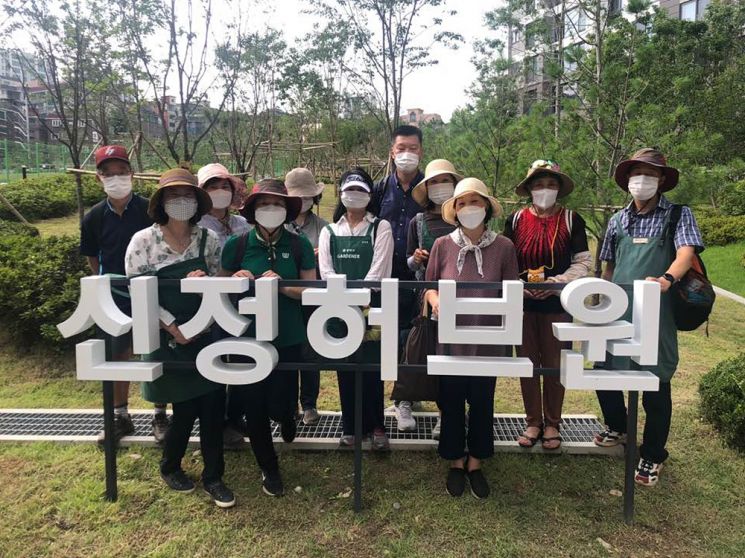
Yangcheon-gu Completes Creation of ‘Sinjeong Herb Garden’ through Participation of ‘Yangcheon Gardener’
[Asia Economy Reporter Park Jong-il] Yangcheon-gu (Mayor Kim Soo-young) announced that it has completed the creation of ‘Sinjeong Herb Garden’ in the donated scenic green space (4,938㎡) in Sinjeong 3-dong through the participation of Seoul City citizen gardeners, ‘Yangcheon Gardener’.
‘Sinjeong Herb Garden’ was created to upgrade the donated scenic green space in Sinjeong 3-dong into a healing space for residents. To create and maintain the garden, the first group of 21 ‘Yangcheon Gardeners’ appointed on June 8 were deployed three times.
‘Yangcheon Gardener’ refers to residents who have completed the theoretical and practical training course for Seoul citizen gardeners. This ‘Sinjeong Herb Garden’ became the starting point for creating a garden city through public-private cooperation.
The ‘Sinjeong Herb Garden’ was planted with subtly fragrant and visually beautiful herb plants.
The main herb species selected were five types preferred by Koreans: rosemary, apple mint, French lavender, sage, and chamomile. The overall color scheme was composed of five colors that provide a warm healing feeling: white, oatmeal, cherry blossom pink, green, and lilac.
Additionally, by planting sedges (grasses with pointed leaves) and woody plants (flowering trees), the garden was designed as a healing space that satisfies the five senses.
Moreover, the planting space was divided into two themes to provide different experiences in each section. The ‘Healing Experience Herb Zone,’ mixed with herbs and seasonal flowers, offers a rich sensory experience, while the ‘Natural Garden Zone,’ centered on grasses and flowers, provides a deep scenic view and abundant attractions.
Since herbs rarely seen in existing parks were planted in ‘Sinjeong Herb Garden,’ the citizen gardeners ‘Yangcheon Gardener’ will continue delicate maintenance two to four times a month even after completion.
Mr. Kim (56, Sinjeong-dong), active as a ‘Yangcheon Gardener,’ said, “I was happy to participate responsibly from the first stage of garden creation to completion through this activity, and I thank Yangcheon-gu for trusting me.”
Mayor Kim Soo-young said, “Sinjeong Herb Garden is meaningful because residents directly participate and nurture it throughout the entire process of creating a public garden. We will continue to promote resident participation gardening in various spaces to build a park city of Yangcheon-gu together with residents.”
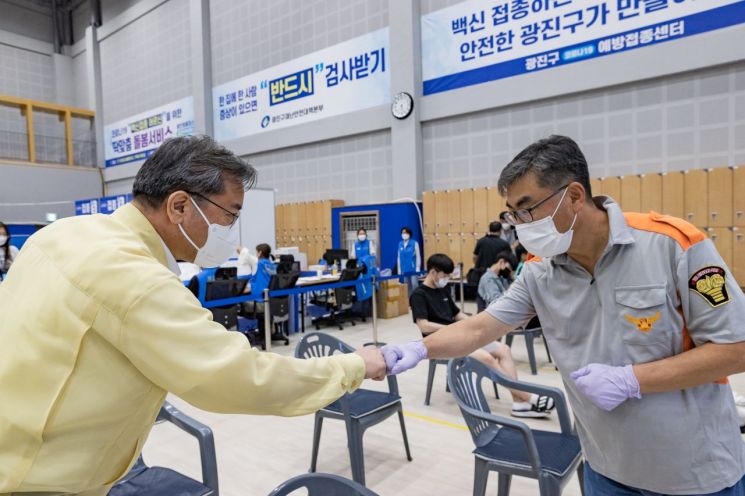
Gwangjin-gu Begins Vaccination for People in Their 50s... High School Seniors Also Undergoing Vaccination
Gwangjin-gu (Mayor Kim Seon-gap) started COVID-19 vaccination for residents aged 55 to 59 from the 26th.
The district sequentially conducted pre-reservations for vaccination for residents in their 50s until 6 p.m. on the 24th and then closed the reservations.
The first dose for people in their 50s will be administered with Pfizer or Moderna vaccines, and the second dose will be given with the same vaccine four weeks later.
Meanwhile, the district is conducting Pfizer vaccinations for high school seniors and high school staff in the area until the 30th. Other college entrance exam candidates, excluding high school students, can make pre-reservations from the 28th to the 30th, with vaccinations scheduled from September 10 to 14.
Vaccinations for those aged 50 to 54 will start on August 16, and the first dose for all people in their 50s will be completed on August 28.
For detailed information on vaccination targets and schedules, residents can inquire through the district website or the Gwangjin-gu Vaccination Call Center.
Mayor Kim Seon-gap said, “Vaccination schedules are currently underway for various target groups. We ask for the active participation of residents to make Gwangjin-gu a safe area from COVID-19.”
Gwanak-gu Designates 560m Section from Hyundai Market Entrance Intersection to Bongcheon-ro Intersection as Car-Free Street
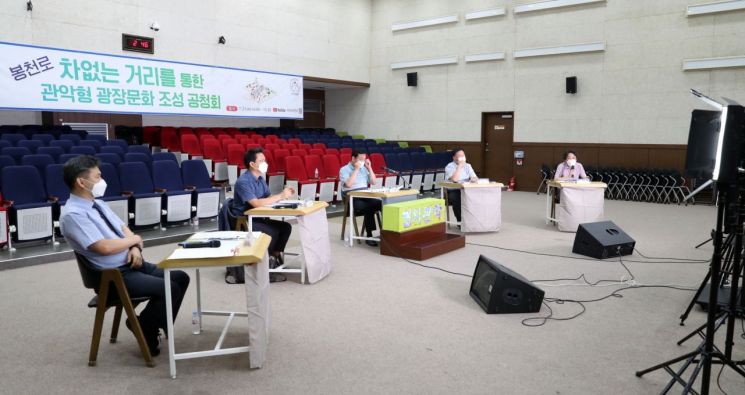
Gwanak-gu (Mayor Park Jun-hee) held a public hearing on the ‘Gwanak-style Plaza Culture Creation Project through Car-Free Streets’ at 2 p.m. on the 21st in the 8th-floor auditorium of the district office.
The project aims to designate a 560m section from Hyundai Market Entrance Intersection to Bongcheon-ro Intersection as a car-free street for a certain period, creating a plaza to provide a healing space in the city for residents.
This project is a public-private cooperative governance project started in 2021, with an implementation promotion team consisting of residents and administration involved from agenda discovery to execution and monitoring.
To gather diverse opinions from residents, the public hearing was held on the 21st with a small number of participants due to social distancing measures, focusing on the host and attendees, and was broadcast live on the official YouTube channel ‘Live Gwanak.’
The hearing was led by Park Tae-jae, head of the Car-Free Street Implementation Promotion Team, adding significance to the public-private cooperation. The agenda included project progress, traffic management plans, and event planning directions.
Hong Moon-gi, Cooperation Coordinator, expressed expectations, saying, “Plazas are spaces where local communities gather to communicate and interact. Although this is the first attempt this year, if sustained for more than three years, it can become a local culture.”
Kim Bong-chan, Executive Director of Urban Future Comprehensive Technology Corporation, said, “We must strive to minimize traffic congestion and maintain smooth traffic flow by sufficiently deploying traffic guidance signs and personnel.”
He also emphasized the importance of voluntary cooperation from citizens who usually use the section by promoting traffic restraint and detour use through various media such as traffic broadcasts.
Ahn Byung-chan, CEO of Gwanak FM, suggested actively utilizing local resources such as the Gang Gam-chan Festival, Jungang-dong I-rang Festival, Dream Market, and flea markets, saying, “It is important for local residents to communicate and create plaza culture together as members of the community.”
Other opinions raised included reducing the frequency of car-free street events due to COVID-19, flexible operation of car-free street hours, and installation of separate trash bins.
The district plans to hold a car-free street event in October. Residents interested in the project can watch the public hearing on the official YouTube channel ‘Live Gwanak.’
Mayor Park Jun-hee said, “We will promote the operation of car-free streets based on public-private cooperation to accommodate diverse demands of residents and create a Gwanak-style plaza culture. We will do our best to actively reflect residents’ suggestions, including those from this public hearing, in district administration,” encouraging resident participation.
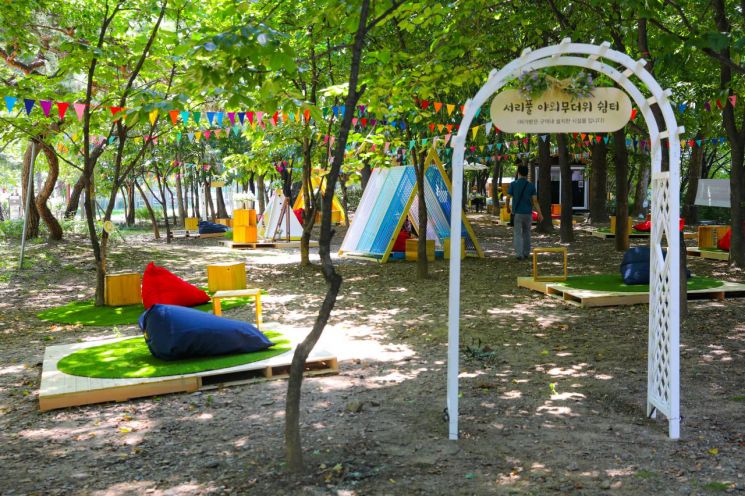
Seocho-gu Operates Four Outdoor Heat Relief Shelters Utilizing Park and Bridge Undersides in the City
Seocho-gu (Mayor Cho Eun-hee) announced that it will operate outdoor heat relief shelters where residents can rest from the heat until August 26.
The outdoor heat relief shelters installed this time are located at ▲Yeoui Stream near Yangjae IC underpass ▲Yangjae Stream Neighborhood Park ▲Dongjak Station Dongjak Bridge ▲Seocho 1 Bridge, totaling four locations, operating from 10 a.m. to 5 p.m.
Especially, the heat relief shelter under the Yeoui Stream Yangjae IC bridge consists of a two-tiered stepped deck, with objects and lighting installed throughout, transforming it into a stylish space reminiscent of a gallery. The district expects this place to provide a dual benefit of heat relief and crime prevention.
The heat relief shelter in Yangjae Stream Neighborhood Park features an Indian tent, bean bags, box tables, and photo zones to create a camping atmosphere. The district provides cooling supplies such as ice water, fans, and ice cushions for visitors, and also stocks non-contact thermometers, masks, and hand sanitizers, regularly disinfecting the area.
The district installed outdoor heat relief shelters because indoor heat relief shelters have been relatively limited due to the prolonged COVID-19 pandemic, utilizing shaded areas in local parks and under bridges to create urban rest spaces.
Along with outdoor shelters, the district operates some indoor heat relief shelters with thorough disinfection. These include 18 community centers (weekdays 9 a.m. to 9 p.m.), 43 senior centers (weekdays 1 p.m. to 5 p.m.), and 3 senior welfare centers (weekdays and holidays 1 p.m. to 5 p.m.), with plans to expand as social distancing eases.
Since July, the district has operated a comprehensive heatwave support situation room to protect vulnerable groups exhausted by the heat. Representative efforts include installing 60 Seoripul cooling chairs at bus stops, operating 204 ‘Seoripul Ondulmak’ shade shelters that have become a nationwide standard at crosswalks, and the popular ‘Seoripul parasol rental service’ at community centers and temporary screening clinics.
Mayor Cho Eun-hee said, “We created outdoor heat relief shelters so residents can spend a cool summer amid COVID-19 and heatwaves. We will continue to carefully manage so everyone can have a healthy summer.”
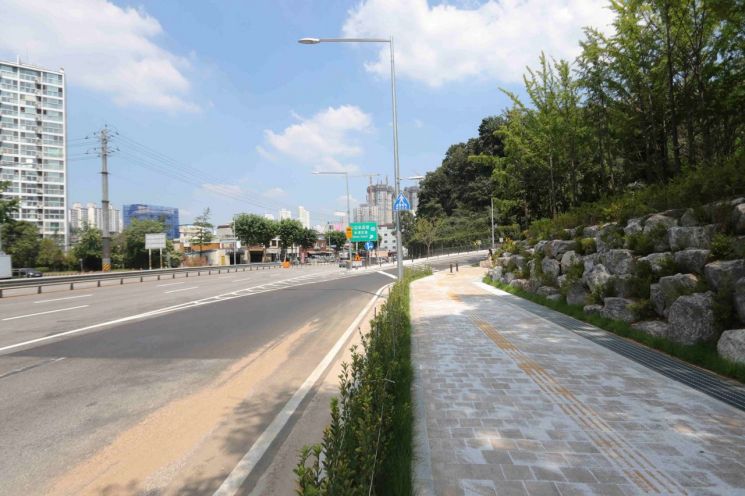
Guro-gu Improves Pedestrian Environment around Gyeongin-ro Oryu IC
Guro-gu (Mayor Lee Sung) has newly constructed a sidewalk for pedestrians on the south side of Gyeongin-ro Oryu IC on Nambu Sunhwan-ro.
The district announced on the 27th that it recently completed the pedestrian environment improvement project to provide safe and convenient passage for pedestrians in the area where sidewalks were disconnected, causing inconvenience to residents who had been requesting the construction of pedestrian paths.
Guro-gu secured 1 billion KRW in city funds through continuous consultations with the Seoul city department in charge to improve residents’ inconvenience and carried out this project.
The newly constructed sidewalk section extends 430m from Gyeongin-ro 240 (around Dongbu Apartment) to Gyeongin-ro 290 (around S-Oil gas station), with a width of 2 to 3 meters. It includes 534 tons of landscaping stones, retaining walls, fences, and drainage facilities.
Additionally, two traffic islands were installed around the new sidewalk to ensure pedestrian safety and smooth traffic flow. Zelkova trees were planted on the traffic islands, and circular benches were provided.
A Guro-gu official said, “This project connecting the disconnected sidewalk on the south side of Gyeongin-ro Oryu IC is expected to prevent safety accidents caused by walking on the shoulder and improve pedestrian convenience.”
Meanwhile, Guro-gu is steadily promoting projects to strengthen transportation infrastructure. The main road construction from Uma-gil in Garibong-dong to Samhwa Printing Factory, 8m wide and 377m long, is scheduled for completion by the end of this year. To cope with increased traffic due to the Hang-dong public housing district move-in, the road width of Yeondong-ro is being expanded from 8m to 12m. The leveling project of Nambu Sunhwan-ro around Gaebong 1-dong intersection is expected to be completed by the end of 2023. Various projects are underway to improve traffic environments, including Sasunggyo expansion, Guro 5-dong Bamdongsan Village access road expansion, and road construction around Gosan Elementary and Oryu Elementary schools.
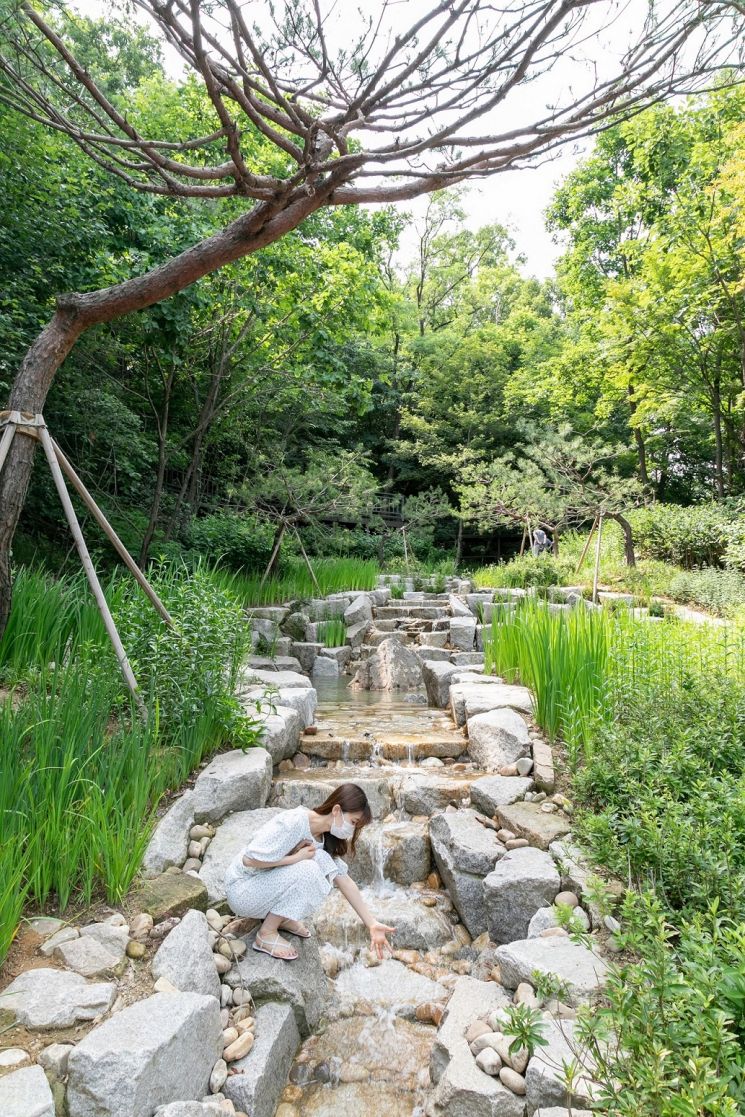
Gangseo-gu Creates ‘Gaehwasan Ecological Park’
Gaehwasan has been reborn as an ecological park where clear water and green forests harmonize.
Seoul Gangseo-gu (Mayor Noh Hyun-song) announced that it has completed the ‘Gaehwasan Revival’ project and entered a pilot operation phase.
The ‘Gaehwasan Revival’ project involves drawing discharged groundwater to Gaehwasan, which lacks water sources, for wildfire prevention and ecological stream water use, creating an artificial waterfall and ecological waterway to develop a waterfront park.
Gaehwasan had been facing depletion of stream and spring water sources, destroying habitats for small organisms, causing tree die-off, and increasing fire risks.
Accordingly, since 2017, the district started the revival project after holding resident briefings and feasibility verification, utilizing 22,464 tons of discharged groundwater from the nearby Gimpo Urban Railway Section 5.
The discharged groundwater was used to flow water into the nearby Gaehwa Stream and pumped back up to the Gaehwasan summit via a relay pump station.
This enabled the creation of a healing forest at the summit, an ecological forest along the entrance to Yaksa Temple, a popular temple, and installation of an ecological pond and artificial waterfall where aquatic flora and fauna live.
The water flowing from the ecological pond and waterfall is reused for wildfire prevention and tree watering during droughts.
Additionally, the district installed pavilions, benches, and observatories to provide open resting spaces where residents can slowly walk through the forest and heal their body and mind.
While preserving the Gaehwasan forest belt as much as possible, the district planted about 28,400 trees and herbaceous plants such as Korean spindle, mountain hydrangea, and iris to enhance forest functions.
The district plans to operate the park stably during the pilot operation period according to social distancing levels.
Mayor Noh Hyun-song said, “Through this project, Gaehwasan is expected to become a representative resting place for residents. We will thoroughly manage it to maintain basic forest functions such as habitats and to make it a healing spot that residents can conveniently visit and enjoy.”
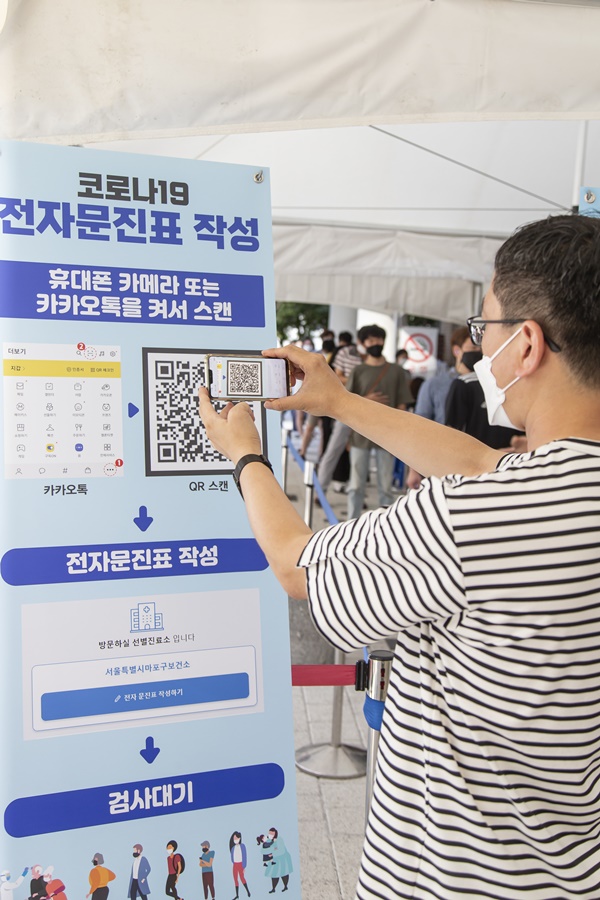
Mapo-gu’s Secret to Faster COVID-19 Screening: Electronic Questionnaire Using QR Codes
Mapo-gu (Mayor Yoo Dong-gyun) announced that from the 16th, it introduced an electronic questionnaire system using QR codes at the health center screening clinics.
This was to alleviate citizens’ fatigue caused by long waiting times as more than 1,200 people on average per day flocked to the health center screening clinics amid the recent surge in COVID-19 cases.
The previous four-step procedure of ‘waiting → manual questionnaire completion → registration → testing’ has been shortened to three steps: ‘waiting (electronic questionnaire completion) → registration → testing’ after introducing the QR code-based electronic questionnaire.
With the manual questionnaire step removed, waiting times have shortened, and the workload of screening clinic staff has decreased.
Additionally, the risk of cross-infection among citizens during manual questionnaire completion has been reduced.
The electronic questionnaire system works by having the testee scan the QR code provided at the health center screening clinic with their phone and fill out the electronic questionnaire themselves.
Afterward, the testing procedure proceeds as before, with the registration desk verifying identity and questionnaire content, printing a barcode, and collecting the specimen.
A resident who recently underwent COVID-19 screening at a health center said, “The process of manually filling out questionnaires while wearing gloves in hot weather and waiting is gone, making it much more comfortable. I praise Mapo-gu’s quick response using QR code technology.”
Mayor Yoo Dong-gyun said, “Voluntary COVID-19 testing by residents is necessary to curb the spread. We will do our best to ensure residents can receive quick and comfortable testing during these difficult times.”
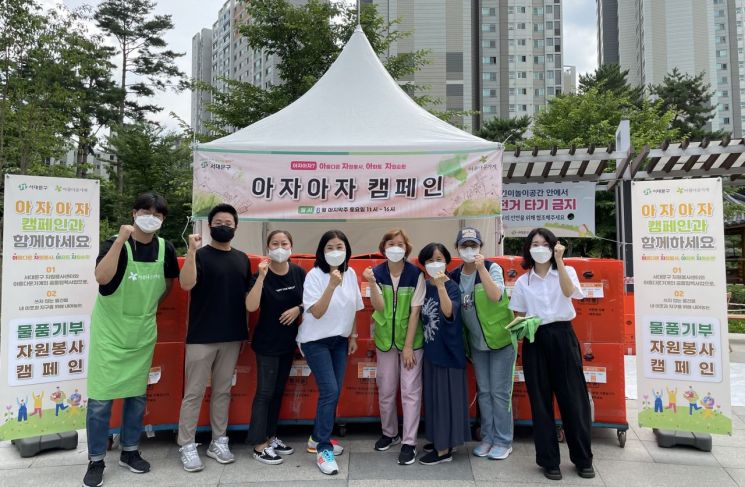
Seodaemun-gu Holds Special Sale of Donated Items with Beautiful Store
Seodaemun-gu (Mayor Moon Seok-jin) and the Beautiful Store Foundation (Chairman Hong Myung-hee) will hold the ‘Beautiful Special Exhibition with Seodaemun-gu’ on the 29th at the Beautiful Store Eunpyeong-gu Office branch.
As part of a joint cooperation project for sharing and circulation, the district and Beautiful Store conducted the ‘Aja Aja (Beautiful Volunteer, Apartment Resource Circulation) Campaign’ on the last Saturdays of April, May, and June this year.
Residents of Bukgajwa 1 and 2-dong and Namgajwa 1 and 2-dong apartments participated, donating a total of 3,171 items.
This special exhibition is an event to sell these donated items, with all proceeds used to help vulnerable residents in Seodaemun-gu through Beautiful Store’s ‘2022 Beautiful Sharing Bundle’ project.
Mayor Moon Seok-jin said, “Many residents participated in the non-face-to-face resource circulation campaign, which was meaningful. I hope many will join the values of resource circulation and sharing through this special exhibition.”
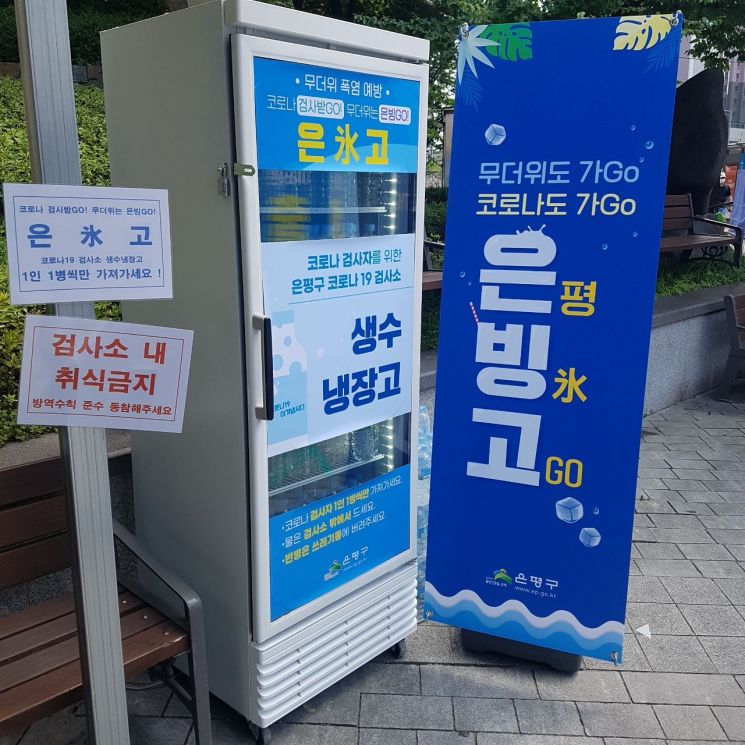
Eunpyeong-gu Provides Cold Water for Residents Waiting in Heat at Temporary COVID-19 Screening Clinics
Eunpyeong-gu (Mayor Kim Mi-kyung) installed refrigerators and provides cold water at two temporary COVID-19 screening clinics (Yeokchon Station and Gupabal Station) on the 26th to help residents waiting for COVID-19 tests amid ongoing heatwaves.
The water refrigerators are installed at the exits of the temporary clinics, allowing tested residents to freely take water to quench thirst caused by waiting in the heat.
The district also plans to install speakers at the clinics to play music to help relieve fatigue for residents waiting for tests.
An Eunpyeong-gu official said, “We are exploring various solutions to help residents cope with the heat during long queues in the hot summer and are making every effort to prevent heat-related safety accidents.”
Currently, Eunpyeong-gu operates three COVID-19 testing sites: Eunpyeong Peace Park (Exit 4 of Yeokchon Station), Gupabal Artificial Waterfall Meeting Plaza (Exit 1 of Gupabal Station), and the screening clinic in front of Eunpyeong-gu Health Center.
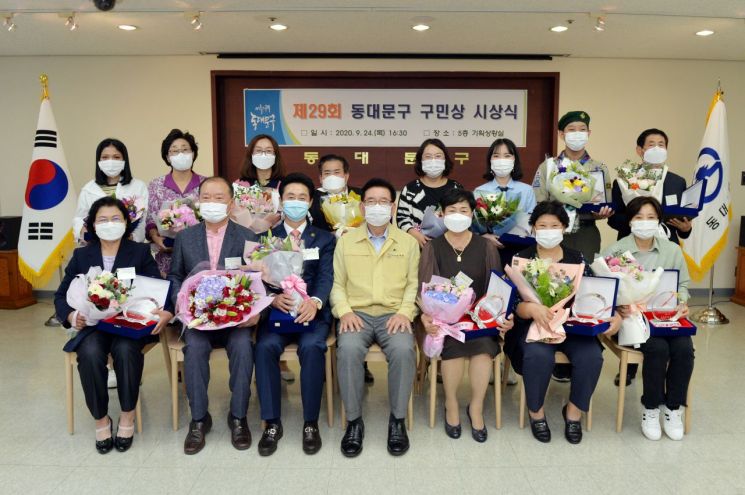
Dongdaemun-gu Accepts Nominations for the 30th Dongdaemun-gu Resident Awards
Dongdaemun-gu (Mayor Yoo Deok-yeol) is accepting nominations for the ‘30th Dongdaemun-gu Resident Awards’ until August 20.
Held to commemorate the ‘30th Dongdaemun Residents’ Day,’ the awards will select a total of 14 recipients across seven categories: Proud Resident Award, Parent Award, Filial Piety Award, Volunteer Award, Model Youth Award, Disabled Person Award, and Multicultural Family Award.
Nominees must have contributed to resident harmony and development in their respective fields and have lived in Dongdaemun-gu or been active in organizations within the district for at least three years as of July 14, 2021.
Nominations can be made through recommendation letters from heads of institutions, organizations, or schools; joint recommendations by two or more Dongdaemun-gu council members; or submission of a petition signed by 10 or more residents. However, organizational heads can directly recommend if the organization’s activity scope exceeds Dongdaemun-gu.
Applications can be submitted by visiting the Dongdaemun-gu Office’s Autonomous Administration Division or community centers, or by mail or email (han4957@ddm.go.kr).
Detailed eligibility criteria for each award category are available on the Dongdaemun-gu Office website under notices and announcements.
The final recipients will be decided through deliberation by the Dongdaemun-gu Resident Awards Selection Committee and are scheduled to be awarded at the 30th Dongdaemun Residents’ Day event on September 27.
Mayor Yoo Deok-yeol said, “Through the awards, we expect to inform more residents of the recipients’ achievements and good deeds, contributing to making Dongdaemun-gu a better place to live.” For more information, contact the Autonomous Administration Division of Dongdaemun-gu Office.
Dongjak-gu Communicates with MZ Generation through Traditional Market Online Promotion Team
Dongjak-gu (Mayor Lee Chang-woo) announced on the 27th that it will operate a ‘Traditional Market Online Promotion Team’ from August, utilizing power bloggers and popular YouTubers to promote local traditional markets and shopping districts.
This project aims to transform traditional markets into places visited by the 2030 MZ generation amid rapidly changing consumer culture centered on online platforms due to the prolonged COVID-19 pandemic.
The promotion team visits traditional markets to take photos and share vivid reviews on their blogs or social media such as YouTube.
To this end, the district operates a promotion team of 15 members: 5 blog experience members, 5 blog reporters, and 5 Instagram reporters. The blog experience members upload reviews after visiting markets, which the blog and Instagram reporters then share on social media.
The traditional markets to be visited include Namseong Four Seasons Market, Seongdae Traditional Market, Sangdo Traditional Market, Namseong Station Alley Market, Heukseok Market, Sangdo 4-dong Goblin Market, Sindaebang 1-dong Alley Commercial Area, and Sadang 1-dong Food Alley Shopping District, totaling eight locations.
The online promotion team was recruited through the website from late July. For details, contact the Economic Promotion Division of Dongjak-gu Office.
Meanwhile, the district plans to link the promotion team with the ‘Jangbom Live Commerce’ project, which sells traditional market products online in real-time through broadcasting media.
Kim Jung-won, head of the Economic Promotion Division, said, “As consumption patterns shift to non-face-to-face and online due to the prolonged COVID-19 pandemic, we will do our best to continuously discover customized support projects to revitalize traditional markets.”
Yongsan-gu (Mayor Sung Chang-hyun) will operate five resident academy courses from August.
This is to guarantee residents’ learning rights and support various leisure and cultural activities, providing employment and start-up opportunities through vocational skill enhancement education in trending fields.
The resident academy courses include ▲Finding Happiness in Life in the COVID Era ▲Reading Instructor Certification Course ▲Coding Creative Instructor Certification Course ▲Creative Convergence Math Instructor Certification Course ▲Becoming a One-Person Creator Professional Course (2nd term).
The ‘Finding Happiness in Life in the COVID Era’ course is prepared to relieve stress for residents exhausted by COVID-19 through humanities lectures by professors in cooperation with Sookmyung Women’s University’s Basic Liberal Arts Department.
The education will be held over three days: August 17 (Healing Reading and Book Therapy), 19 (Communicating with People from Different Worlds: Overcoming Generational Conflicts), and 24 (Death, Nothingness, and Another Life). The number of participants is 30, and the course is free.
The ‘Reading Instructor Certification Course’ is a leader course to educate proper reading training and habit acquisition for children and adolescents. Graduates will have opportunities to work as lifelong education instructors linked with related institutions.
The course runs from August 17 to October 28 (every Tuesday and Thursday, 10 a.m. to noon) for 20 sessions. The number of participants is 30, and the tuition fee is 20,000 KRW.
Certificates are issued upon 80% attendance and submission of four assignments. Passing the institution’s exam grants the reading instructor certification.
The ‘Coding Creative Instructor Certification Course’ is related to the 4th Industrial Revolution, providing theory and practice of Scratch block coding for certification and employment/start-up in the coding field.
The course runs from August 23 to October 4 (every Monday and Thursday, 10 a.m. to noon). The number of participants is 15, and the tuition fee is 20,000 KRW. Completion of attendance, project assignments, and lesson plan evaluation allows issuance of Level 2 Coding Creative Instructor certification.
The ‘Creative Convergence Math Instructor Certification Course’ teaches storytelling learning methods using various teaching aids for the entire elementary math curriculum.
The course runs from August 25 to October 6 (every Wednesday and Friday, 1 p.m. to 3 p.m.). The number of participants is 12, and the tuition fee is 20,000 KRW. Completion of attendance, project assignments, and lesson plan evaluation allows issuance of Level 2 Creative Convergence Math Instructor certification.
A district official said, “The math instructor certification is advantageous for employment/start-up as after-school instructors or academy teachers and helps reduce private education costs for families wishing to homeschool their children.”
The ‘Becoming a One-Person Creator Professional Course’ educates residents interested in video production and video platforms on content planning, production, and distribution to nurture them as one-person media producers.
The course runs from September 2 to October 7 (every Thursday, 10 a.m. to 1 p.m.). The number of participants is 30, and the tuition fee is 20,000 KRW.
Residents wishing to take the resident academy courses can apply through the Yongsan-gu Education Comprehensive Portal. The application period is until August 9 (August 6 for the Reading Instructor Certification Course). Priority is given to new students at the district lifelong learning center.
To prevent the spread of COVID-19, all classes will be conducted non-face-to-face using the Zoom video conferencing program. Detailed information on education content and lecture attendance methods is available on the district education portal.
Mayor Sung Chang-hyun said, “Despite COVID-19, we prepared resident academy courses to meet residents’ desire to learn. We will continue to develop various programs to expand lifelong learning opportunities for residents.”
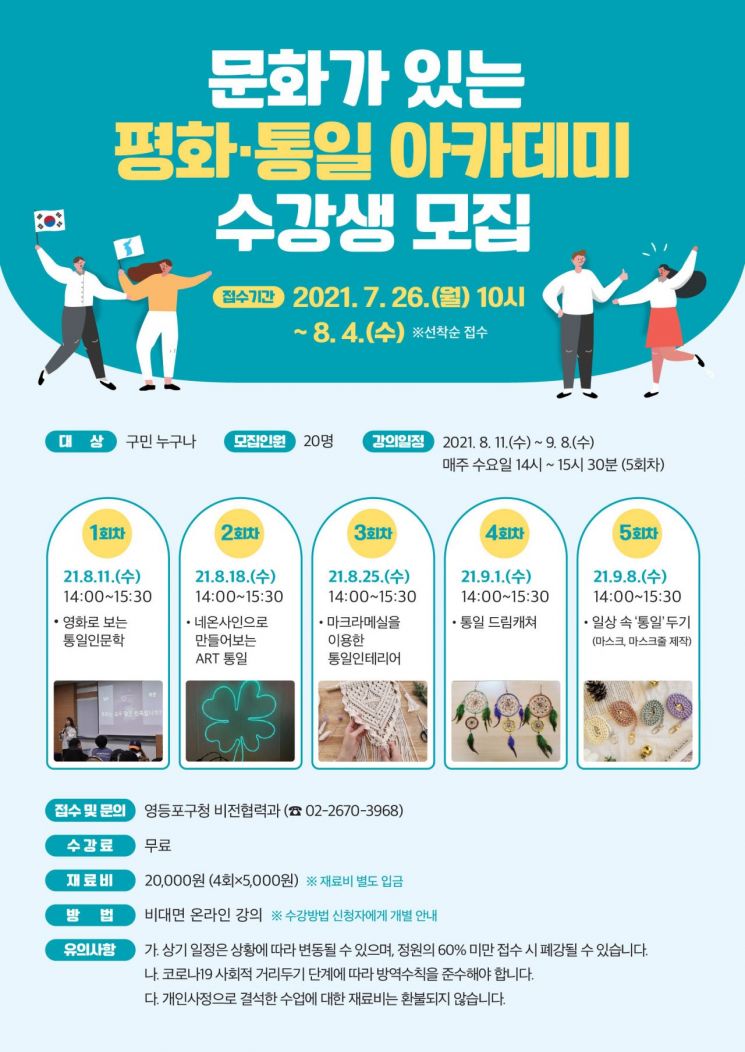
Yeongdeungpo-gu Operates ‘Peace and Unification Resident Academy’ Online... Recruiting 20 Students on a First-Come, First-Served Basis
Yeongdeungpo-gu (Mayor Chae Hyun-il) will operate the ‘Peace and Unification Resident Academy’ online from August 11 to September 8 to spread correct understanding and consensus on peace and unification through cultural experience programs easily and enjoyably accessible to residents.
The academy targets residents of various age groups, operating cultural activity programs to reflect on the meaning of communication and harmony between North and South Korea and to establish correct values by understanding the reality of the Korean Peninsula’s division.
The academy consists of five sessions held every Wednesday from August 11 to September 8.
The first session starts with a lecture titled ‘Unification Humanities through Movies,’ watching films about peace and unification and drawing the reality and aspirations of the Korean Peninsula’s division. The second session features ‘ART Unification Expressed through Neon Signs,’ creating images of unification with neon signs. The third session offers ‘Unification Interior,’ making interior accessories using various macram? knotting techniques to reflect on ethnic harmony and solidarity.
The fourth session involves making a ‘Unification Dreamcatcher’ expressing wishes for peace on the Korean Peninsula. The final fifth session is ‘Unification in Daily Life,’ creating masks and mask straps to pray for a safe and healthy community and peaceful unification.
Any interested resident can apply by phone to the Vision Cooperation Division of Yeongdeungpo-gu Office. Recruitment started on July 26, with 20 students accepted on a first-come, first-served basis. The course is free, but a material fee of 20,000 KRW is required.
Additionally, to ensure safe and familiar learning environments without COVID-19 concerns, all lectures will be conducted online.
Materials for practice will be individually delivered to selected students’ homes, and online lecture attendance methods will be separately guided.
The district plans to collect photos of practice results from students, manage them, and gather feedback to ensure substantial education operation.
Mayor Chae Hyun-il said, “To spread the atmosphere of peace on the Korean Peninsula and establish correct values for peaceful unification, we converted the lectures to an online format. We will actively support various peace and unification-themed programs that residents can participate in and empathize with.”
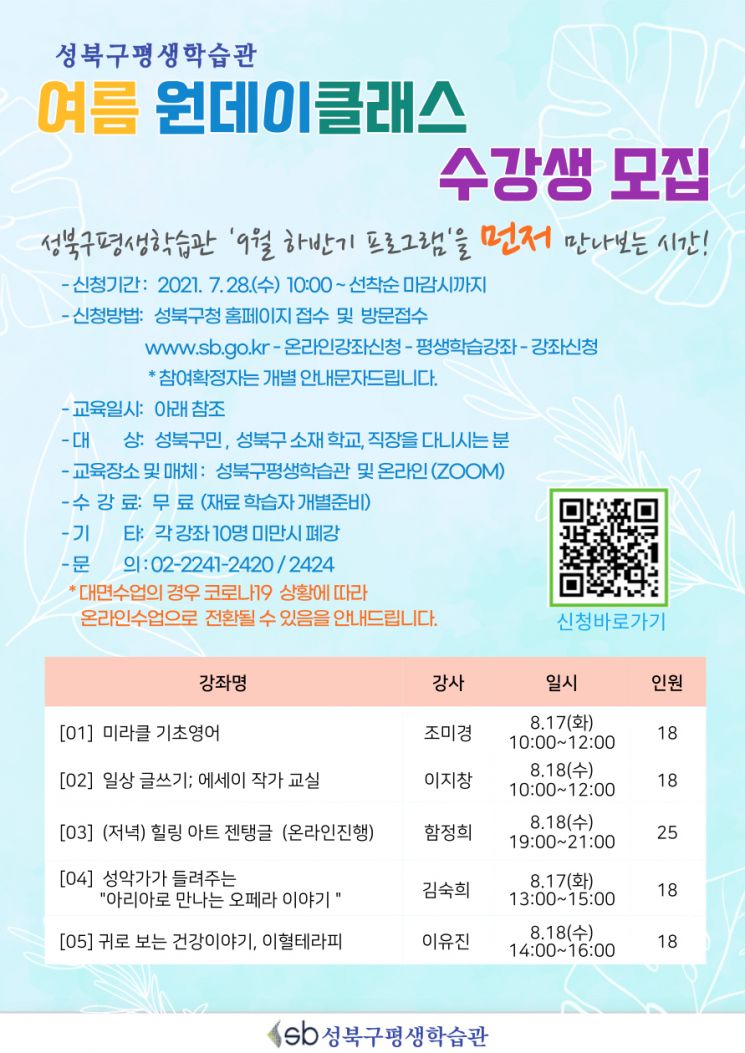
Seongbuk-gu (Mayor Lee Seung-ro) will operate ‘Summer One-Day Classes’ on August 17 and 18 to revitalize lifelong learning for residents.
This one-day class offers a preview of new programs for the second half of September at the Seongbuk-gu Lifelong Learning Center, including five programs: ▲Miracle Basic English ▲Daily Writing: Essay Writer’s Workshop ▲Healing Art Zentangle ▲Opera Stories through Arias by a Vocalist ▲Health Stories through Listening, Acupuncture Therapy. These will be conducted both face-to-face and online.
Enrollment starts at 10 a.m. on the 28th via the Seongbuk-gu Office website (Online Lecture Application - Lifelong Learning Courses), and the classes are free and open to all Seongbuk-gu residents on a first-come, first-served basis.
For details, contact the Seongbuk-gu Office website’s lifelong learning course application or the Seongbuk-gu Lifelong Learning Center.
The Seongbuk-gu Lifelong Learning Center has been operating various face-to-face and online programs to ensure residents can continue learning despite COVID-19. In the first half of this year, it operated 26 programs while complying with COVID-19 prevention guidelines, providing joy of learning to residents exhausted by the pandemic and receiving positive responses.
© The Asia Business Daily(www.asiae.co.kr). All rights reserved.
![Clutching a Stolen Dior Bag, Saying "I Hate Being Poor but Real"... The Grotesque Con of a "Human Knockoff" [Slate]](https://cwcontent.asiae.co.kr/asiaresize/183/2026021902243444107_1771435474.jpg)

















