Continued Middle East Exit Strategy Following Afghan Withdrawal
Some Predict Complete Withdrawal from Iraq Will Be Difficult
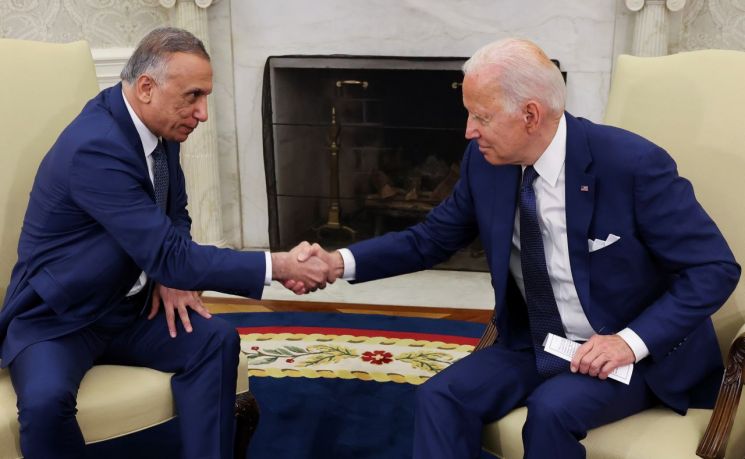
[Asia Economy Reporter Hyunwoo Lee] U.S. President Joe Biden announced during a meeting with Iraqi Prime Minister Mustafa Al-Kadhimi that the U.S. military will end combat missions in Iraq starting at the end of this year. This move is interpreted as part of the Biden administration's Middle East exit strategy following the withdrawal from Afghanistan. However, since extremist terrorist groups such as the Islamic State (IS) and pro-Iranian Shia militias continue to pose threats in Iraq, it is expected that a full troop withdrawal like in Afghanistan will be difficult.
On the 26th (local time), President Biden stated during the meeting with Prime Minister Al-Kadhimi at the White House, "From the end of the year, U.S. troops will no longer carry out combat missions," adding, "Going forward, the role of U.S. forces in Iraq will focus on training and advising Iraqi forces fighting IS." However, he did not specify whether there would be additional troop withdrawals following the end of combat missions.
Currently, the number of U.S. troops stationed in Iraq is estimated to be around 2,500. CNN, citing senior U.S. government officials, reported, "A complete withdrawal of U.S. troops from Iraq, as seen in Afghanistan, is not expected," and "It is still unknown whether the number of stationed troops will be further reduced." Iraq is currently witnessing a resurgence of IS forces, along with ongoing terrorist attacks and assaults on U.S. military bases by pro-Iranian Shia militias, making a full withdrawal like Afghanistan unlikely.
The end of combat missions for U.S. troops stationed in Iraq marks the first time in 18 years since the U.S.-led coalition invaded Iraq in 2003. The U.S. military withdrew from Iraq in 2011 but redeployed in 2014 after IS captured large areas across Iraq and Syria, causing instability. At its peak in 2007, the number of U.S. troops stationed in Iraq reached 170,000.
This decision to end combat missions is seen as part of the Biden administration's ongoing Middle East exit strategy since taking office. President Biden decided to withdraw all U.S. troops from Afghanistan by the end of August this year, marking the 20th anniversary of the 9/11 attacks, and the withdrawal process is nearly complete. The Biden administration is following a policy of reallocating resources concentrated in the Middle East to counter China and balance military and diplomatic power in Northeast Asia.
Going forward, U.S. support for Iraq is expected to focus on the economic sector. The Biden administration plans to send 500,000 doses of Pfizer COVID-19 vaccines to Iraq and provide $5.2 million through the United Nations to support the Iraqi elections scheduled for October. Previously, Iraq also passed a resolution calling for the withdrawal of U.S. troops. Prime Minister Al-Kadhimi stated, "We no longer need U.S. combat troops. We still require intelligence support, training, capacity building, and advisory assistance."
© The Asia Business Daily(www.asiae.co.kr). All rights reserved.
![Clutching a Stolen Dior Bag, Saying "I Hate Being Poor but Real"... The Grotesque Con of a "Human Knockoff" [Slate]](https://cwcontent.asiae.co.kr/asiaresize/183/2026021902243444107_1771435474.jpg)















