Major Chinese Indexes Fall by Over 2%
KOSDAQ, Which Recorded Year-to-Date High, Also Turns Downward
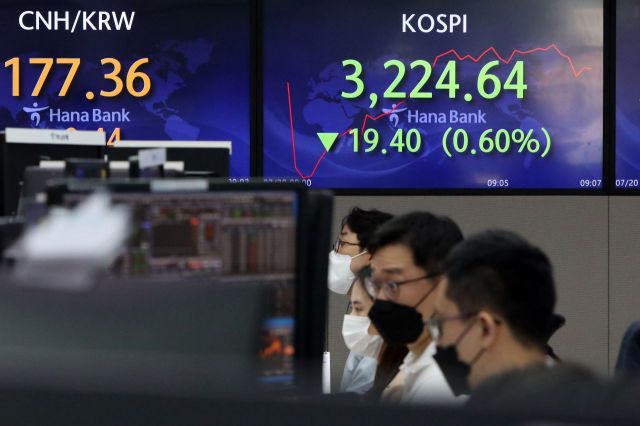
[Asia Economy Reporter Gong Byung-sun] Adverse factors such as the conflict between the United States and China and the Chinese government's regulations on platform companies negatively impacted the domestic stock market. The KOSPI, which started the day higher, turned to a decline and widened its losses to nearly 1%. The KOSDAQ, which had reached a yearly high, also turned downward.
On the 26th, the KOSPI closed at 3,224.95, down 0.91% (29.47 points) from the previous trading day. Although it started higher, it turned to a decline at 9:13 a.m.
The decline in the domestic stock market is interpreted as being caused by adverse factors originating from the Chinese market. The Shanghai Composite Index and the Shenzhen Composite Index fell by over 2%, while the Hong Kong Hang Seng Index dropped by over 3%. Park Gwang-nam, a researcher at Mirae Asset Securities, explained, "The decline widened in the afternoon due to news of clashes during the high-level talks between the U.S. and China," adding, "Overall investment sentiment was dampened by the Chinese authorities' strict regulations on private education and controls over platform companies."
Although the high-level U.S.-China talks were held for the first time in four months, Chinese Vice Foreign Minister Xie Feng sharply criticized U.S. Deputy Secretary of State Wendy Sherman. Vice Minister Xie said, "Some U.S. officials treat China as a virtual enemy," and added, "They seem to believe that if China's development is blocked, problems inside and outside the U.S. will be resolved and the U.S. will regain hegemony." Sherman's response to this statement has not been disclosed.
Sales by foreigners and institutions also influenced the index decline. On that day, foreigners and institutions sold a net 376.6 billion KRW and 336.5 billion KRW, respectively. Individuals bought a net 721.5 billion KRW.
All sectors except medical precision declined. The machinery sector had the largest drop at 2.09%, followed by construction (-1.52%), insurance (-1.39%), securities (-1.35%), and non-metallic minerals (-1.32%). Medical precision rose by 2.52%.
Most of the top 10 market capitalization stocks showed weakness. Samsung SDI had the largest decline at 1.86%, followed by Celltrion (-1.68%), Kakao (-1.34%), LG Chem (-1.33%), SK Hynix (-1.27%), Samsung Electronics (-0.63%), Kia (-0.58%), and Hyundai Motor (-0.44%). Samsung Biologics rose by 0.11%, and NAVER remained flat.
The KOSDAQ closed at 1,047.63, down 0.75% (7.87 points) from the previous trading day. It rose to 1,060.21 in the morning, setting a yearly high, but turned downward at 12:17 p.m.
Foreigners and institutions showed strong selling pressure. Foreigners and institutions sold a net 182 billion KRW and 37.9 billion KRW, respectively. Individuals bought a net 231.5 billion KRW.
Most sectors declined. The computer services sector had the largest drop at 2.68%, followed by construction (-2.52%), information devices (-1.79%), digital content (-1.78%), and other services (-1.63%). Textile and apparel (1.23%), publishing and media reproduction (1.30%), internet (0.94%), general electric and electronics (0.54%), and broadcasting services (0.35%) rose.
Most of the top 10 market capitalization stocks declined. Kakao Games had the largest drop at 5.38%, followed by Alteogen (-3.02%), Seegene (-2.89%), Celltrion Healthcare (-1.64%), Celltrion Pharm (-1.55%), SK Materials (-0.80%), and Pearl Abyss (-0.76%). EcoPro BM (4.63%), CJ ENM (1.50%), and HLB (0.58%) rose.
© The Asia Business Daily(www.asiae.co.kr). All rights reserved.
![Clutching a Stolen Dior Bag, Saying "I Hate Being Poor but Real"... The Grotesque Con of a "Human Knockoff" [Slate]](https://cwcontent.asiae.co.kr/asiaresize/183/2026021902243444107_1771435474.jpg)















