Greeting from the Tax Development Deliberation Committee
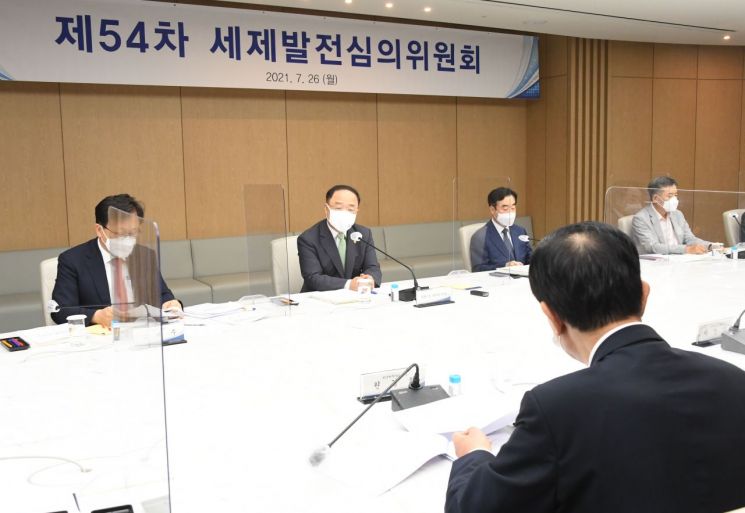 Hong Nam-ki, Deputy Prime Minister and Minister of Economy and Finance, is speaking at the Tax System Development Deliberation Committee held on the 26th at the Korea Chamber of Commerce and Industry conference room in Jung-gu, Seoul. (Photo by Ministry of Economy and Finance)
[Sejong=Asia Economy Reporter Son Sun-hee] Hong Nam-ki, Deputy Prime Minister and Minister of Economy and Finance, said on the 26th, "We will make every effort to collect taxes from the people and spend those taxes on budget projects based on fiscal principles, utilizing them in the most rational and efficient way."
Deputy Prime Minister Hong made these remarks in his opening speech while presiding over the Tax System Development Deliberation Committee (Tax Committee) at the Korea Chamber of Commerce and Industry conference room in Jung-gu, Seoul, in the afternoon. On this day, the Tax Committee finalized and announced the 2021 tax law amendment bill.
Hong Nam-ki explained, "As important as fiscal expenditure as a policy tool is tax support directly related to people's livelihoods, that is, tax reform," adding, "This year's tax reform plan focuses on overcoming the COVID-19 crisis, supporting the transition to a leading economy, and strengthening the inclusiveness of our economic society."
The tax law amendment bill announced by the Ministry of Economy and Finance on this day includes tax support measures for various groups facing difficulties due to the COVID-19 pandemic, such as small and medium-sized enterprises, workers, self-employed individuals, and farmers and fishermen. In addition, it designates three major sectors?'semiconductors, batteries, and vaccines'?as 'national strategic technologies' and includes substantial tax credits for related research and development (R&D) and facility investments. The bill also strengthens the tax infrastructure, including a stable revenue base, prevention of tax avoidance, and the creation of a taxpayer-friendly environment.
Hong emphasized, "The tax support effect of this year's tax reform plan is estimated to be about 1.5 trillion won," adding, "Most of the tax revenue effect comes from support for national strategic technologies such as semiconductors (1.16 trillion won) and the expansion of the Earned Income Tax Credit (EITC) (260 billion won), which are essential areas for enhancing the resilience, growth engine, and inclusiveness of our economic society."
The finalized tax reform plan will soon undergo legislative notice and Cabinet approval and is scheduled to be submitted to the National Assembly along with the next year's government budget proposal on September 3.
Regarding this, Deputy Prime Minister Hong posted on his social media immediately after the Tax Committee meeting, "The tax reform plan was prepared by reflecting the results of discussions, including fierce deliberations and debates, while gathering opinions from various stakeholders across eight subcommittees covering income, corporations, property, customs, and more over several months." He added, "The calm yet somewhat solemn expressions of Chairman Kang Byung-gu and the committee members are likely because the tax reform plan was prepared at a time when the resurgence of COVID-19 and the worsening difficulties of people's livelihoods coincide." He reiterated, "We will make every effort based on fiscal principles."
© The Asia Business Daily(www.asiae.co.kr). All rights reserved.
![Clutching a Stolen Dior Bag, Saying "I Hate Being Poor but Real"... The Grotesque Con of a "Human Knockoff" [Slate]](https://cwcontent.asiae.co.kr/asiaresize/183/2026021902243444107_1771435474.jpg)
















