SH "Customized supply possible throughout Seoul... Will present measures to resolve vacant houses"
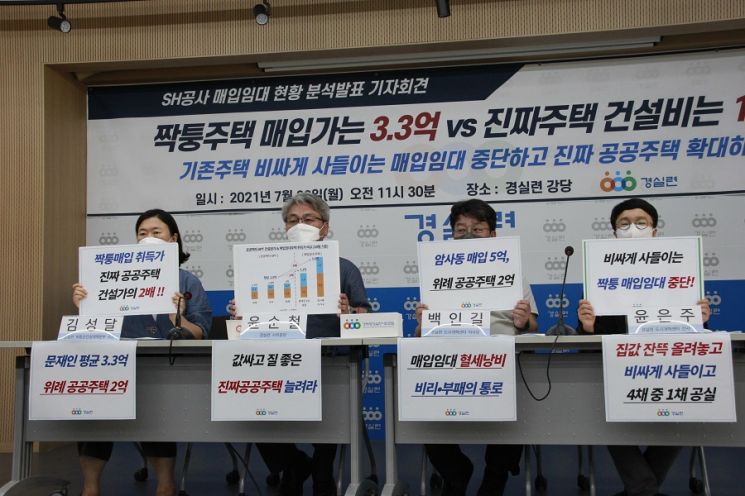
[Asia Economy Reporter Onyu Lim] The Citizens' Coalition for Economic Justice (CCEJ) demanded that the Seoul Housing and Communities Corporation (SH Corporation) stop supplying purchased rental housing.
On the 26th, CCEJ held a press conference at the CCEJ auditorium in Jongno-gu, Seoul, stating, "SH Corporation has purchased 20,000 housing units over the past 19 years for 4 trillion won," and added, "Although tens to hundreds of billions of won have been invested in purchasing housing, the review of appropriateness is lax, turning it into a feast of unearned income for corrupt forces."
Based on the 'SH Purchased Rental Housing Status' data submitted by SH Corporation to Ha Tae-kyung, a member of the People Power Party, CCEJ analyzed the acquisition cost, information subsidies, and book value of the purchased rental housing.
The analysis showed that SH Corporation acquired 20,000 housing units in 1,730 buildings from 2002 to 2020 for 4.08 trillion won. This amounts to 2.3 billion won per building and 190 million won per household. By type, 66% were multi-family houses, 26% urban lifestyle housing, and 1% social housing.
CCEJ pointed out that developing public land could supply twice as many apartments compared to purchasing housing with the same budget.
While the construction cost of public land apartments developed by SH Corporation in Naegok, Suseo, Wirye, and other areas averaged 9.3 million won per pyeong, the acquisition cost of purchased rental housing (based on criteria after the Moon Jae-in administration) was 16.4 million won per pyeong, about 1.8 times more expensive.
The most expensive purchase was a multi-family house in Amsa-dong, Gangdong-gu, with an acquisition cost of 29.6 million won per pyeong. A multi-family house in Siheung-dong, Geumcheon-gu, was purchased for 40 billion won, making it the highest acquisition cost per building.
CCEJ stated, "It is doubtful whether proper reviews were conducted on whether the prices of the purchased houses were appropriate and whether supply and demand were adequate."
CCEJ also analyzed that purchases are concentrated in specific areas, resulting in a high vacancy rate of 24%. By district, Gangdong-gu had the highest supply of purchased rental housing with 2,256 households, accounting for 11% of the total.
In contrast, the total supply of purchased rental housing in the bottom five districts, including Yongsan-gu with 31 households and Jung-gu with 39 households, was only 492 households.
CCEJ stated, "Purchasing existing houses that have surged in price due to skyrocketing housing prices can lead to budget waste and corruption," and urged the suspension of purchased rental housing supply until the housing price bubble subsides.
In response, SH Corporation released rebuttal materials, stating, "Purchased rental housing is a public rental housing project that can maximize efficiency on small land," and added, "With limited supply of permanent rental apartments, the policy focuses on rapid supply within the city for vulnerable housing groups."
SH Corporation added, "(Purchased rental housing) offers the advantage of being demand-customized housing with high proximity to workplaces compared to long-term land development projects, allowing residence throughout Seoul," and said, "We will prepare and implement measures to resolve vacancies."
© The Asia Business Daily(www.asiae.co.kr). All rights reserved.
![Clutching a Stolen Dior Bag, Saying "I Hate Being Poor but Real"... The Grotesque Con of a "Human Knockoff" [Slate]](https://cwcontent.asiae.co.kr/asiaresize/183/2026021902243444107_1771435474.jpg)
















