
[Asia Economy Reporter Ji Yeon-jin] Attention is focused on whether the KOSPI, which has been on an upward trend for the past eight months, can break the longest monthly record in 44 years. Although the spread of the COVID-19 Delta variant is hampering the index, the recent unprecedented liquidity supply by the U.S. Federal Reserve (Fed) is a variable factor.
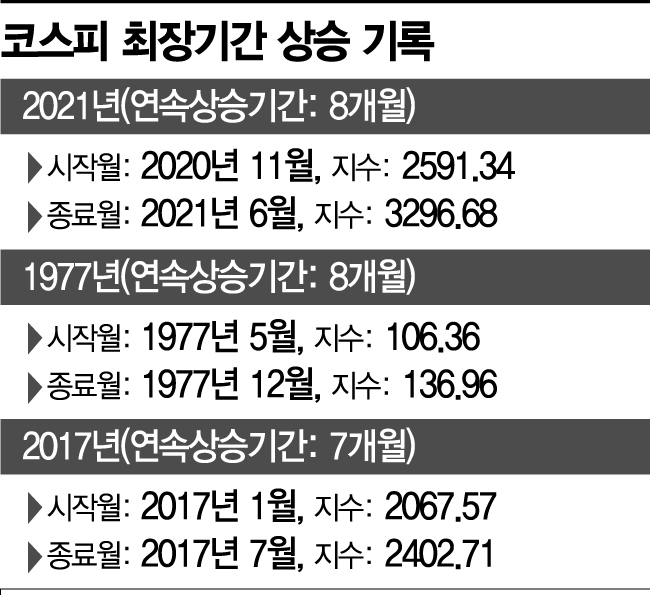
According to the financial investment industry on the 26th, the record of the KOSPI rising for eight consecutive months based on monthly closing prices has only occurred twice: once during the Middle East construction boom in 1997 and the current period starting last year. In 1977, the KOSPI rose consecutively for eight months from May to December. This time, it is in an eight-month rising rally from November last year to June, and if the closing price at the end of this month also rises, it will set a historic record of nine consecutive months of increase. As of the closing price on the 23rd, the KOSPI stood at 3,254.42, which is 38.79 points (1.18%) lower than the previous month's closing price of 3,293.21.
For the KOSPI to rise further, greater momentum is needed, but the domestic and international stock market conditions are not favorable. First, the U.S. stock market has shown a sluggish trend for several months after concerns about a peak emerged, and there are fears of an economic recession due to the global spread of the Delta variant. Kim Byung-yeon, a researcher at NH Investment & Securities, pointed out, "Although the recent economic recession concerns raised in the bond market are considered excessive, from the perspective of risk asset investors, they act as a factor slowing the upward momentum of the stock market." Moreover, with the start of the vacation season, policy momentum such as additional fiscal stimulus measures including the U.S. infrastructure bill is in a dormant state, limiting factors for stock price increases.
On the other hand, the Fed's total assets on a weekly basis have recently been on a sharp upward trend. As the Fed prepares for tapering but has not confirmed a clear recovery in the employment market amid the spread of the Delta variant, it is supplying massive liquidity. This is considered a factor defending against a decline in the stock market. Researcher Kim said, "The Fed and the U.S. government's goal is broad job recovery and maintaining maximum employment levels, so the Fed will maintain a dovish stance until doubts about the employment market are resolved," adding, "The KOSPI index is expected to show a steady and gradual upward trend with a stock market where various issues and themes circulate and spread." However, Seo Sang-young, a researcher at Mirae Asset Securities, predicted, "There is a possibility that the Fed's hawkish tone may be mentioned at the Federal Open Market Committee (FOMC), and since earnings improvements have already been priced in, the upward momentum may not expand but rather lead to a more cautious stance."
In the industry, while achieving the longest KOSPI rising record is uncertain, the possibility of a trend upward is highly anticipated. Lee Jin-woo, a researcher at Meritz Securities, said, "KOSPI companies earned a net profit of 85 trillion won last year, and this year, excluding Naver's one-time profit, net profit is expected to be 145 trillion won," adding, "Since stock prices reflect the future, next year's net profit is 175 trillion won, and as earnings level-up continues, there may be some pauses or corrections in between, but the direction is unlikely to change." Lee Kyung-min, a researcher at Daishin Securities, also said, "The spread of the Delta variant is expected only to stimulate economic anxiety," emphasizing, "The global economic recovery remains solid, and the worsening domestic COVID-19 situation, resulting won liquidity instability, and short-term KOSPI volatility expansion are opportunities to increase weight. Now is the time to prepare for entering the COVID-19 calming phase, stabilizing the won-dollar exchange rate downward, and stabilizing and improving foreign and institutional demand."
© The Asia Business Daily(www.asiae.co.kr). All rights reserved.
![Clutching a Stolen Dior Bag, Saying "I Hate Being Poor but Real"... The Grotesque Con of a "Human Knockoff" [Slate]](https://cwcontent.asiae.co.kr/asiaresize/183/2026021902243444107_1771435474.jpg)
















