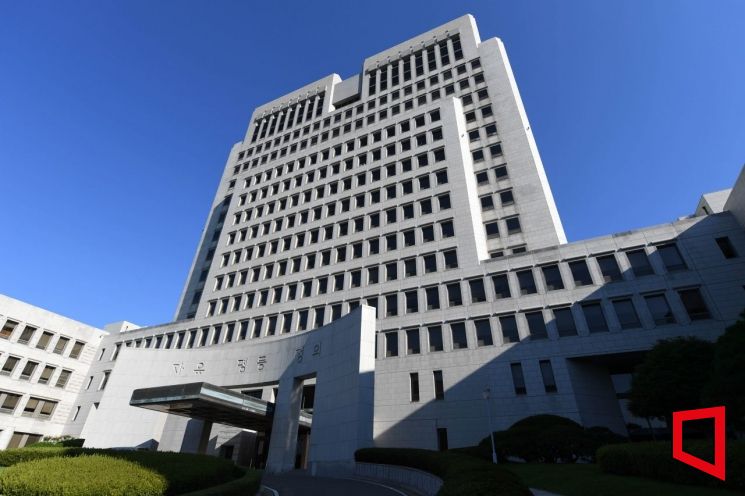
 Supreme Court, Seocho-gu, Seoul. Photo by Honam Moon munonam@
[Asia Economy Reporter Kim Daehyun] The Supreme Court has ruled that if advertisements are installed within 500 meters of a road boundary line in non-urban areas, they should be punished for violating the Outdoor Advertising Act, even if on private property.
On the 24th, the Supreme Court's 3rd Division (Presiding Justice No Jeonghee) announced that it upheld the lower court's ruling that sentenced Mr. A to a fine of 2 million won in his appeal trial for violating the Outdoor Advertising Act.
Earlier, Mr. A was prosecuted for installing a freestanding circular advertisement board with the phrase "Cafe-type Real Estate" on a utility pole by the roadside in front of a B consulting office in Cheonan, Chungnam, in 2019. He was also charged with posting rental and sale apartment price information on the front glass of the office without being a licensed real estate agent.
Article 4, Paragraph 1 of the current Outdoor Advertising Act stipulates that "to preserve beautiful scenery and public morals, prevent harm to the public, and create a healthy and pleasant living environment, advertisements shall not be displayed or installed in areas, places, or on objects designated by Presidential Decree."
In court, Mr. A's side argued, "The advertisement was installed on a telephone cable pole on private property, not on a utility pole managed by Korea Electric Power Corporation where advertisement installation is prohibited, so it does not violate the Outdoor Advertising Act."
They also claimed, "During the preparation to open a real estate brokerage office, we received a response from the local district office that attaching real estate materials to the front glass was allowed, and since no actual brokerage activities were conducted, there was no violation of the Licensed Real Estate Agents Act."
However, both the first and second trials found all charges against Mr. A to be guilty. The second trial court pointed out, "Since the defendant installed advertisements within 500 meters from the road boundary line in an area not designated as an urban area under the National Land Planning Act, it constitutes a violation of the Outdoor Advertising Act." It added, "Displaying information about brokerage objects without registering the real estate office is a violation of the Licensed Real Estate Agents Act. Whether the defendant was preparing to open the office or actually conducted brokerage activities does not affect the establishment of the crime."
Nevertheless, "Based solely on the evidence submitted by the prosecution, it cannot be proven that the advertisement board was installed on a 'utility pole' where advertisement display is prohibited under Article 4, Paragraph 1 of the Outdoor Advertising Act and Article 24, Paragraph 1, Subparagraph 2(b) of the Enforcement Decree of the Outdoor Advertising Act," the court lowered the fine from 3 million won to 2 million won. They also took into account that Mr. A removed the advertisement and ceased office operations once the investigation began.
The Supreme Court agreed with this judgment. The bench stated, "The lower court did not err in its legal interpretation regarding the establishment of violations of the Licensed Real Estate Agents Act and the Outdoor Advertising Act," and dismissed Mr. A's appeal.
© The Asia Business Daily(www.asiae.co.kr). All rights reserved.
![Clutching a Stolen Dior Bag, Saying "I Hate Being Poor but Real"... The Grotesque Con of a "Human Knockoff" [Slate]](https://cwcontent.asiae.co.kr/asiaresize/183/2026021902243444107_1771435474.jpg)














