IMF Projects South Korea's Potential Growth Rate to Fall to 1.7% in the 2040s
Decline in Labor Productivity and Capital Investment Effects
Excessive Regulation Also Hinders Economic Growth
[Asia Economy Reporter Jang Sehee] As the international credit rating agency Fitch downgraded South Korea's potential growth rate, concerns are growing that even with all economic factors mobilized to the fullest, growth will remain in the 1% range. In particular, the vulnerability in the labor sector, one of the three production factors?land, labor, and capital?is emerging as the biggest constraint on growth.
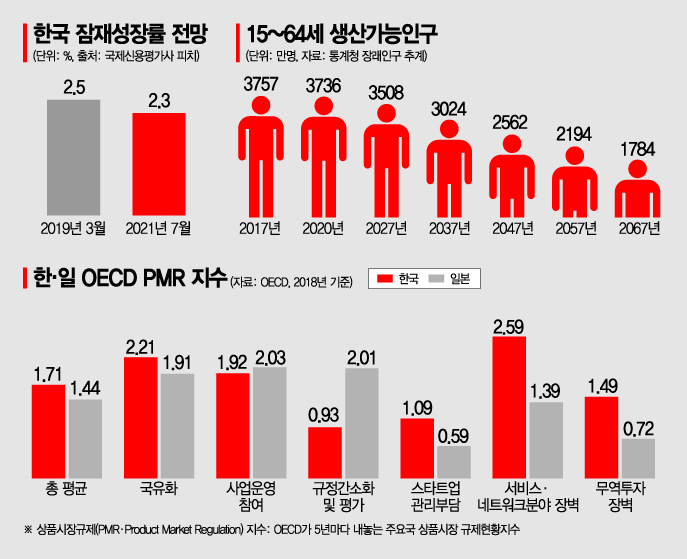
Fitch announced South Korea's sovereign credit rating yesterday and lowered the country's potential growth rate from 2.5% to 2.3%. It had maintained 2.5% until 2018 and 2019, but reflecting aging population and other factors, it was reduced by 0.2 percentage points. The potential growth rate refers to the maximum growth rate an economy can achieve without overheating or slowing down, given economic conditions. This indicates that the fundamental strength of economic growth is gradually weakening.
This view is not unique to Fitch. The International Monetary Fund (IMF) also projected earlier this year that South Korea's potential growth rate will decline to 2.5% during 2021?2030, fall to 2.0% during 2031?2041, and further drop to 1.7% by 2041?2050.
The main reason why international economic organizations have a negative outlook on South Korea's potential growth rate is the decline in the working-age population due to low birth rates and aging. Last year, the annual number of births (272,400) fell below the number of deaths (305,100), marking the first-ever natural population decrease. The proportion of the elderly population aged 65 and over is expected to rise from 15.7% in 2020 to 20.3% in 2025, entering a super-aged society. The working-age population aged 15?64 decreased from 37.57 million in 2017 to 37.36 million last year, a reduction of 210,000 over three years. It is predicted to fall to 17.84 million by 2067, dropping into the 10 million range.
According to the Korea Productivity Center's '2020 Labor Productivity Trends,' the total labor input across all industries fell from 1.2% in 2018 to 0.9% in 2019, and further dropped to -3.2% last year. This decline was due to reductions in working hours and the number of workers. Professor Kim Sangbong of Hansung University’s Department of Economics stated, "Although the current potential growth rate is around 2%, it could fall to the 1% range over the next decade due to the decrease in the labor population."
Regarding the contribution of factors to potential growth, the share of capital income has declined from 2.2% in the early 2000s to 1.4% recently. As reforms across the industrial structure have been delayed, the growth contribution from capital input has also been limited. Professor Kim Soyoung of Seoul National University’s Department of Economics pointed out, "In the 1960s, there were no factories, so simply building factories had a large production effect. However, since factories are now saturated, even if new facilities are built, the additional production capacity compared to the past inevitably decreases."
Excessive market regulation is also cited as a problem. According to the Product Market Regulation (PMR) index released by the OECD in 2018, South Korea scored 1.71. This is higher than the OECD average of 1.41, as well as Germany’s 1.08 and Japan’s 1.44, indicating widespread regulation.
The decline in productivity caused by COVID-19 is also critical for potential growth. Lee Ju-yeol, Governor of the Bank of Korea, remarked, "Considering the deterioration in domestic employment conditions and the decline in service sector production capacity, the potential growth rate is likely much lower than before COVID-19," adding, "When an economic crisis occurs, labor input and capital accumulation shrink significantly, and productivity also declines."
© The Asia Business Daily(www.asiae.co.kr). All rights reserved.
![Clutching a Stolen Dior Bag, Saying "I Hate Being Poor but Real"... The Grotesque Con of a "Human Knockoff" [Slate]](https://cwcontent.asiae.co.kr/asiaresize/183/2026021902243444107_1771435474.jpg)















