[Seoul Metropolitan Council and District Council News] Seoul Councilor Josangho Criticizes "On-site Inspection of Seoul-type Resident Autonomy Association Pilot Project Subsidy Execution Status, Some Inspectors' High-handed Attitude and Reckless Attempt to Remove Documents"... Raises Suspicion of Targeted Audit Based on Confirmation Bias... Gwangjin-gu Council Holds Meeting with Autonomous Crime Prevention Association Union
[Asia Economy Reporter Jong-il Park] The Seoul Metropolitan Government's on-site inspection of the "Seoul-type Resident Autonomy Council Pilot Project Subsidy Execution Status in the First Half of This Year" (hereinafter referred to as the on-site inspection), which was pushed forward to review the field issues of resident autonomy councils and propose effective improvement policies, has sparked controversy over high-handed audits.
According to Seoul City Council member Sang-ho Cho (photo, Seodaemun 4, Democratic Party), during the on-site inspection conducted from July 5 to 9, some inspectors consistently displayed intimidating and rude behavior, and acted recklessly by attempting to copy and remove personal information documents such as personnel records without permission, causing resentment.

Several resident autonomy councils also expressed discomfort and frustration due to the inspectors' lack of understanding of the project, unfamiliarity with budget processing regulations, electronic document systems, and other work procedures, yet the inspections were forcibly carried out.
Seoul City conducted the "Seoul-type Resident Autonomy Pilot Project 2021 First Half Subsidy Execution Status On-site Inspection" over five days from July 5 to July 9, targeting 22 resident autonomy councils (one per district) and 22 district resident autonomy project teams. A total of 15 personnel (five teams of three members each) were deployed, including five officials from the Seoul Metropolitan Government's Autonomous Administration Division and ten members of the Seoul Public Audit Group.
This on-site inspection followed Mayor Oh Se-hoon's statement on June 7 that a comprehensive review of Seoul's resident autonomy councils was necessary. Seoul City announced that it aimed to enhance the project's effectiveness by identifying the subsidy execution status and whether the project was being properly implemented.
However, due to some inspectors' lack of understanding of the project and unfamiliarity with work procedures such as electronic document handling, the on-site inspection was delayed, and cases of unfair and hasty administrative inspections, including unilateral orders and high-handed attitudes, have been increasingly confirmed. In some locations, inspectors attempted to copy and arbitrarily remove personnel documents such as employee resumes without formal official document requests but were stopped.
The excessive exercise of authority by the Seoul Public Audit Group, which accompanied the Autonomous Administration Division during the on-site inspection, also became an issue. The Seoul Public Audit Group, composed of external (private) experts, is granted authority during field audits conducted according to the basic audit plan, but their duties are limited to advisory, monitoring, and education during subsidy-supported projects and administrative inspections by the responsible department.
Council member Sang-ho Cho strongly criticized the inspectors' high-handed administrative attitude. He diagnosed that Seoul City's true colors were fully revealed by perceiving "residents" not as the subjects of autonomy and partners in cooperation but as objects of unilateral scolding, orders, and control, still trying to dominate residents.
The standards for audits by central administrative agencies and local governments specify in Article 8 (Audit Attitude) that "auditors must not engage in language or behavior that causes intimidation or discomfort to those being audited," and that "auditors must not conduct audits with prejudice or arbitrary judgment but must listen sufficiently to opinions from related organizations and derive audit results based on fair procedures and objective evidence," thereby establishing mutual respect and rational audits as principles.
There are also suspicions that this on-site inspection is no different from a targeted audit driven by political intentions and confirmation bias. On-site, complaints have emerged that the resident autonomy councils are regarded as organizations of a particular political camp, and the inspection is conducted with a predetermined conclusion to reduce or abolish related projects and organizations.
In fact, Seoul City cites "negative media evaluations regarding effectiveness compared to the budget" as the background for inspecting the resident autonomy council pilot project and village community projects. However, by excluding positive articles and selectively presenting only negative reports as grounds for project re-examination and inspection, it appears difficult to avoid criticism of a targeted audit.
Moreover, contrary to the original intent to check subsidy execution status and proper project implementation, the actual inspection mainly involved requests and verification of personnel and recruitment-related materials rather than checking the purpose and execution methods of subsidy items. Also, the "Seoul-type Resident Autonomy Council Pilot Project 2021 First Half Subsidy Execution Status On-site Inspection Plan" obtained by Council member Cho lacks typical administrative inspection plan items such as "key inspection points" and "checklists," which reasonably raises suspicion of a hasty and targeted audit driven by political motives.
Council member Cho stated, "In-depth review and seeking improvement measures are essential for mature resident autonomy," but expressed strong concern about recent Seoul City actions, saying, "However, the achievements of resident autonomy should not be reduced or distorted, nor should the status of resident autonomy be disparaged due to political beliefs and interests."
To verify the appropriateness and fairness of this on-site inspection, Council member Cho plans to request related materials from the Autonomous Administration Division and urge correction of the intimidating and rude attitudes of some auditors and inspectors and prevention of recurrence. He also announced that, with the advent of a new era of local autonomy, he will seek ways to develop resident autonomy through neutral and fair evaluations of resident autonomy council operations and related projects.
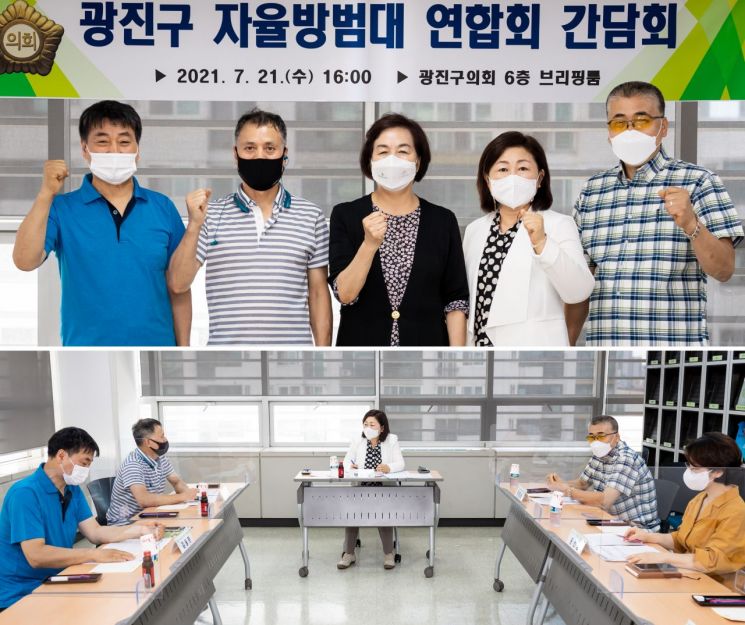
Gwangjin District Council Holds Meeting with Autonomous Crime Prevention Corps Federation
Park Soon-bok, a member of the Gwangjin District Council (Chairperson Park Sam-rye), held a meeting with the "Autonomous Crime Prevention Corps Federation" on the 21st at the Gwangjin District Council briefing room.
This meeting was held to listen to and share opinions from stakeholders ahead of the proposal of a partial amendment to the ordinance concerning the establishment and support of the Autonomous Crime Prevention Corps in Gwangjin District.
Attendees included Park Soon-bok, the host and council member of Gwangjin District Council, Wang Gyu-seong, president of the Autonomous Crime Prevention Corps Federation, Jeong Myeong-sun, secretary-general, and Kim Dong-hwan, operations committee chairman.
At the start of the meeting, Council member Park Soon-bok said, "In an era where the value of sacrifice is becoming rare, I deeply thank all members of the Autonomous Crime Prevention Corps Federation, including its executives, for their efforts to maintain security and safety for Gwangjin District residents despite COVID-19." She added, "Since this meeting was organized to seek improvements and development directions for the operation of the Autonomous Crime Prevention Corps, I ask everyone to share diverse opinions."
The main agenda of the meeting was the "Change of the authority responsible for establishment and registration acceptance (from Gwangjin Police Chief to Gwangjin District Mayor)." Council member Park explained that this proposal was reviewed to improve difficulties caused by the dualization of the acceptance authority and support and supervision institutions and to enable systematic operation and support of the Autonomous Crime Prevention Corps.
Additionally, she proposed joining functional organizations to foster close relationships between groups and participation in district and neighborhood events. The Autonomous Crime Prevention Corps Federation agreed with the opinions presented and suggested various measures for a more advanced Autonomous Crime Prevention Corps, including support policies for smooth operation and insertion of a "Autonomous Crime Prevention Corps Federation" clause in the ordinance.
At the conclusion of the meeting, Council member Park Soon-bok expressed, "I once again deeply thank the Autonomous Crime Prevention Corps for their efforts to ensure community safety despite the spread of COVID-19 and the scorching heat." She concluded by saying, "Based on the valuable opinions shared today, I will enact a substantial ordinance and hope to continue ongoing communication and dialogue for the development of Gwangjin District."
© The Asia Business Daily(www.asiae.co.kr). All rights reserved.

















