"4th Wave" but Office Workers Can't Work from Home
Seoul Workplace Infections Continue, Causing 'Anxiety'
Experts "Must Quickly Decide to Implement Remote Work"
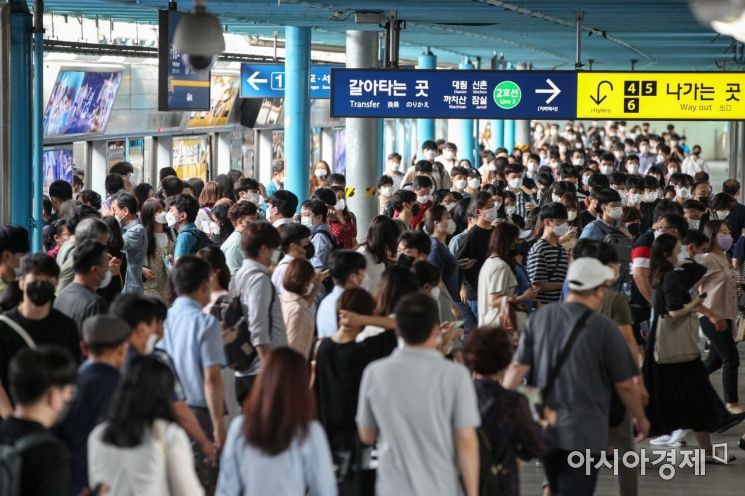 On the 9th, when the number of COVID-19 confirmed cases exceeded 1,000, citizens wearing masks were heading to work at Sindorim Station in Guro-gu, Seoul. Photo by Jinhyung Kang aymsdream@
[Asia Economy Reporter Kang Joo-hee] "There’s no word about working from home," "The crowded public transportation is making me anxious."
As the fourth wave of COVID-19 hits with the highest daily number of confirmed cases ever recorded, many office workers commuting to and from work are expressing concerns. They have to use crowded public transportation daily during rush hours and often have to eat lunch outside, raising fears of infection.
Experts suggest that, given the prolonged spread of COVID-19, a swift decision to implement work-from-home policies is necessary.
Mr. Park, in his 30s and working in Seoul, said, "Last year, when there were fewer confirmed cases than now, we worked from home. But now, even with the highest number of cases, there’s no talk of working remotely." He added, "It’s true that I worry about the packed subways and elevators during commute times, especially when going out for lunch."
Park continued, "Even recently, when an employee at our company tested positive, the atmosphere wasn’t very concerned," and "Compared to before, everyone seems to have become more lax about quarantine measures." On social media platforms, many netizens share similar concerns about commuting.
According to the Central Disease Control Headquarters (CDCH) on the 22nd, as of midnight, there were 1,533 new domestic COVID-19 cases and 309 imported cases, totaling 1,842. The previous day (21st) recorded 1,784 cases, the highest so far, but this record was broken again within a day.
The government currently recommends that workplaces have 30% of their workforce work from home. The revised social distancing guidelines effective from the 1st specify that at Level 2, 10% of employees should work remotely; at Level 3, 20%; and at Level 4, 30%. However, these are recommendations and not mandatory.
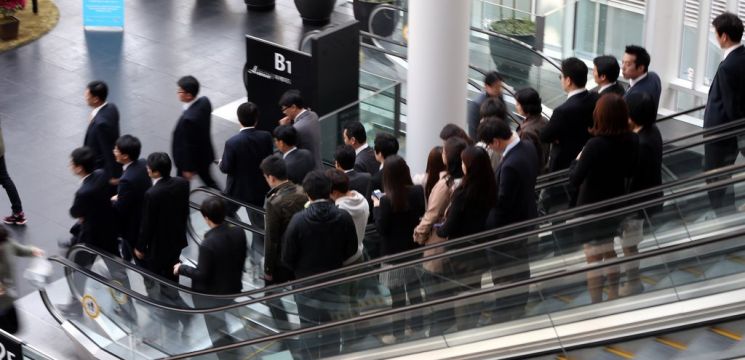
In response to the worsening spread, major domestic companies have recently expanded and strengthened work-from-home measures. According to media reports, SK Group decided to implement work-from-home for all employees except essential personnel. LG Group made it mandatory for over 50% of employees to work remotely, up from the previous 40%. Other companies like Coupang’s office staff and Hyundai Motor Group have also expanded remote work.
However, citizens complain that while some companies have expanded work-from-home, many have not. Mr. Kim (29), working in Incheon, said, "Our company has never allowed working from home." He added, "Working remotely might be inconvenient, but it doesn’t seem impossible, yet the company doesn’t seem very interested."
He continued, "I hear other companies are doing work-from-home, but it feels like a story from another world," and "If coming to work is absolutely necessary, it can’t be helped, but at least I wish they would provide alternatives for high-risk situations like lunchtime."
Meanwhile, multiple cluster infections at workplaces have been reported in Seoul. According to the city, recently, 16 people were infected in a cluster at a workplace in Yongsan-gu. In Jongno-gu, after the first confirmed case on the 13th, 11 more cases were confirmed, and in a workplace in Gwanak-gu, after the first case on the 15th, a total of 10 additional infections occurred.
Experts recommend that, given the prolonged spread of COVID-19, a prompt decision on implementing work-from-home policies is necessary, and companies should create environments conducive to remote work.
Professor Eom Jung-sik of the Department of Infectious Diseases at Gachon University Gil Medical Center said, "When an outbreak grows as large as it has in the metropolitan area, quick decisions regarding work-from-home implementation are essential." He pointed out, "Some multinational and foreign companies in Korea have quickly transitioned, and even when lifting work-from-home policies, they decide cautiously. However, most companies tend to avoid remote work as much as possible."
He added, "COVID-19 does not seem to be ending soon, and the spread is expected to continue for some time. The mindset of treating work-from-home as a temporary measure must be discarded. We need to prepare environments and infrastructure that enable long-term remote work."
© The Asia Business Daily(www.asiae.co.kr). All rights reserved.
![Clutching a Stolen Dior Bag, Saying "I Hate Being Poor but Real"... The Grotesque Con of a "Human Knockoff" [Slate]](https://cwcontent.asiae.co.kr/asiaresize/183/2026021902243444107_1771435474.jpg)
















