Pregnant Male Emoji Sparks Debate...Netizens "Confused" vs "Respect Diversity"
83% of Global Users Say "More Diverse Emojis Needed"
Experts "Diverse Identities Should Be Visible Across Society"
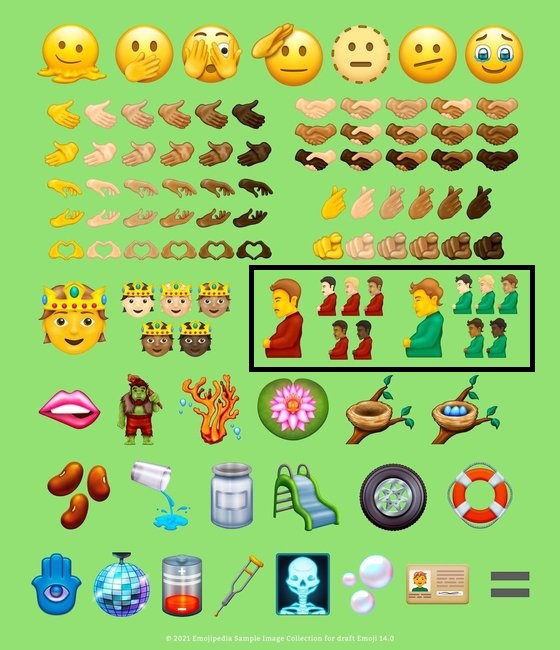 Final candidates for Unicode Consortium's 'Emoji 14.0' version released on the 17th. Includes the 'Pregnant Man' emoji. / Photo by Emojipedia
[Asia Economy Reporter Kang Juhee] The final candidates for new emojis to be included in smartphone chat windows next year have sparked controversy, with options such as 'Pregnant Man' and 'Pregnant Person' added. While some reacted with comments like "How can a man be pregnant?" and "It doesn't make sense," others gave positive evaluations, calling it "a new attempt to respect diversity." These emojis were created to represent the diversity of sexual minorities.
Experts emphasized that to improve misunderstandings and negative perceptions of minorities, diverse identities must be visible across various sectors of society.
On the 17th, the emoji creation site 'Emojipedia' revealed the final candidates for the new emoji update. These emojis will be included in 'Unicode 14.0,' which the 'Unicode Consortium' will release next year. The Unicode Consortium is a non-profit organization that develops and manages unified character codes for computers and is responsible for emoji standardization and release.
Among the emoji candidates released that day, the depiction of a pregnant man attracted particular attention. The emoji named 'Pregnant Man' shows a man with a beard wearing a red top, placing his hand on a protruding belly, and comes in six different skin tones.
Emojipedia explained, "It was created to inform that transgender men can also become pregnant," adding that it aims to show gender diversity and neutrality.
Similarly, an emoji called 'Pregnant Person,' featuring a different hairstyle and wearing a green top, was created to raise awareness of the possibility of pregnancy among non-binary individuals (those who do not identify strictly as male or female).
Additionally, 15 emojis depicting handshakes between different skin tones and gender-neutral designs replacing the traditional gender-specific images of 'princess' and 'prince' were included.
The Unicode Consortium has previously added designs representing various people and identities, such as individuals in wheelchairs, same-sex couples, women with beards, and flags symbolizing transgender people. The intention is for emojis to go beyond simple communication and allow users to express their identities.
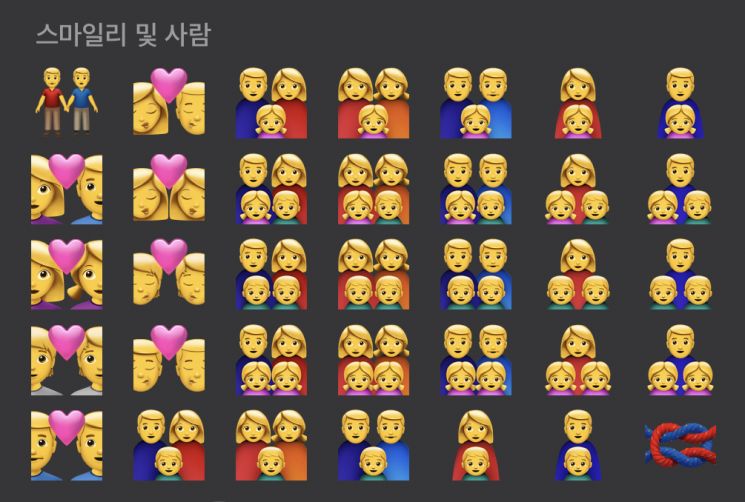 Emojis representing various family forms, including male-female couples, same-sex couples, and diverse family types. Photo by Emojipedia
This sparked heated debates online. Netizens who saw the pregnant man and person emojis reacted with disbelief, saying things like "How can a man be pregnant?", "I couldn't believe my eyes," and "Pregnancy is only for women," expressing their astonishment.
On the other hand, some expressed support, saying, "If there are men who can actually become pregnant, having such emojis doesn't really matter," and "It's good to respect diversity."
There have been several reported cases of transgender men giving birth through biological pregnancy. In 2008 in the United States, Thomas Beatie, a transgender man, became the first transgender individual to successfully conceive and give birth through artificial insemination. Beatie was born female but underwent gender reassignment surgery in 2002, retaining his female reproductive organs, which enabled him to become pregnant.
Beatie reportedly decided to give birth himself after his wife Nancy underwent a hysterectomy, making pregnancy impossible for her. He gave birth to his first daughter in 2008, a second son in 2009, and a youngest son in 2010, attracting significant attention.
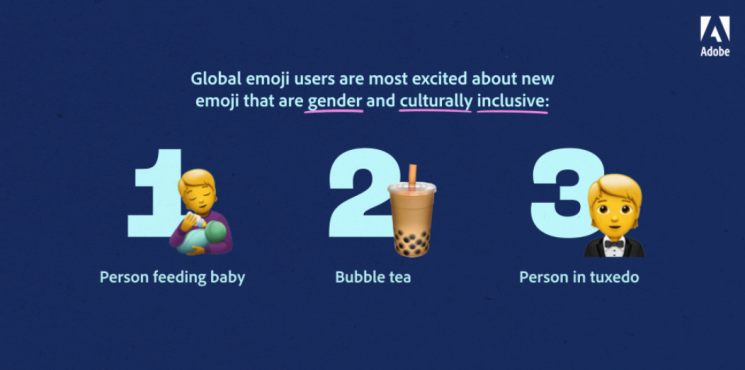 According to a survey announced by Adobe last April, among the 'newly added emojis in 2020,' the diversity emojis that users were most enthusiastic about were 'person feeding a baby,' 'bubble tea,' and 'person wearing a tuxedo,' in that order. Users responded that they look forward to the emergence of new emojis that broadly embrace gender and cultural identities. Photo by Adobe
According to a survey, there is a high demand for emojis that represent diversity and inclusion. Adobe conducted a survey of 7,000 emoji users across seven countries, including South Korea, the United States, the United Kingdom, and Germany. The results showed that 83% of users felt the need for more diverse emojis to facilitate faster communication and better express their individuality and emotions.
This demand was especially strong among Korean users (90%). However, only 47% of Korean users responded that the currently available emojis adequately reflect their identities.
Among the 'newly added emojis in 2020,' the diversity emojis that users were most enthusiastic about included 'person feeding a baby,' 'bubble tea,' and 'person wearing a tuxedo.' In some countries, there was also a strong reaction to 'gender-neutral Santa' and 'person wearing a wedding dress.' Adobe analyzed this as indicating a growing awareness that breaks away from traditional gender roles and respects cultural diversity.
Experts emphasized the importance of making diverse identities visible in various parts of society.
Kim Jihak, director of the Korea Diversity Research Institute, said, "There are many people in the world who identify not just as female or male but as transgender or other genders beyond assigned ones, yet they are often treated as if they do not exist around us. Therefore, it is important for diverse identities to be visible in many areas of society, including emojis."
He added, "There are also emojis representing different skin tones, people in wheelchairs, same-sex couples with children, and the pregnant man emoji is not something that appeared out of nowhere but is an extension of the idea that many real people around us should be included. This visibility is an effort to include diverse people as members of society and is an essential part of our society."
© The Asia Business Daily(www.asiae.co.kr). All rights reserved.
![Clutching a Stolen Dior Bag, Saying "I Hate Being Poor but Real"... The Grotesque Con of a "Human Knockoff" [Slate]](https://cwcontent.asiae.co.kr/asiaresize/183/2026021902243444107_1771435474.jpg)


















