Apartment Construction Cost for 30-Pyeong Units Rose from 60 Million to 610 Million Won Over 22 Years
Calls to Abolish the Standard Construction Cost System Introduced During Roh Moo-hyun Administration
"Construction Companies Inflate Costs by Charging Additional Fees Regardless of Actual Work"
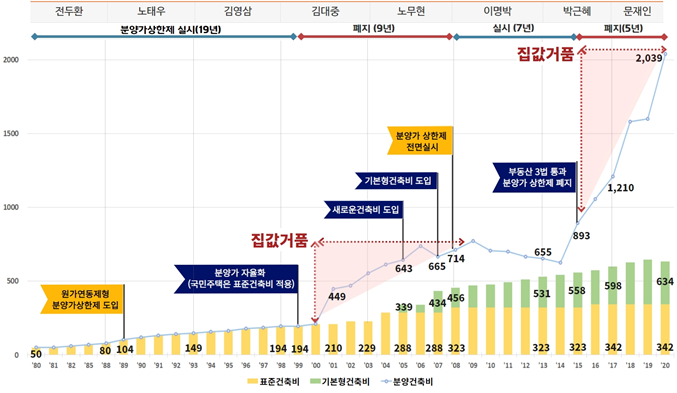
[Asia Economy Reporter Onyu Lim] The Economic Justice Practice Citizens' Coalition has claimed that the construction cost of major apartment sales increased by 250 million KRW for a 30-pyeong unit during the four years of the Moon Jae-in administration. It pointed out that the basic construction cost system introduced during the Roh Moo-hyun administration is being exploited by construction companies to inflate prices, encouraging overpriced sales.
On the 20th, the Citizens' Coalition for Economic Justice (CCEJ) announced the results of an analysis of apartment construction cost changes over the past 22 years at the CCEJ auditorium in Jongno-gu, Seoul. Construction costs, along with land costs, are major components of apartment sale prices.
According to CCEJ, the construction cost for a 30-pyeong apartment rose from 60 million KRW in 1998 to 610 million KRW last year, an increase of about 10.5 times. Breaking it down by administration, the increase during the Moon Jae-in government was the highest at 250 million KRW, followed by ▲Park Geun-hye government 170 million KRW ▲Kim Dae-jung government 110 million KRW ▲Roh Moo-hyun government 40 million KRW ▲Lee Myung-bak government -20 million KRW. A CCEJ official explained, "Since the abolition of the price ceiling system in December 2014, construction costs have risen by 420 million KRW, of which 250 million KRW increased during the Moon Jae-in administration."
CCEJ identified the basic construction cost system introduced during the Roh Moo-hyun administration as the main cause of the sharp rise in construction costs. Under this system, additional costs can be separately calculated and added on top of the basic construction cost. These additional costs vary depending on factors such as rock foundation work, structure, intelligent facilities, apartment performance grades, and eco-friendly housing construction. Construction companies are allegedly exploiting this to arbitrarily set high sale prices. A CCEJ official pointed out, "Regardless of the actual construction input costs, construction companies inflate construction costs by adding additional costs to the basic construction cost, leading to overpriced sales."
For example, in January, the construction cost for Raemian One Bailey approved by Seocho-gu, Seoul, was 14.68 million KRW, of which additional costs were 8.34 million KRW, 2 million KRW higher than the basic construction cost of 6.34 million KRW. In contrast, the construction cost for Uijeongbu Gosan Sujain, sold in January, was 8 million KRW, with additional costs of only 1.24 million KRW. A CCEJ official emphasized, "While land prices vary depending on location conditions, construction costs consist of labor and material costs, which do not differ by region. Therefore, construction cost differences for apartments built at the same time should not be significant." He added, "Nevertheless, due to the flexible additional costs, construction costs between apartments vary greatly."
CCEJ criticized that as construction costs are arbitrarily set, the gap between construction costs and workers' wages has widened from 4.1 times in 1998 to 18 times last year. This means that one would have to save wages without spending a single penny for 18 years to cover the construction cost of a 30-pyeong apartment. A CCEJ official stated, "The government claimed that the 3rd new town prices are at 60-80% of market prices, but they presented sales prices inflated far beyond costs," and urged, "The basic construction cost system should be abolished and a single, clear construction cost should be established."
© The Asia Business Daily(www.asiae.co.kr). All rights reserved.

















