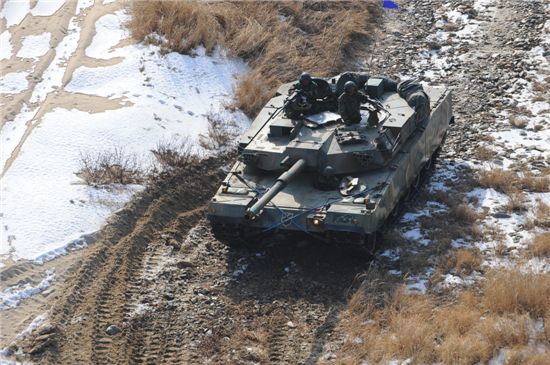
 The K1 tank underwent simplification of the turret structure, including changes to the gunner's aiming device according to the mass production stage.
[Asia Economy Yang Nak-gyu, Military Specialist Reporter] Our military is facing a dilemma over whether to produce additional K2 'Black Panther' tanks or upgrade the performance of the existing K1A2 tanks. The Army has been pushing for the first batch production of 100 K2 tanks, the second batch of 106 tanks, and the third batch of 54 tanks. The Army advocates for additional procurement of the K2 tank because it is a world-class tank developed with domestic independent technology. It possesses performance equal to or exceeding that of advanced countries' main battle tanks such as the U.S. M1A2 SEP, France's Leclerc, and Germany's Leopard A6EX.
Some argue that upgrading the performance of the K1 and K1A2 tanks is urgent to counter North Korea's anti-tank rockets. North Korea is accelerating the development of projectiles capable of penetrating our tanks. The kinetic and chemical energy rounds used by North Korea's T-54 tanks, Seongunho, and Cheonmaho can penetrate our K1 and K1A1 tanks. North Korea uses chemical energy rounds that can penetrate armor thicknesses of 550mm and new chemical energy rounds capable of penetrating 900mm. Considering that the armor thickness of the K1 tank is 350mm, it is said that our tanks are defenseless against these threats.
The Army requested a review from the Joint Chiefs of Staff after the first performance upgrade project excluded protection against North Korea's anti-tank missiles. The Army claims that to enhance the tank's ballistic protection, the tank's armor thickness must be increased, which would increase the tank's weight from 51 tons to 57 tons, resulting in slower speed. Therefore, upgrading the 1,200-horsepower engine and transmission (powerpack) is inevitable.
Reproduction of the K1A1 tank is practically impossible. If a production line is established to reproduce the K1A1 tank, the production cost per tank is expected to rise from the initial launch price of 4.7 billion won to 7 billion won. Even producing engines in small quantities is expected to require significant investment. The engines currently installed in the K1 series are products of German MTU, which were localized through a technology partnership with a domestic company. When introduced in 1988, the price per unit was 280 million won, but it has now risen to 650 million won. The German side states that price increases are inevitable due to small-scale production. If the K1 series tanks are completely phased out and replaced entirely with K2 tanks, the cost will increase further. Replacing about 1,000 K1 tanks and 480 K1A1 tanks with K2 tanks is estimated to cost over 14 trillion won.
Overseas, there is also a trend to upgrade engine performance to enhance tank protection, considering economic factors. Russia increased the weight of the T-72 tank introduced in 1973 (41 tons, 780-horsepower diesel engine) to 46 tons and installed a 1,130-horsepower diesel engine. The T-90 tank introduced in 1993 (46 tons, 840 horsepower) was also increased to 48 tons in 2014 and replaced with a 1,130-horsepower diesel engine. Israel's situation is similar. The Merkava tank introduced in 1983 (63 tons, 908 horsepower) was increased to 65 tons and upgraded with a 1,500-horsepower diesel engine.
© The Asia Business Daily(www.asiae.co.kr). All rights reserved.
![Clutching a Stolen Dior Bag, Saying "I Hate Being Poor but Real"... The Grotesque Con of a "Human Knockoff" [Slate]](https://cwcontent.asiae.co.kr/asiaresize/183/2026021902243444107_1771435474.jpg)














