Fourfold Increase in Lithium-Ion Exports to the US
Increased Imports from Major Producers China and Japan
Rising Demand from Electric Vehicle Expansion and ESS
US Domestic Supply Seems Tight
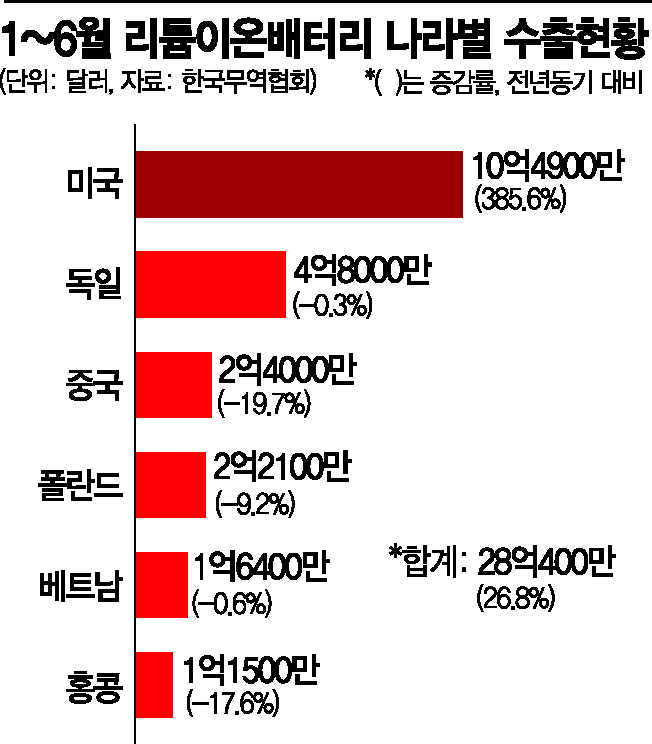
[Asia Economy Reporter Choi Dae-yeol] It has been revealed that South Korea's exports of lithium-ion batteries to the United States increased more than fourfold compared to last year. This is attributed to the expansion of electric vehicle adoption and the growing demand for energy storage systems (ESS) in the U.S. The volume imported by the U.S. from major battery-producing countries including South Korea, China, and Japan has all increased simultaneously. Although battery demand within the U.S. is rising, it is expected to take more time before domestic factories can operate to meet supply, so battery imports are likely to continue steadily increasing for the time being.
According to statistics from the Korea International Trade Association on the 19th, South Korea's lithium-ion battery exports to the U.S. in the first half of this year amounted to $1.049 billion, a 386% increase compared to the same period last year. As a result, the U.S., which was ranked 4th among South Korea's battery export countries until the first half of last year, rose to the top position as of the first half of this year. Notably, more than one-third of the total battery export volume ($2.804 billion) in the first half of this year was concentrated in the U.S. Meanwhile, most of South Korea's major battery export countries such as Germany, China, Poland, and Vietnam saw a decrease in export volume compared to the same period last year.
Lithium-ion batteries are rechargeable secondary batteries that are lightweight and have high density, mainly used in small electronics, power tools, electric vehicles, and ESS. The automotive sector is the largest and fastest-growing market. Especially after U.S. President Joe Biden took office and made expanding electric vehicle adoption a key pledge, major automakers have also established electric vehicle production plants in the U.S., rapidly increasing demand.
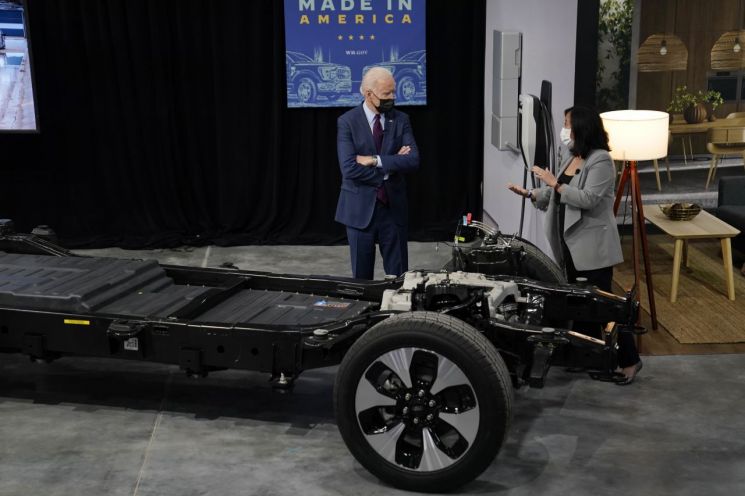 In May, U.S. President Joe Biden is receiving an explanation during his visit to the Ford Rouge EV Center in Dearborn, Michigan.
 Although battery demand is surging, domestic supply is lagging behind. In the U.S., lithium-ion battery manufacturing is dominated about two-thirds by Panasonic, which established large-scale local factories through a joint venture with Tesla, and LG Energy Solution, which supplies a significant volume to General Motors (GM). The remaining companies hold less than 5% market share each.
Until last year, the U.S. steadily increased battery exports to neighboring countries such as Mexico and Canada, but this year, export volumes have decreased. This is the first time the U.S. has reduced battery exports, indicating tight domestic supply. The U.S. battery import volume from January to May this year was $2.949 billion, about a 75% increase compared to the same period last year.
President Biden's immediate directive after taking office to review the domestic battery supply chain was due to concerns that the high dependence on imports could pose issues from a trade security perspective. However, it is expected to take more time before production and supply systems are fully established domestically. LG Energy Solution, which has emerged as the world's largest battery company, is building a joint factory with GM in the U.S., and SK Innovation is also developing large-scale production facilities in Georgia, but normal operations are expected to begin no earlier than the end of this year or next year. Major Chinese battery companies, which have grown based on domestic demand, have yet to successfully enter the U.S. market, and Japanese companies' responses are also slow.
© The Asia Business Daily(www.asiae.co.kr). All rights reserved.
![Clutching a Stolen Dior Bag, Saying "I Hate Being Poor but Real"... The Grotesque Con of a "Human Knockoff" [Slate]](https://cwcontent.asiae.co.kr/asiaresize/183/2026021902243444107_1771435474.jpg)
















