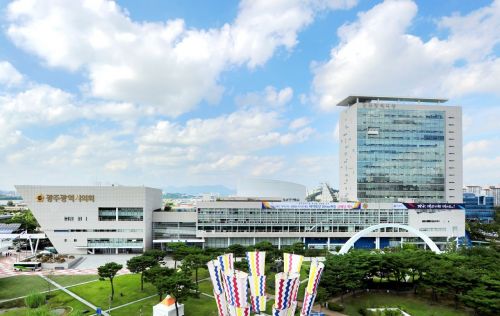
[Asia Economy Honam Reporting Headquarters Reporter Yoon Jamin] Gwangju Metropolitan City is accelerating its energy transition together with citizens, businesses, and various institutions.
Since Gwangju's bold declaration in July last year of becoming a ‘2045 Carbon Neutral Energy Self-Reliant City’ five years ahead of the government’s plan, the Gwangju community has been engaging in comprehensive implementation efforts, including establishing detailed promotion systems, encouraging citizen participation in energy transition, village-level practice movements, and active involvement of businesses and administration, the city announced on the 18th.
In February, the city launched the ‘Carbon Neutral Promotion Committee,’ a public-private cooperative governance body involving the city, city council, city education office, chamber of commerce, civic groups, and businesses, to begin full-scale citizen-led execution of the ‘2045 Carbon Neutral Energy Self-Reliant City’ initiative.
Based on this, citizens are carrying out energy transition practice movements, companies are fostering new energy industries through 100% renewable energy (RE100), and the administration is creating energy infrastructure linked with artificial intelligence, thereby developing an energy transition model.
Citizens are voluntarily and proactively participating by installing solar panels in their homes and establishing citizen solar power plants through cooperatives under the slogan, ‘The electricity I use is the electricity I produce.’
The first citizen solar power plant, created through collaboration between citizens and public institutions, began operation in April. This solar power plant was built by citizens forming an energy cooperative and raising funds voluntarily, with a goal to install a total of 145 such plants by 2045.
The profits from power generation are shared among citizens and reinvested in energy welfare or the construction of new solar power plants.
To expand citizen solar power plants, Gwangju has been promoting a public contest project worth 800 million KRW since May, and it is expected that solar power plants with a capacity of over 1200 kW will be established this year.
The ‘Energy Transition Village’ initiative is also notable. Each autonomous district is establishing an ‘Energy Transition Village Hub Center’ to lead grassroots, village-level energy transition practice movements aimed at addressing climate crisis and energy issues.
Following the opening of the Cheomdan Transition Village Network in Gwangsan-gu on the 2nd, the ‘Jiwon Village Energy Transition Solidarity’ was inaugurated and began activities on the 13th in Jiwon 1-dong, Dong-gu.
By the end of next month, the ‘Ilgok Transition Village Network’ in Buk-gu’s Ilgok Village, ‘Transition Village Pungam’ in Seo-gu, and ‘Yangrim Transition Village Network’ in Nam-gu will open consecutively.
The ‘Energy Transition Villages’ conduct various education and promotional activities, local resource surveys and research, and build citizen solar power plants tailored to each village’s characteristics. They develop a ‘Gwangju-style energy transition’ model and spread the outcomes to other villages through a results presentation meeting in December when the project concludes.
Businesses are also joining forces to use renewable energy.
On January 13th, 13 institutions and energy-intensive companies formed the ‘2030 Corporate RE100 Promotion Council’ to participate in 100% renewable energy (RE100).
These institutions and companies are practicing greenhouse gas reduction by directly installing renewable energy in factories or buildings or voluntarily purchasing renewable energy certificates (REC) to improve energy efficiency.
Gwangju is also planning a model to support RE100 achievement for companies located in industrial complexes by utilizing abundant renewable energy such as solar and wind power in the southwestern coastal area.
The administration is focusing on creating an energy self-reliant environment centered on Gwangju’s strength in artificial intelligence.
As energy transition activates, various types of electricity will be produced at solar power plants, and irregular renewable energy demand will occur in industrial complexes and companies.
To manage this complex power supply and demand in real time, the city plans to create new future growth engines and quality jobs by integrating energy transition with artificial intelligence based on the AI industrial infrastructure it established ahead of other cities and provinces.
In particular, through the ‘Green Energy ESS (Energy Storage System) Power Generation Regulatory Free Zone,’ the city is experimenting with a new private-sector-led power trading model.
The regulatory free zone project involves directly selling electricity generated from solar power facilities within a 2.5 km² area of the Advanced Science Industrial Complex to cars or buildings via energy storage systems. Infrastructure construction and system design are currently underway.
Additionally, a ‘Future Smart Grid’ demonstration project targeting 7 apartment complexes with 6,240 households and a ‘Blockchain-based Electric Vehicle-Renewable Energy Linked DC Power Trading’ project at Chosun University are being promoted to develop power trading and efficient energy use models using artificial intelligence and big data.
Notably, Gwangju was selected in May for the government’s ‘Noise Barrier Tunnel Solar Power Technology Development’ project, securing 9 billion KRW in national funding. Over three years, it plans to invest 16.4 billion KRW to develop integrated power generation technology for noise barriers and noise tunnels, contributing to the Green New Deal.
Mayor Lee Yong-seop of Gwangju said, “In a situation where countries around the world are rushing to pursue carbon neutrality, nations, cities, and individuals lagging in energy transition will lose competitiveness. Gwangju will proactively switch to renewable energy to achieve carbon neutrality and energy self-reliance by 2045 and become a leading city driving Korea’s Green New Deal.”
© The Asia Business Daily(www.asiae.co.kr). All rights reserved.