Special Exception for Rent from Sep Last Year to Mar This Year Not Considered Late
Rent Paid After Exception Period Counts as Arrears
Termination Rights Arise for Unpaid Rent Even if Paid Apr-Jun This Year
Landlord "Get Out" vs Tenant "I Paid, What Are You Saying?" Lawsuit
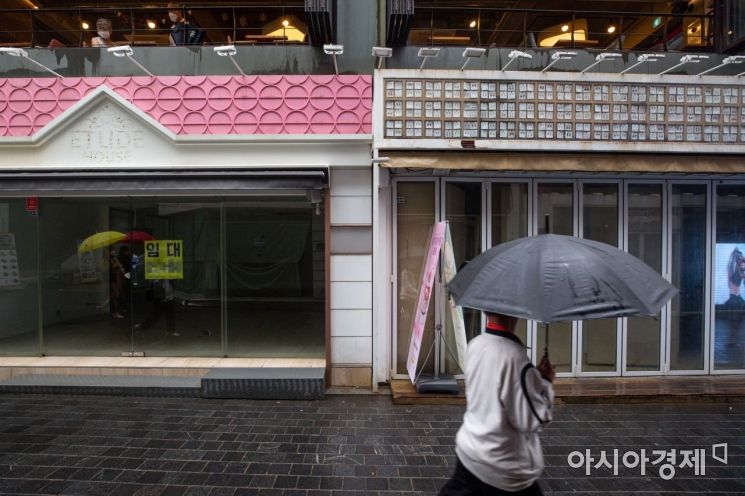 Due to the rapid increase in COVID-19 confirmed cases, social distancing measures in the metropolitan area have been extended. On the 4th, the Myeongdong area in Jung-gu, Seoul, remained quiet even on a holiday. Photo by Jinhyung Kang aymsdream@
#Mr. A, a tenant operating near Sinchon Station in Mapo-gu, Seoul, recently received a request from the store owner to vacate the premises. The reason given was that "the rent has been overdue for more than three months, which constitutes grounds for contract termination." Mr. A, who had consistently paid rent for the past three months, protested by showing a copy of his bankbook with deposit records, but the landlord continued to demand eviction. Mr. A even consulted a lawyer but was told that contract termination could indeed apply.
Although special provisions were established to protect commercial tenants struggling due to COVID-19, conflicts between commercial tenants and landlords are deepening due to vague legal regulations.
According to real estate specialized law firms on the 15th, consultations related to commercial lease disputes have sharply increased recently. Most of these consultations concern disputes arising from the temporary special provisions related to COVID-19.
The amended "Commercial Building Lease Protection Act," revised last September, introduced temporary special provisions stating that "for a period of six months from the date of enforcement of the amended law, overdue rent during this period shall not be considered as overdue rent that constitutes grounds for contract termination, refusal to renew the contract, or exclusion from the right to collect key money."
Rent arrears occurring until March of this year, after the amended law took effect, are not considered overdue. Tenant Mr. A, whose sales dropped by nearly half due to COVID-19, did not pay rent during this period but managed to pay starting in April. The problem is that the rent paid in April is applied, under the legal principle of statutory repayment allocation, not to the rent for that month but to the unpaid rent from September of the previous year. In other words, even if rent for April to June is paid after the special period ends, it is considered repayment of rent unpaid from September to November of the previous year.
Therefore, landlords can claim contract termination due to non-payment of rent for the three months after the temporary special period (April to June) and can also issue eviction orders. Landlords argue for eviction due to rent arrears, while tenants counter that they have already paid rent, leading to disputes in many places.
Experts point out that this problem arose because the system does not fully understand the realities on the ground. Kim Garam, lead attorney at Good Plan Law Firm, said, "The COVID-19 special provisions were hastily enacted, causing much confusion in the field," adding, "Especially, it seems they did not anticipate cases involving repayment allocation." It is expected that related lawsuits will surge until legal adjustments are made.
To prevent such conflicts in advance, experts advise tenants to utilize 'designated repayment allocation.' Most tenants in commercial settings transfer rent amounts to landlords without specific remarks or supporting documents. For example, when transferring rent, they might only note 'monthly rent' or 'rent' in the bankbook.
In contrast, designated repayment allocation means specifying the exact purpose during the transfer, such as 'April 2021 rent.' This prevents the payment from being applied to previously overdue amounts, thus avoiding grounds for arrears. Attorney Kim advised, "Entering specific dates and purposes in the bankbook during the transfer, as well as verbally communicating the intent, is sufficient to establish effectiveness."
© The Asia Business Daily(www.asiae.co.kr). All rights reserved.
![Clutching a Stolen Dior Bag, Saying "I Hate Being Poor but Real"... The Grotesque Con of a "Human Knockoff" [Slate]](https://cwcontent.asiae.co.kr/asiaresize/183/2026021902243444107_1771435474.jpg)















