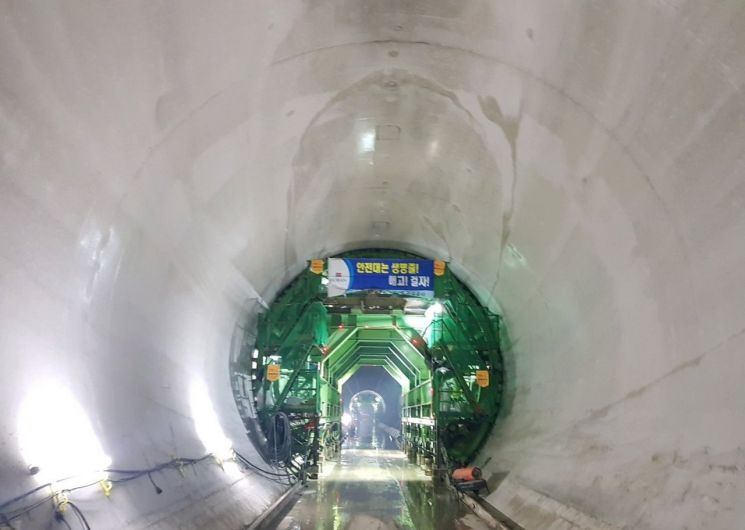
The Banpo Stream watershed separation tunnel, a large-scale underground drainage facility, is expected to serve as a ‘guardian’ preventing flood damage around Gangnam Station in Seoul. Currently showing over 80% progress, the Banpo Stream watershed separation tunnel is temporarily halted by the Seoul Metropolitan Government to prepare for the monsoon and typhoons, and is being used as a temporary water passage facility to prevent flood damage.
Until now, the area around Gangnam Station has been one of Seoul’s representative habitual flood zones. Because the terrain is lower than the surrounding areas, during summer heavy rains, water from Gangnam and Seocho districts would often concentrate all at once, causing sewage backflow and earning the infamous nickname ‘Gangnam Water Park.’
Flood damage was especially severe in 2010 and 2011. In September 2010, when a heavy rainstorm with hourly rainfall of 100mm and a daily maximum of 200mm hit the central and southern parts of Seoul, the Gangnam Station subway was flooded, causing the subway to pass through without stopping, resulting in great confusion. The following summer, another flood occurred due to a squall with hourly rainfall reaching 113mm, delaying the opening of the nearly completed Shinbundang Line by one month.
According to statistics from the Seoul Metropolitan Government’s natural disaster occurrence status, in 2010 and 2011, there were 2,000 households flooded and 4,076 disaster victims in Gangnam-gu.
In response, Seoul established the ‘Drainage Improvement Measures around Gangnam Station’ in 2015, focusing on the construction of the Banpo Stream watershed separation tunnel, watershed boundary adjustments, and improvement of reverse slope sewage pipelines. Among these, the Banpo Stream watershed separation tunnel is considered the core facility for flood prevention measures. Constructed by Hoban Industry and Seowoo Construction, the tunnel is designed to drain rainwater from the higher elevation area around Seoul Nambu Terminal directly to the midstream of Banpo Stream without passing through the low-lying sewage pipelines around Gangnam Station.
Visiting the Banpo Stream watershed separation tunnel construction site last May, the Mayor of Seoul said, “The Gangnam Station intersection often experienced flood damage during sudden heavy rains, so I am very pleased that we can prepare for heavy rains this summer. Even if a heavy rain that occurs once every 30 years falls, the Gangnam and Seocho areas will be able to handle it, allowing those who have suffered flood damage to live with peace of mind.”
The Banpo Stream watershed separation tunnel construction also applied Hoban Construction Group’s latest excavation method, the Gripper TBM (Gripper Tunnel Boring Machine) from HobanTBM. TBM is an advanced tunnel boring machine that breaks rock by rotating a cutter head attached to the front, effectively excavating underground spaces with automation. It is an eco-friendly tunnel excavation method without blasting or vibration, minimizing environmental damage such as noise, dust, and vibration, making it suitable for construction zones in urban areas densely populated with apartments and public facilities. In Korea, HobanTBM of Hoban Construction Group holds the largest number of TBM construction records and protects various equipment.
The Banpo Stream watershed separation tunnel is scheduled to resume finishing work around October, after the summer rainy season ends. Once the Seoun-ro pipeline expansion work is completed by the end of 2022, it is expected to have disaster prevention performance capable of handling up to 95mm per hour rainfall.
© The Asia Business Daily(www.asiae.co.kr). All rights reserved.
![Clutching a Stolen Dior Bag, Saying "I Hate Being Poor but Real"... The Grotesque Con of a "Human Knockoff" [Slate]](https://cwcontent.asiae.co.kr/asiaresize/183/2026021902243444107_1771435474.jpg)















