Recent Incidents of Public Officials' Misconduct Including Sexual Crimes and Drunk Driving
Criticism That Intensive Inspections Have Achieved Little Effect
Experts Say "Some Have a Wrong Sense of Privilege"
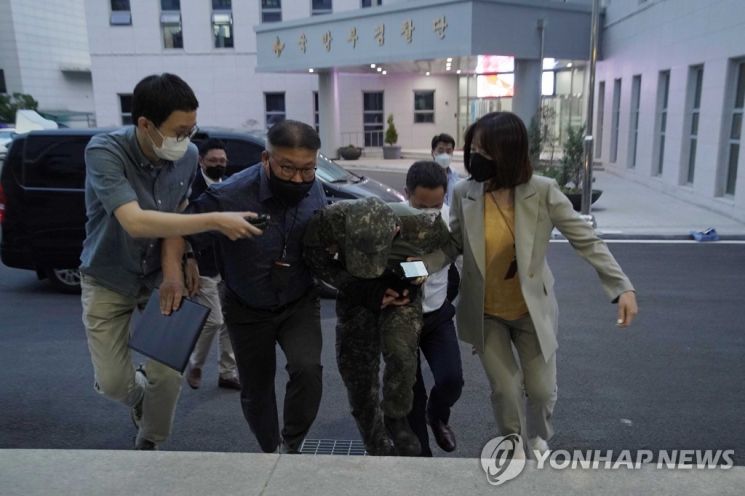 Master Sergeant Jang, accused of sexually harassing a female Air Force non-commissioned officer who died by suicide, was escorted to the Ministry of National Defense Military Court on the 2nd for a detention warrant hearing.
 [Image source=Yonhap News]
[Asia Economy Reporter Kim Choyoung] There have been consecutive cases of public officials engaging in misconduct, including being caught illegally filming parts of women's bodies and receiving the highest fines after being caught for drunk driving three times. Along with criticisms that focused inspections have not yielded significant results, voices are calling for harsher punishments to raise awareness. Experts believe that the misconduct of public officials stems from a misguided sense of privilege.
According to the legal community on the 9th, public official A (43) approached a woman wearing a dress near a bus stop in Gangnam-gu, Seoul, last May and secretly filmed under her skirt. It was revealed that A had a smartphone in a bag with a slightly open zipper and secretly filmed women's bodies 104 times in the Gangnam area, including the Express Bus Terminal, within a single day.
The court stated, "Given the prior convictions of the same kind and the fact that the crime was committed systematically against an unspecified number of victims, the nature of the crime is very serious," and sentenced A, who was charged with violating the Special Act on the Punishment of Sexual Crimes (filming using a camera, etc.), to one year in prison and ordered immediate detention.
Last month, public official B (58) from Cheongju City Hall caused controversy after being caught for drunk driving three times, dismissed from public service, and receiving the highest fine for drunk driving from the court. B was caught driving about 40 meters in a state of 0.097% blood alcohol concentration at a shopping area in an apartment complex in Seowon-gu, Cheongju, last October.
B was found to have been fined twice before for driving under the influence in 2017 and 2019. Accordingly, Cheongju City held a disciplinary committee meeting in February and decided to dismiss B under the "three strikes out" policy for public officials caught drunk driving three or more times.
Recently, as misconduct such as sexual crimes and drunk driving by public officials has occurred repeatedly, voices are saying that the discipline within the public service has gone too far. It is pointed out that public officials, who should have a strong sense of law-abiding spirit and strict ethics to enhance public value, are leading various misconducts.
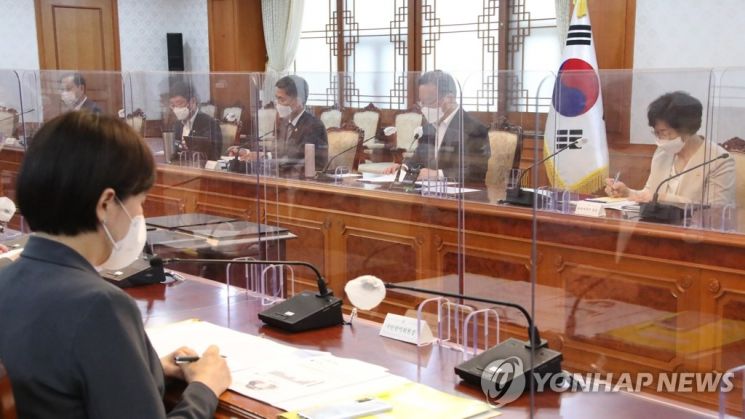 Prime Minister Kim Boo-kyum (second from the right) is presiding over the Ministerial Meeting on Public Service Discipline and Corruption Prevention held at the Government Seoul Office Building on the 7th.
 [Image source=Yonhap News]
According to the Ministry of Personnel Management, the number of national public officials disciplined for misconduct last year was 2,032, an increase of 4.1% (80 people) compared to the previous year, marking a reversal to an increase after five years since 2016. The number of disciplined officials had increased by 19.7% (497 people) to 3,015 in 2016 compared to the previous year, then decreased in 2017 (2,344), 2018 (2,057), and 2019 (1,952).
The most common misconduct leading to discipline was violation of the duty to maintain dignity, with 1,308 cases, followed by violation of the duty of sincerity (514), violation of the duty of integrity (67), violation of prohibition of leaving the workplace (36), violation of confidentiality (29), and violation of service duties (22).
Given this situation, criticism has arisen that special inspections conducted by the government to establish discipline in the public service are ineffective. In April, when allegations of real estate speculation by some employees of the Korea Land and Housing Corporation (LH) surfaced, the Blue House held a public service discipline council meeting to investigate misconduct by central government and local government officials, as well as employees of public institutions.
At that time, the Blue House stated, "We will strictly hold those responsible accountable under the principle of zero tolerance to establish public service discipline," but recent incidents such as high-ranking officials drinking during work hours and the death of an Air Force non-commissioned officer who was a victim of sexual harassment have led to evaluations that focused inspections have failed to prevent misconduct.
Some argue that repeated misconduct by public officials with prior convictions is due to the low level of punishment.
According to the Ministry of Personnel Management, 904 people (44.4%) received "severe disciplinary actions" last year, which is less than half of all disciplined personnel. Among them, the lowest level of suspension accounted for the majority with 590 people. Fifty-six were dismissed, 163 were discharged, and 95 were demoted.
The remaining 1,128 people (55.5%) received "light disciplinary actions." Among them, 688 received warnings, and 440 received salary reductions.
The government plans to conduct a "special inspection to establish public service discipline" for two weeks starting from the 19th, covering not only headquarters but also affiliated public institutions, to check basic service conditions, compliance with COVID-19 quarantine rules, and various misconducts. After the special inspection, monthly service management checks will be conducted under the responsibility of the heads of institutions.
The Fair Trade Commission, which faced issues last month when it was revealed that a director-level executive drank excessively during work hours, will conduct a high-intensity inspection of service conditions and power abuse for two months starting this month. For high-ranking officials, a "one-strike-out" policy will be introduced, where even a single service violation will result in immediate sanctions.
Experts believe that misconduct by public officials stems from a misguided sense of privilege. Professor Seol Donghoon of the Department of Sociology at Jeonbuk National University said, "There are cases where public officials approach their work with a sense of privilege rather than pride as public servants. It is highly likely that the recent series of revealed misconducts continued without a strong sense of problem until they were caught."
© The Asia Business Daily(www.asiae.co.kr). All rights reserved.


















