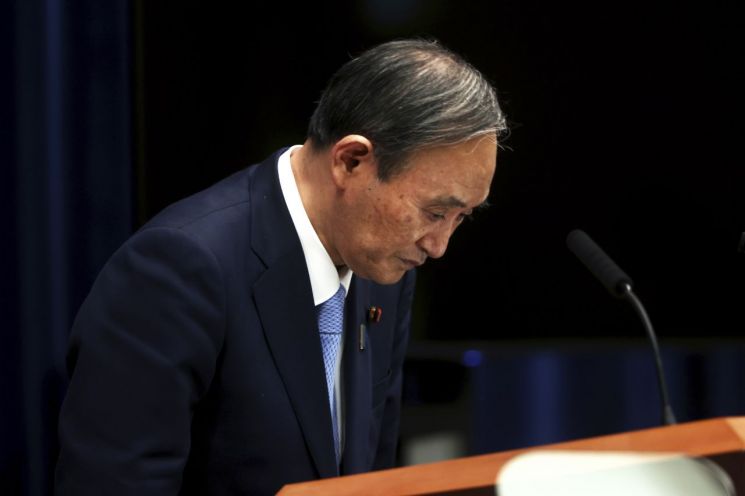
[Asia Economy Reporter Kwon Jae-hee] The Japanese government's inconsistent COVID-19 measures are expected to become a liability for the Suga Yoshihide administration ahead of the general election.
According to the Asahi Shimbun on the 14th, the Japanese government withdrew its plan the previous day to request liquor wholesalers and others to stop transactions with restaurants that do not comply with authorities' requests to close in order to prevent the spread of COVID-19.
Earlier, the National Tax Agency of Japan had sent an official letter to related organizations urging them to halt transactions, but this was reversed within a few days.
The series of measures drew criticism for the government overstepping its legal authority and forcibly intervening in private transactions.
Prime Minister Suga said at a press conference held at the Prime Minister's Office on the 14th, "We have caused great inconvenience to everyone," and "I apologize."
Nishimura Yasutoshi, Minister in charge of Economic Revitalization, who led the plan to 'lock down' alcohol consumption in restaurants, also apologized, saying, "I sincerely apologize for causing anxiety to business operators."
Until now, the government had induced restaurants to close or stop selling alcohol through cooperation money and fines, but as the emergency declarations were repeated and the food service industry reached its limits, cases of not following government requests or orders emerged, prompting a strong response that backfired.
According to Kyodo News, Sakurada Kengo, Secretary General of the Keizai Doyukai, one of Japan's three major economic organizations, criticized the idea of using financial institutions to request restraint on alcohol sales, saying, "If there is no legal basis, it reminds me of discretionary administration in the past," and "I cannot help but question the emergence of such an idea."
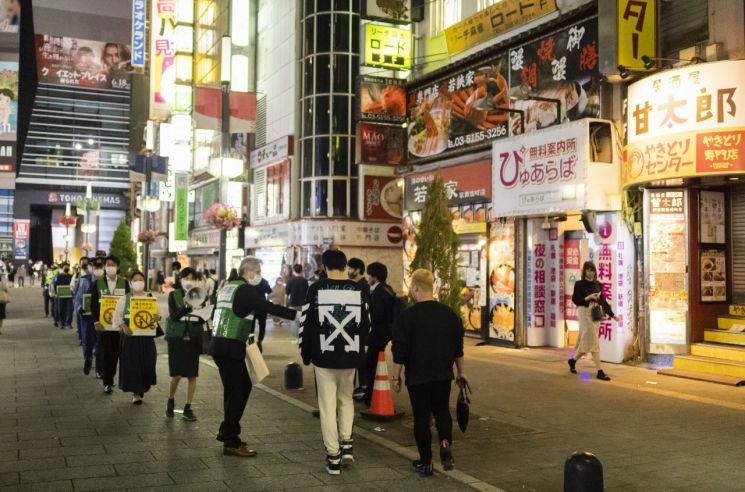
Critics also say the premature measures reveal confusion within the administration.
Regarding Minister Nishimura's remark that banks would persuade restaurants not to sell alcohol, Prime Minister Suga said at a press conference on the 9th, "I did not know."
However, Nishimura claimed on the 13th that he had reported this plan to Prime Minister Suga in advance, raising suspicions that communication about current issues is not properly conducted even within the core of the administration.
This incident is expected to be a negative factor for the ruling party ahead of the general election.
A mid-level member of the Liberal Democratic Party evaluated, "It revealed arrogance and sensory paralysis that the public would follow whatever is said."
Since the term of the House of Representatives expires on October 21 this year, a general election is expected to be held within three months regardless of whether the Diet is dissolved.
Ko Ga-go, a senior editorial board member of the Mainichi Shimbun, pointed out in a signed column published on the 14th, "Probably there will be no riots in Japan," but "distrust of the administration continues to grow, and a general election will be held within three months."
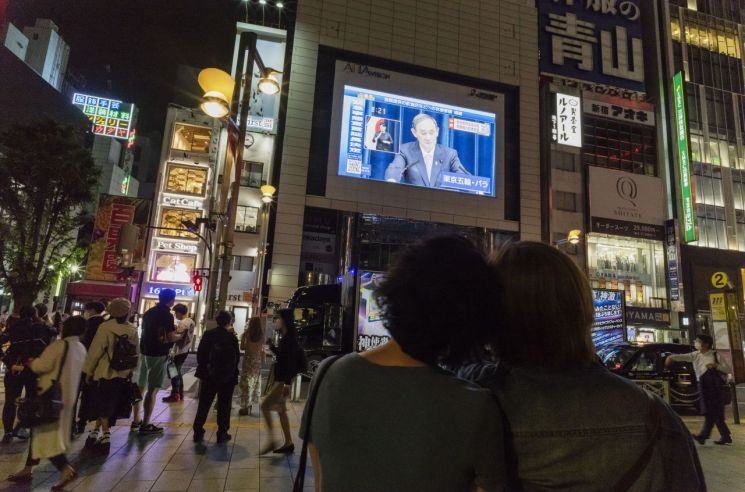
Discontent with vaccines is also rising.
After Prime Minister Suga set a goal of vaccinating one million people per day, large-scale and workplace vaccinations expanded, and vaccinations proceeded very rapidly for a while, but recently, a decrease in vaccine supply was expected, leading to a suspension of new workplace vaccination registrations.
The Japanese government judged that some unused vaccines were being stockpiled and announced a measure to reduce vaccine supply to some local governments after August and redistribute the surplus to areas lacking vaccines.
However, local governments complain that the vaccine record system does not accurately reflect the situation on the ground and that the government is engaging in desk-based administration by looking only at numbers.
In Kobe City, Hyogo Prefecture, as of the 11th of this month, 1 million doses of the Pfizer vaccine were supplied, and the vaccine record system shows that 730,000 doses have been administered, making it appear as if there is a stock of 270,000 doses.
However, a Hyogo City official told the Yomiuri Shimbun that those vaccines are allocated to medical institutions for second doses and that there is actually no surplus.
Taro Kono, Minister in charge of Administrative Reform who oversees the vaccine program, apologized regarding supply disruptions, saying, "Vaccinations proceeded at a speed beyond expectations," and "The reality is that supply cannot keep up," according to the Tokyo Shimbun.
© The Asia Business Daily(www.asiae.co.kr). All rights reserved.
![Clutching a Stolen Dior Bag, Saying "I Hate Being Poor but Real"... The Grotesque Con of a "Human Knockoff" [Slate]](https://cwcontent.asiae.co.kr/asiaresize/183/2026021902243444107_1771435474.jpg)


















