Number of Certification Holders Exceeds Teaching Recruitment Quota
Teaching Recruitment Stands at 20% of Certification Holders
Pre-Service Teachers' 'Practical Semester System' to Pilot from Second Half of Next Year
Teachers' Colleges Focus on 'Common Curriculum' for Teacher Training
Graduate Schools of Education Reorganized to Focus on In-Service Teacher Retraining
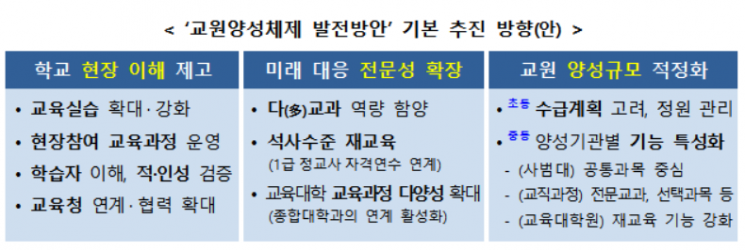
[Asia Economy Reporter Han Jinju] The Ministry of Education will gradually reduce the scale of secondary teacher training by 2026. Starting next year, it will also pilot the 'Practical Training Semester System,' which extends the practicum period for prospective teachers to one full semester.
On the 13th, the Ministry of Education announced the release of the 'Teacher Training System Development Plan (Draft)' and stated that it will gather public opinions through a national forum. The Ministry formulated this plan based on social consultations by the National Education Council and discussions by the 'Teacher Training System Innovation Committee' since May this year.
The reduction in the scale of secondary teacher training will be implemented gradually until 2026. The plan is to reflect the downsizing measures for each training institution in the '6th Cycle Teacher Training Institution Competency Diagnosis (2022?2025).' This year, the quota for teacher training through colleges of education, teacher certification programs, and graduate schools of education is 21,666, whereas the number of appointments is only about 4,000. The lack of specialization among the three types of training institutions and overlapping functions have resulted in an excessive number of teacher trainees.
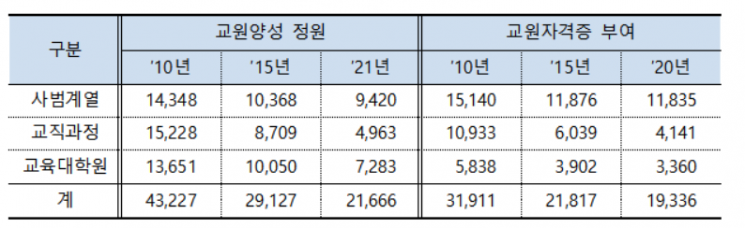
Last year, 19,336 people obtained secondary teacher certificates, but this year, the recruitment number for the teacher appointment exam is only 4,282, about one-fifth. The mismatch between the number of secondary teachers produced and appointments has become severe, with competition rates for some subjects reaching 8 to 1. As the competition for appointments increases, more education college students are seeking other career paths, and it has become difficult to find schools willing to accept student teachers for practicum, according to the Ministry of Education.
An official from the Ministry of Education explained, "Resolving the high competition rate for secondary teacher appointments is a task necessary for the nation and society. It is also necessary to appropriately manage this so that talented individuals do not get stuck in this competition while nurturing prospective teachers who want to pursue teaching careers." He added, "Since the scale reduction must be carried out gradually for each of the three institutions, it is difficult to set immediate targets."
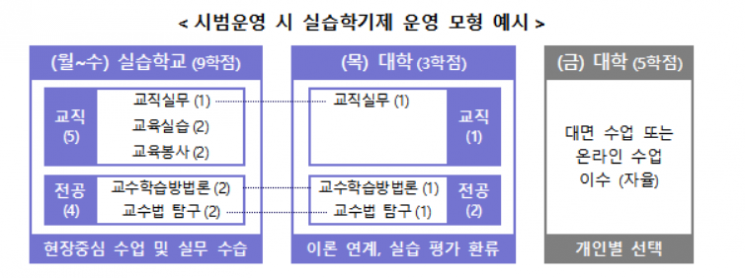
The 'Practical Training Semester System,' which strengthens the practicum for prospective teachers, will also be piloted from the second half of next year. Currently, student teachers go out for practicum during a specific period within a semester, but this period will be extended to the entire semester to enhance understanding of students and schools. The Ministry of Education plans to gradually expand the system with the goal of fully implementing the Practical Training Semester System by 2028 while reducing the scale of teacher training by 2026. The pilot will be conducted in at least two schools per education office, involving 40 schools and 200 participants.
Currently, the practicum is credited as 2 or more credits, but it will be converted to a semester system, extending the practicum period to the second semester of the third year or the first semester of the fourth year. The Ministry is developing operation models for the Practical Training Semester System, such as three to four days per week of field practicum and one to two days per week of practicum-related lectures. A support center for the Practical Training Semester System will be designated to research and support various operation models and provide training for practicum supervising teachers, thereby creating a practicum ecosystem.
Additionally, the Ministry will consider a plan to complete a convergence major (formerly a minor) linked with first-grade teacher training. This involves renaming existing minors for in-service teachers as convergence majors and expanding qualification training to a one-semester course at graduate schools of education. This is a measure to equip teachers with multi-subject competencies to adapt to changing environments such as the high school credit system or elementary subject specialization.
Furthermore, common subjects such as Korean, English, Mathematics, Social Studies, and Science among secondary teachers will be trained mainly through colleges of education. Training for specialized, elective, or new field teachers will focus on teacher certification programs in general departments. Graduate schools of education will adjust their roles to focus on re-education of in-service teachers, such as first-grade teacher qualification training.
An official from the Ministry of Education explained, "Training common subjects mainly through colleges of education is being considered as a way to appropriately manage the excessive number of prospective teachers produced by teacher certification programs in general departments." He added, "For graduate schools of education, since training in extracurricular or special areas is necessary, quotas will be maintained, while adjustments will be made for other subject areas."
Moreover, the Ministry plans to provide active administrative and financial support if integration between colleges of education and comprehensive universities or between colleges of education is pursued. They plan to secure budgets necessary for integration and revise related laws to ensure stable operation after integration.
The Ministry of Education will hold national forums to gather public opinions on the teacher training system development plan. Starting with the first forum on the 16th, a total of four sessions will be held. The first to third sessions will be thematic discussions, and the fourth will be a public hearing. Anyone can submit opinions through the National Rights Commission's 'People's Thinking Box.'
Lee Sang-su, Director of the School Innovation Support Office at the Ministry of Education, said, "The teacher training system is an agenda to design a better future for Korea amid changes in future society and to prepare for a major transition to future education. Not only training universities but all citizens should think together and gather opinions. We will carefully listen to the opinions received and strive to reflect them in policies."
© The Asia Business Daily(www.asiae.co.kr). All rights reserved.
![Clutching a Stolen Dior Bag, Saying "I Hate Being Poor but Real"... The Grotesque Con of a "Human Knockoff" [Slate]](https://cwcontent.asiae.co.kr/asiaresize/183/2026021902243444107_1771435474.jpg)

















