Cancellation of Mandatory Residence in Reconstruction... Real Estate Policy's Zigzag Moves
Encouraging Housing Rental Business → "Abolition" → "Reconsideration from Scratch"?
"Endure and Win"... Public Opinion: "Listening to the Government Means Lifelong Sudden Poverty"
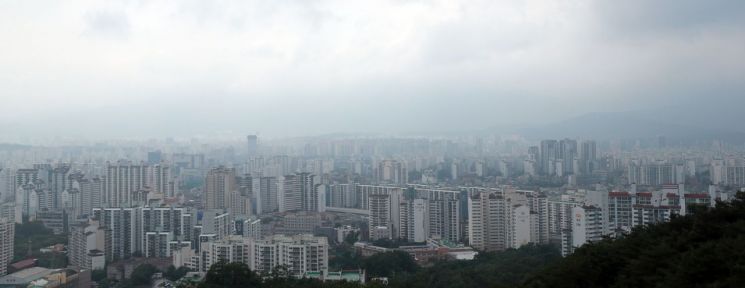 Apartment prices in 'Nodogang' (Nowon, Dobong, Gangbuk districts) in Seoul have risen the most over the past year. According to the monthly housing price trend time series statistics from KB Kookmin Bank on the 11th, the average apartment sale price per 3.3㎡ in Seoul last month was 44.33 million KRW, up 24.4% from 35.62 million KRW in June last year. The photo shows apartment complexes in the Nowon and Dobong districts of Seoul in the afternoon of the same day.
 As the government has scrapped the two-year actual residence obligation for reconstruction apartment association members, criticism is growing that the erratic real estate policies are the main cause of housing price instability. This year alone, the government has caused market confusion by showing indecisiveness over the housing rental business system and the comprehensive real estate tax, in addition to the recent reconstruction residence regulation.
According to the government and the National Assembly on the 13th, the Land, Infrastructure and Transport Committee of the National Assembly held a subcommittee meeting on land and housing bills the day before and decided to remove the provision imposing an actual residence obligation on reconstruction association members from the amendment to the ‘Urban and Residential Environment Improvement Act.’ This was a measure proposed in the June 17th policy last year and had been criticized as excessive regulation. The National Assembly explained that the decision also reflected concerns about potential conflicts with the recently implemented lease protection law and the operation of even stronger regulations such as the land transaction permit system.
The problem is that this is not the first time the government has caused market confusion and undermined housing price stability with contradictory policy signals. The housing rental business system and the comprehensive real estate tax are representative examples. This is why the government is being pointed out as the biggest source of housing price instability.
The Democratic Party of Korea announced a real estate policy improvement plan in May, including easing the comprehensive real estate tax. This plan included the abolition of the housing rental business system, overturning a policy that had been actively promoted with tax and financial benefits a few years ago. There were growing concerns that abolishing the system would cause side effects such as overheating in the monthly rent market. In June, the ruling party said it would "accept public opinion well and readjust the policy to fit reality," announcing a re-examination of the rental business system from scratch. In just one month, the main direction of major real estate policies was reversed 180 degrees.
The easing of the comprehensive real estate tax faced internal opposition as a ‘tax cut for the rich,’ causing back-and-forth moves that only stirred public opinion. Eventually, it was decided to adjust the tax imposition target to the ‘top 2% (around 1.1 billion KRW in official property price).’ The top 2% criterion was criticized as a violation of the principle of tax legality rarely seen worldwide and as real estate politics dividing the public into the 2% and the 98%.
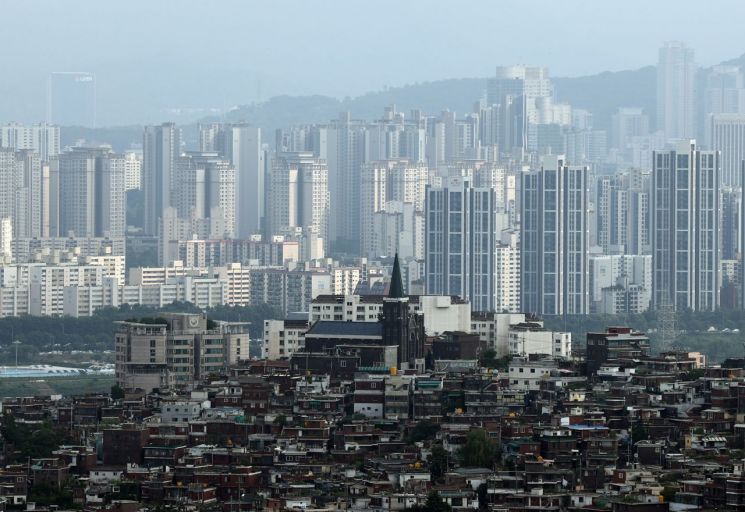
There was also a case where a major supply policy announced by the government was nullified. In the ‘8.4 Supply Plan’ announced last year, the government proposed supplying 4,000 housing units using idle land at the Government Complex Gwacheon site. However, facing strong opposition from residents, the government withdrew the plan in June. Instead, it said it would build 4,300 units on self-sufficient land in the existing Gwacheon district, but this set a bad precedent that government-driven supply plans can be halted at any time. Residents near candidate sites in the metropolitan area included in a series of government housing supply projects?such as Taereung Golf Course, Yongsan Station maintenance depot, Western Driver’s License Test Center, Seoul Regional Public Procurement Service, and the National Diplomatic Academy site?have almost without exception expressed opposition.
Criticism is rising that the government is eroding policy credibility by focusing solely on approval ratings rather than establishing reasonable principles and standards and consistently adhering to them. Seo Jin-hyung, president of the Korea Real Estate Society (professor at Gyeongin National University), said, "Because real estate policies are being made ignoring procedures and based on political interests, market confusion is intensifying, and the damage is continuously affecting all citizens, including the homeless and multi-homeowners." In fact, multi-homeowners have chosen to ‘hold out’ through inheritance rather than putting properties on the market, while young adults in their 20s and 30s are rushing into their first-ever real estate purchases in fear, saying things like ‘If not now, I will never be able to buy a home,’ and ‘If you trust the government, you will never escape being poor overnight’ amid soaring housing prices.
Meanwhile, despite the government’s successive measures, the average apartment price in Seoul rose by nearly 100 million KRW in the first half of this year. According to the monthly KB Housing Market Trend time series data from KB Kookmin Bank’s Liv Real Estate, the average apartment sale price in Seoul in June was 1,142.83 million KRW, up nearly 100 million KRW (99.84 million KRW) from December last year (1,042.99 million KRW) in just six months. The apartment price rising by about 100 million KRW in a half-year period has happened only twice since KB started compiling this statistic in December 2008, including the second half of last year (117.9 million KRW increase).
© The Asia Business Daily(www.asiae.co.kr). All rights reserved.
![Clutching a Stolen Dior Bag, Saying "I Hate Being Poor but Real"... The Grotesque Con of a "Human Knockoff" [Slate]](https://cwcontent.asiae.co.kr/asiaresize/183/2026021902243444107_1771435474.jpg)
















