Growing Calls to Protect Franchise Owners
The Online Platform User Protection Act,
which aims to oversee the 'Online Platform Ecosystem',
is sidelined in the Science and ICT Committee amid partisan conflict

[Asia Economy Reporter Cha Min-young] Following the ‘Shrimp Tempura Gapjil Incident,’ calls to protect lodging and delivery application (app) franchise owners from certain black consumers have grown louder, but legislative discussions overseeing the platform ecosystem have been pushed aside due to partisan conflicts.
On the 12th, although the number of platform users reporting economic and psychological damages caused by malicious reviews and rating terrorism from some gapjil customers?such as the recent shrimp tempura case and the ‘salmon sushi case’?has increased, the legal system overseeing the protection of platform users, a major pillar of the platform ecosystem, remains insufficient.
The Korea Communications Commission (KCC), the regulatory body in charge of platform companies classified as value-added telecommunications service providers, has initiated policy measures including the establishment of ‘Guidelines for Improving Platform Service Reviews and Rating Systems,’ but these remain limited to encouraging industry self-regulation. Within the current legal framework, it is difficult to implement policies that comprehensively manage disputes among end users (consumers), platform users, and platforms. Moreover, the evaluation of user protection tasks is limited to the top nine value-added telecommunications service providers with large transaction volumes, making it insufficient to oversee the entire industry.
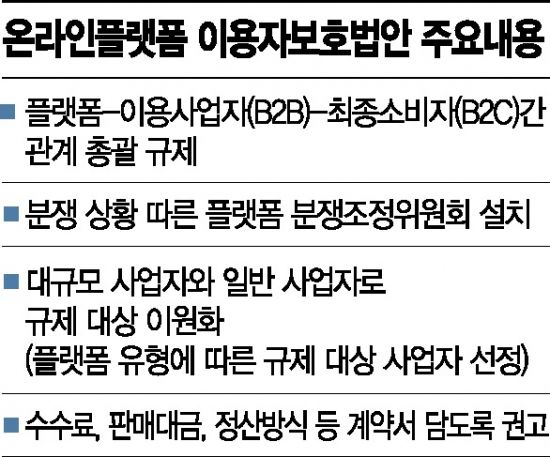
The ‘Online Platform User Protection Act,’ introduced by Representative Jeon Hye-sook of the Democratic Party of Korea on December 11 last year, has been pending in the National Assembly for over seven months. Discussions stalled after the first bill review subcommittee meeting on April 27 in the Science, Technology, Information and Broadcasting and Communications Committee, the standing committee. A public hearing scheduled for the 24th of last month was also canceled amid partisan conflicts. Due to overlap issues with the Fair Trade Commission’s ‘Online Platform Fairness Act,’ inter-agency coordination is required, further complicated by political disputes. A National Assembly official from the Science and ICT Committee remarked, “With partisan conflicts at their peak and the upcoming National Assembly inspection event, the focus is on processing multiple bills, including the urgent ‘Google Gapjil Prevention Act (Amendment to the Telecommunications Business Act),’ making it realistically difficult to advance this bill.”
Representative Jeon’s bill aims to comprehensively regulate the stakeholders involved: platforms and platform users, as well as platforms and end users. The establishment of the Platform Dispute Mediation Committee and provisions for consent-based resolutions are included for this reason. Kim Hyun, Vice Chairman of the KCC, also emphasized, “This is the only bill that comprehensively regulates online platform operators, users, and end users through a single law, so its enactment is urgent.” The KCC expects that once the Online Platform User Protection Act passes, platform operators will be prohibited from imposing unfair or discriminatory conditions or restrictions on platform users.
However, voices calling for consideration of internet operators’ concerns about overlapping regulations have also emerged, highlighting the need for communication efforts with businesses. There are many criticisms that mandatory uniform standard contract drafting and sensitive algorithm disclosure, without considering industry characteristics, are coercive. An industry insider stated, “Whether it’s the Fair Trade Commission’s or the KCC’s bill, from the operators’ perspective, these are burdensome factors, and we just hope that the industry’s self-regulatory efforts will also be acknowledged.”
© The Asia Business Daily(www.asiae.co.kr). All rights reserved.
![Clutching a Stolen Dior Bag, Saying "I Hate Being Poor but Real"... The Grotesque Con of a "Human Knockoff" [Slate]](https://cwcontent.asiae.co.kr/asiaresize/183/2026021902243444107_1771435474.jpg)
















