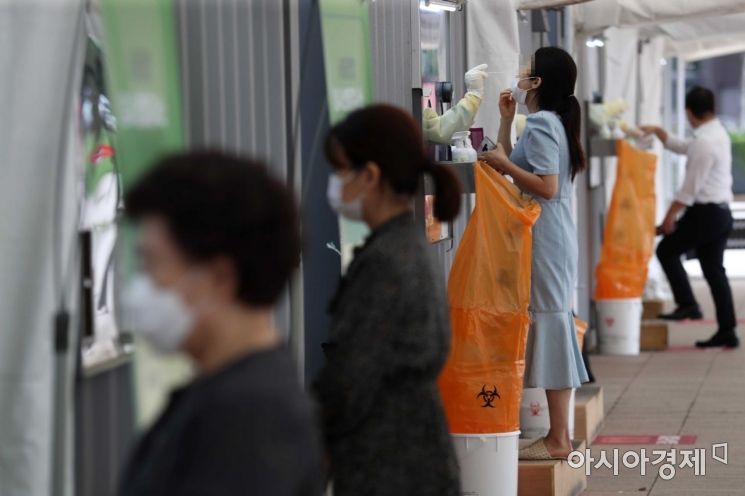
 The number of new COVID-19 cases is breaking record highs day after day. On the 9th, citizens are getting tested at a temporary screening clinic set up in front of Seoul City Hall Plaza. Photo by Mun Ho-nam munonam@
[Asia Economy Reporter Junho Hwang] With the spread of the COVID-19 Delta variant, the possibility of ‘pandemic trauma (COVID-19 post-traumatic stress disorder)’ putting pressure on the stock market has increased. Given South Korea’s low vaccination rate, concerns over a slowdown in economic recovery due to the Delta variant’s spread could lead to weakened investor sentiment toward risk assets. The securities industry is advising a focused approach on IT, automotive, and secondary battery sectors, which have experienced significant declines so far.
According to Yuanta Securities on the 12th, the KOSPI investor sentiment index stood at 30% as of the 9th. The investor sentiment index indicates the ratio of days with gains out of the last 10 trading days. A level of 25% or below is interpreted as weakened investor sentiment, leading to a flood of sell orders and considered a buying opportunity at low prices. The investor sentiment index halved over the past week (from 60% over 5 days) due to the spread of the Delta variant.
This is the result of the shock from the Delta variant’s spread acting as a threat to the stock market, given the lower vaccination rate compared to leading countries. Hainhwan KB Investment & Securities Research Center analyst said, "Economic indicators such as U.S. consumer prices on the 13th and retail sales on the 16th will be released, and if they fall short of market expectations, it will be interpreted as a stronger signal of economic recovery slowdown." However, he added, "With this market correction, the mechanical net selling by pension funds may come to an end, and once the tapering issue passes in the second half of the year, there could be a turning point where foreign net buying returns."
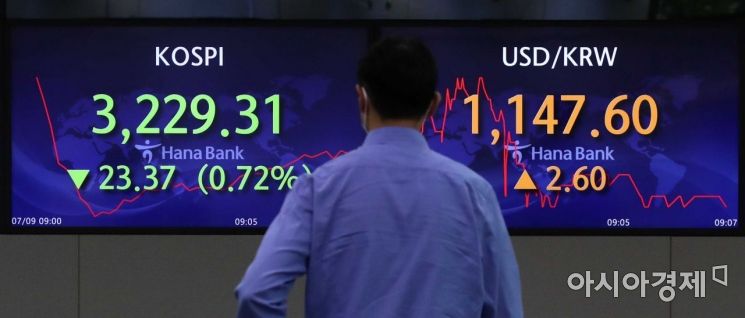 On the 9th, as the spread of COVID-19 intensifies, the KOSPI index is displayed in the dealing room of Hana Bank in Euljiro, Seoul. On this day, the KOSPI started at 3,245.52, down 7.16 points (0.22%) from the previous session, showing a downward trend. Photo by Moon Honam munonam@
To avoid downward pressure, it is necessary to focus on stocks exporting to countries with high vaccination rates. Younghwan Kim, NH Investment & Securities analyst, said, "It is necessary to pay attention to manufacturing sectors (automobiles, IT home appliances) where exports to leading vaccination countries account for a large portion of sales, related intermediate goods (steel), and healthcare stocks that have been neglected from a rotation perspective." However, he noted, "Sectors related to domestic consumption or services are inevitably facing worsening business conditions due to strengthened quarantine measures for the time being."
However, the possibility of improved third-quarter earnings for Samsung Electronics and LG Electronics should also be considered. Hyunki Chae, Cape Investment & Securities analyst, analyzed, "Despite notable second-quarter earnings announcements from Samsung Electronics and LG Electronics, their stock prices fell due to increased uncertainty over third-quarter earnings." Samsung Electronics’ stock price fell below the 80,000 KRW level on the 9th.
There is also an observation that attention should be paid to the current phase of change. Jaeman Lee, Hana Financial Investment analyst, said, "The U.S. 10-year Treasury yield (1.3%) and China’s economic surprise index (-88 points) appear to have shifted to risk-off (a period of risk asset aversion), but oil, copper prices, and the Baltic Dry Index (BDI) indicate ‘risk-on.’" He analyzed, "If yields and indices rebound, focus should be on shipbuilding and refining sectors, but if there is no reversal, focus should be on stocks that can secure relatively advantageous positions such as software and healthcare."
Donggil Noh, Shinhan Financial Investment analyst, said, "Foreign investors are the key players determining the KOSPI’s direction, and with their lack of confidence in domestic IT sectors such as semiconductors, the direction of the won-dollar exchange rate is expected to directly affect supply and demand." However, he added, "The selling pressure from foreign investors could be alleviated through two weeks of strong social distancing, and a strategy to increase weights mainly in growth stocks such as IT and secondary batteries, which had been sold off, is reasonable."
© The Asia Business Daily(www.asiae.co.kr). All rights reserved.
![Clutching a Stolen Dior Bag, Saying "I Hate Being Poor but Real"... The Grotesque Con of a "Human Knockoff" [Slate]](https://cwcontent.asiae.co.kr/asiaresize/183/2026021902243444107_1771435474.jpg)

















