Analysis Through the Korea Automotive Technology Institute's Report on Trends and Challenges in In-House Production of Vehicle Semiconductors
[Asia Economy Reporter Changhwan Lee] It is forecasted that the shortage of automotive semiconductors will continue until next year.
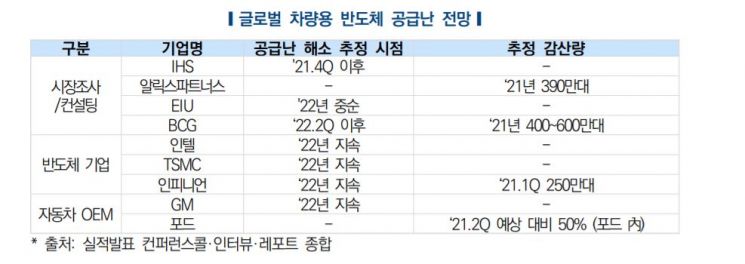
On the 12th, the Korea Automotive Technology Institute released a report titled "Trends and Challenges in Internalizing Automotive Semiconductor Production," projecting that the shortage of automotive semiconductors will peak in the second quarter of this year and gradually recover in the second half, but the situation will persist until 2022.
The institute explained that although production capacity affected by the fire at Renesas' plant in Japan, one of the major suppliers of automotive semiconductors, has been restored, it will take time to secure quality.
It also stated that even if major foundry companies such as TSMC expand their factories, it will take more than three years for verification and mass production.
Automotive semiconductors are expected to be integrated into high-performance chips by function, and the irreplaceability of TSMC's process is increasing.
Compared to other automotive semiconductor sectors, the MCU (multi-chip packaging) fabless industry has a high concentration, and the MCU foundry industry has a very high industrial concentration with TSMC holding over 70% market share.
To overcome this situation, support policies from governments and efforts by automobile companies are ongoing, but limitations were also pointed out.
In the United States, Intel is entering the foundry industry and plans to supply Ford and GM by adding automotive products to existing processes without establishing additional processes, expecting mass production within nine months. The government is supporting subsidies and comprehensive cooperation.
Domestically, Hyundai Motor Group is promoting semiconductor internalization, and through the government's "Future Car-Semiconductor Alliance and Cooperation Council," they are collaborating with fabless companies on supply items and sharing information.
However, it was emphasized that for true localization, fostering domestic foundries through cooperation on automotive dedicated processes is required.
In particular, for high-performance semiconductors requiring 12-inch wafer processes, except for Samsung Electronics, there are few companies in Korea capable of mass production, so the government needs to mediate direct cooperation between Hyundai Motor and Samsung Electronics as well as foster policies for other foundry companies.
© The Asia Business Daily(www.asiae.co.kr). All rights reserved.