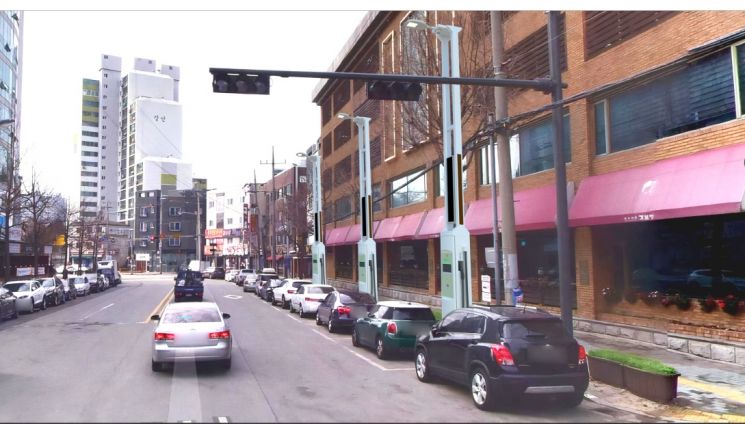
[Asia Economy (Suwon) = Reporter Lee Young-gyu] Suwon City in Gyeonggi Province will install streetlight-type electric vehicle fast chargers in on-street parking lots for the first time nationwide.
On the 8th, Suwon City announced that by the end of next month, it plans to install four streetlight-type electric vehicle fast chargers at Jangdari Public On-Street Parking Lot and Maetan 4 District On-Street Parking Lot. These chargers will be available for use starting early September.
In March, Suwon City signed a business agreement with a private charging operator and is expanding charging infrastructure focusing on areas with a shortage of electric vehicle fast chargers.
General fast chargers will be installed by the end of July at Manseok Park No. 1 Public Parking Lot, Hwaseong Haenggung Public Parking Lot, and Yeonmudae Parking Lot.
Actively promoting eco-friendly electric vehicles, Suwon City plans to distribute an additional 500 eco-friendly electric passenger cars to the private sector in the second half of this year and provide subsidies.
The subsidy amounts are up to 12.5 million KRW for electric passenger cars (14.5 million KRW for taxis), up to 27.5 million KRW for electric cargo vehicles, and up to 128 million KRW for electric buses.
Applicants can visit dealerships selling the desired vehicle models to fill out and submit application forms. Required documents include the electric passenger car purchase application, vehicle purchase contract, and resident registration certificate (or business registration certificate).
If there are no disqualifications, applicants will be selected as electric vehicle recipients in the order of delivery and registration.
Suwon City's electric vehicle distribution targets for this year are 936 electric passenger cars, 221 electric cargo vehicles, and 120 electric buses.
In the first half of this year, 415 electric passenger cars, 110 electric cargo vehicles, and 12 electric buses were distributed. Currently, 166 electric buses operate in Suwon City.
Electric vehicles do not emit air pollutants such as carbon monoxide, nitrogen oxides, or fine dust. Operating one vehicle can reduce greenhouse gas emissions by 1.4 tons annually. Driving 20,000 km per year can save about 2.5 million KRW in maintenance costs compared to gasoline vehicles of the same class.
A city official stated, "We will expand charging infrastructure so that electric vehicle users can conveniently charge their cars as easily as charging their mobile phones," adding, "We will continue to promote eco-friendly vehicles to establish a foundation for a 'low-carbon city.'"
© The Asia Business Daily(www.asiae.co.kr). All rights reserved.
![Clutching a Stolen Dior Bag, Saying "I Hate Being Poor but Real"... The Grotesque Con of a "Human Knockoff" [Slate]](https://cwcontent.asiae.co.kr/asiaresize/183/2026021902243444107_1771435474.jpg)















