Yoon Soon-jin, Chair of the Carbon Neutrality Committee, Attends KDI International Conference
Despite Industry Concerns, Maintains "Carbon Neutrality Is Not a Matter of Whether to Do It"
Academia States "True Carbon Neutrality Requires Technological Advancement"
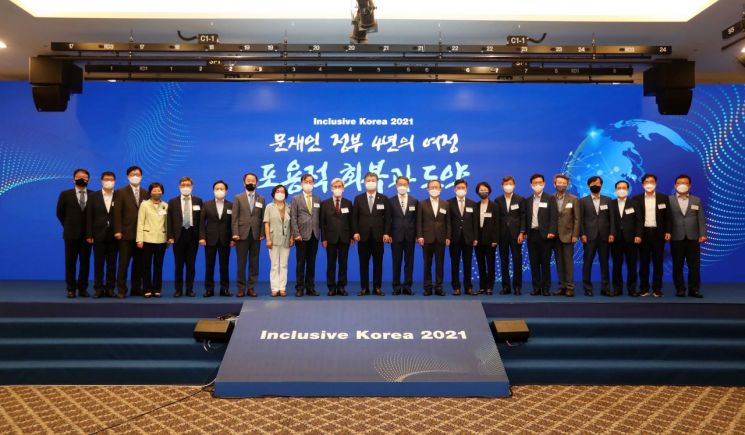
[Asia Economy Reporter Jang Sehee] Yoon Soon-jin, Chair of the Carbon Neutrality Committee, emphasized that "carbon neutrality is not a matter of whether to do it or not, but a global trend." In a situation where the industry is concerned about the rapid pace of carbon neutrality, this message can be interpreted as "compromise is difficult," indicating that the path to carbon neutrality will not be easy.
On the 6th, Chair Yoon attended the ‘Inclusive Korea 2021 International Conference’ hosted by the Presidential Policy Planning Committee and the National Research Council for Economics, Humanities and Social Sciences, and organized by the Korea Development Institute (KDI). He stated, "Carbon neutrality is a global trend that no country can or should go against," and emphasized, "It is important to find out how and by what means to achieve the goal."
He continued, "If companies change their consumption strategies to renewable energy strategies, they can transform the global energy market and accelerate the transition to a decarbonized economy." Chair Yoon mentioned RE100, asserting that "companies are changing the global RE100 market by requiring their partners to use 100% renewable energy power." RE100 is a voluntary commitment by companies to use only 100% renewable energy by 2050. Previously, the government announced three major policy directions and ten implementation tasks to strengthen the carbon neutrality system, consisting of ▲low-carbon economic structure ▲creation of a promising low-carbon industrial ecosystem ▲fair transition to a carbon-neutral society.
◆First ’Carbon Neutrality Budget‘ to be Established Next Year and Fund to be Created=However, despite these policies, legal grounds remain insufficient. The ‘Carbon Neutrality Act,’ which serves as the legal basis for carbon neutrality, is pending in the National Assembly’s Environment and Labor Committee. Although the bill was discussed in the Environment and Labor Committee’s subcommittee, it failed to pass as the opposition party opposed the abolition of the Framework Act on Low Carbon, Green Growth. A government official emphasized, "To implement detailed carbon neutrality tasks and secure funding, a legal basis must be established," adding, "The law must be passed in the National Assembly as soon as possible." Despite the sluggish discussion on the legal basis, the government plans to secure resources such as budgets and funds to realize carbon neutrality.
At the government level, the first carbon neutrality budget will be established next year. To this end, the concept of carbon neutrality will be clarified, and a climate crisis response fund will be created alongside the Green New Deal projects. A government official stated, "Some of the existing Green New Deal projects will be integrated into carbon neutrality," and "We are also in the process of newly discovering projects that can reduce carbon."
The government plans to specify the climate crisis response fund once the legal basis is established. The fund’s resources are expected to be secured through revenues from the paid allocation of greenhouse gas emission permits, with the scale estimated to be around 3 trillion won. The government previously amended the Special Act on Materials, Parts, and Equipment and established a special account worth 2.5 trillion won to secure stable funding. However, if the definition of carbon neutrality broadens, the size of the fund could increase further. Since the fund’s resources will be secured through revenues from the paid allocation of greenhouse gas emission permits, the burden on companies is expected to increase. In fact, emission permits were all allocated free of charge from 2015 to 2017, then 3% were allocated for a fee from 2018 to 2020, and this rate was raised to 10% starting this year.
Professor Hong Woo-hyung of Hansung University’s Department of Economics said, "True carbon neutrality is possible when technological advancements that can improve energy efficiency are assumed," adding, "There are limits to just injecting finances." He also pointed out, "Carbon neutrality is being pushed at an excessively rapid pace based on policy decisions rather than economic logic."
© The Asia Business Daily(www.asiae.co.kr). All rights reserved.
![Clutching a Stolen Dior Bag, Saying "I Hate Being Poor but Real"... The Grotesque Con of a "Human Knockoff" [Slate]](https://cwcontent.asiae.co.kr/asiaresize/183/2026021902243444107_1771435474.jpg)















