Amendment to Insurance Business Act Including Non-face-to-face Cancellation Processed by the Political Affairs Committee
"Mid-term Cancellation Refund May Be Less Than Paid Amount"
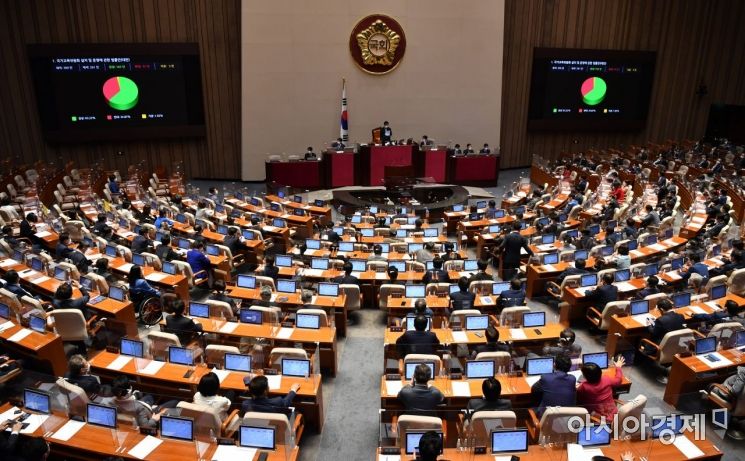 On the 1st, the bill on the establishment and operation of the National Education Committee was passed in the plenary session of the National Assembly with 165 votes in favor, 91 against, and 5 abstentions. Photo by Yoon Dong-joo doso7@
[Asia Economy Reporter Oh Hyung-gil] The possibility of terminating insurance contracts through non-face-to-face methods such as phone or online is expected to open up. While insurance subscription is possible non-face-to-face, it has been pointed out that termination requires prior consent for non-face-to-face cancellation, causing inconvenience.
According to the insurance industry on the 2nd, the National Assembly's Political Affairs Committee processed a bill to amend the Insurance Business Act containing such provisions the day before. However, this bill must pass the Legislation and Judiciary Committee review and then the plenary session, but there remains a variable as the ruling and opposition parties have not yet finalized the distribution of standing committees in the National Assembly.
The amendment includes provisions allowing consumers to terminate insurance contracts non-face-to-face if they verify their identity as the policyholder through methods ensuring safety and reliability, even after the insurance contract has been concluded.
Currently, insurance contract termination by phone is possible, but not all subscribers can terminate contracts this way. Only subscribers who agreed to contract termination via communication means such as phone or computer at the time of contract conclusion can terminate insurance contracts by phone.
There has also been criticism that while insurance subscription is possible non-face-to-face, termination is not, which goes against consumer rights. Last year, among non-life insurance products, contracts concluded via phone or online accounted for as much as 15.7%, showing that non-face-to-face subscription is common.

Vulnerable groups such as the elderly or disabled, who have difficulty moving, face challenges as they must visit insurance companies or meet agents in person to terminate insurance, and with the acceleration of non-face-to-face trends due to COVID-19, calls for improvement in insurance termination methods have been raised.
However, concerns have also been voiced about side effects if anyone can easily terminate contracts non-face-to-face. Early termination of insurance may result in surrender refunds being less than the premiums paid or refusal of re-subscription to the same insurance. The insurance industry advises utilizing premium payment deferral, reduction, or paid-up reduction systems to maintain contracts rather than terminating them for economic reasons.
The premium payment deferral function allows maintaining the insurance contract without paying premiums for a certain period. Risk premiums and business expenses necessary for contract maintenance are deducted from the surrender refund. If these amounts cannot be covered, the insurance contract may be automatically terminated.
The reduction system refers to lowering the insured amount and premiums to maintain the insurance contract. The reduced portion is treated as terminated, and surrender refunds are paid accordingly.
Additionally, the paid-up reduction system means that if premium payment is difficult, premium payments are stopped, and the new insured amount is determined by the surrender refund at that time to maintain the contract. The insurance period and payment conditions of the insurance contract do not change, but the coverage amount decreases.
© The Asia Business Daily(www.asiae.co.kr). All rights reserved.
![Clutching a Stolen Dior Bag, Saying "I Hate Being Poor but Real"... The Grotesque Con of a "Human Knockoff" [Slate]](https://cwcontent.asiae.co.kr/asiaresize/183/2026021902243444107_1771435474.jpg)
















