Korea Research Foundation Professors Kim Wook and Yang Si-young's Team Confirm Effects of Spherical Self-Assembled Hyaluronic Acid Nanoparticles
Previously Used Only as Drug Delivery Materials... "Cartilage Protection and Inflammation Relief Effects Observed in Mouse Experiments"
[Asia Economy Reporter Kim Bong-su] A study has found that an auxiliary substance, which has traditionally served as a delivery agent for degenerative arthritis treatments, actually exhibits greater therapeutic effects than the treatments themselves.
The National Research Foundation of Korea announced on the 29th that a research team led by Professors Kim Wook and Yang Si-young from Ajou University confirmed the cartilage-protective and anti-inflammatory effects of spherical self-assembled hyaluronic acid nanoparticles through animal experiments using mice.
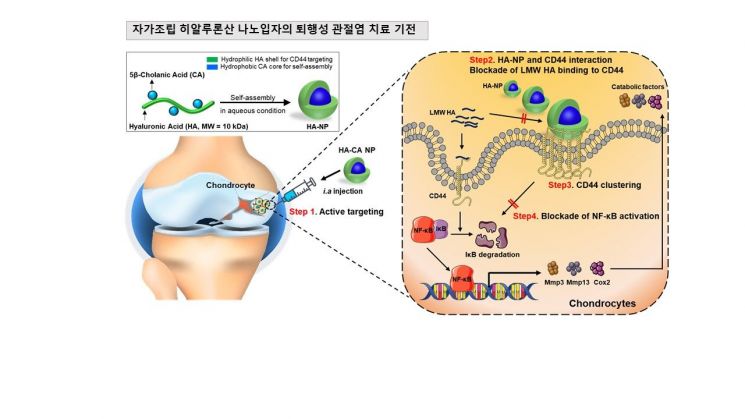
This substance is spherical nanoparticles formed by the self-assembly of hyaluronic acid conjugated with hydrophobic materials via hydrophobic interactions in aqueous solutions, widely used as drug delivery vehicles encapsulating drugs inside.
It is expected to provide a clue to enhancing the biostability and efficacy of linear hyaluronic acid, which is used as a cartilage protector for degenerative arthritis.
The research team hypothesized that, unlike linear hyaluronic acid, the compressed spherical self-assembled hyaluronic acid nanoparticles would have higher stability, persist longer in vivo, and enhance anti-inflammatory effects. In fact, when the team injected self-assembled hyaluronic acid nanoparticles into the knees of mice, they confirmed through multiphoton and confocal microscopy that the nanoparticles penetrated the cartilage and bound to CD44 receptors on the cartilage cell membranes, preventing cartilage destruction. The nanoparticles have multiple CD44 binding sites, allowing simultaneous binding to several CD44 receptors, inducing CD44 clustering on the cell membrane, thereby effectively inhibiting CD44 activity. In other words, the self-assembled hyaluronic acid nanoparticles, which are drug delivery vehicles without encapsulated drugs, reduced the occurrence of CD44 receptors (cell membrane receptors highly expressed in patients with degenerative arthritis) that mediate cartilage destruction by assisting catabolic factors.
The research team also reaffirmed that CD44 receptors can be a target for developing degenerative arthritis treatments. In a mouse model lacking CD44 receptors, artificially induced degenerative arthritis in the knee joints showed significantly less cartilage destruction compared to the control group where CD44 receptors were present.
This study suggests that self-assembled hyaluronic acid nanoparticles acting on CD44 receptors could be candidate substances for degenerative arthritis treatments and are expected to provide a clue to overcoming the low biostability and inflammation caused by degradation products of conventional linear hyaluronic acid. The study was published on the 19th in the international journal Biomaterials.
© The Asia Business Daily(www.asiae.co.kr). All rights reserved.
![Clutching a Stolen Dior Bag, Saying "I Hate Being Poor but Real"... The Grotesque Con of a "Human Knockoff" [Slate]](https://cwcontent.asiae.co.kr/asiaresize/183/2026021902243444107_1771435474.jpg)















