"Education Level as a 'Rational Discrimination Factor,'" Ministry of Education Revises Stance After Criticism
Experts Say "'Spoon Class Theory' Emerged Because Government Overlooked Social Structure"
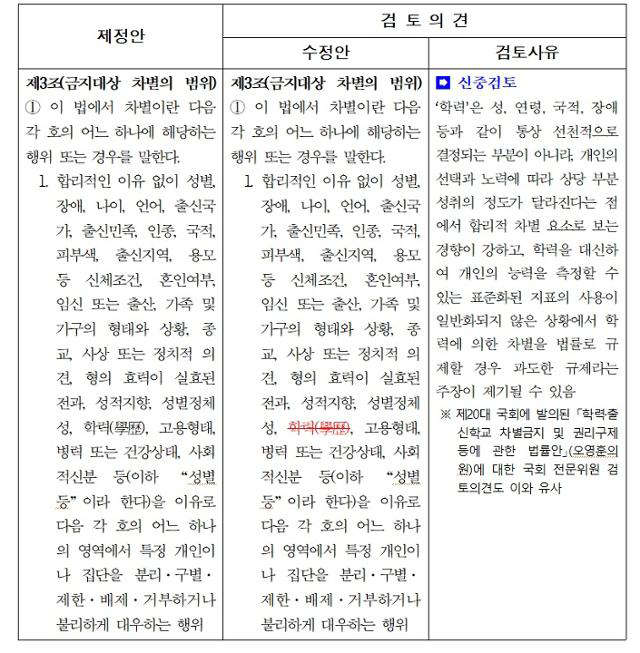 The Ministry of Education submitted an opinion to the National Assembly proposing to remove "educational background" from the discrimination categories in the "Anti-Discrimination Act" bill, which was primarily proposed by Jang Hye-young, a member of the Justice Party.
 /Photo by Jang Hye-young's office
[Asia Economy Reporter Kang Joo-hee] The Ministry of Education has reportedly proposed removing 'academic background' from the list of prohibited discrimination categories specified in the 'Anti-Discrimination Act,' sparking controversy. The argument is that academic background is not determined innately but varies according to individual effort, making it a 'rational basis for differentiation.'
However, in South Korean society, where discrimination and division based on academic background are severe, the Ministry of Education? which should be working to eliminate such practices?is instead being criticized for reinforcing academic elitism. There are also criticisms that the ministry is attempting to justify discriminatory acts based on academic background.
Experts have criticized the Ministry of Education's proposal as overlooking structural social issues and reflecting a distorted perception that only exams and abilities are fair.
According to Justice Party lawmaker Jang Hye-young, the Ministry of Education recently submitted a review opinion to the National Assembly's Legislation and Judiciary Committee proposing to exclude 'academic background' from the types of discrimination prohibited under the Anti-Discrimination Act.
The Ministry of Education justified this by stating, "Academic background, unlike gender, age, or nationality, is not typically determined innately but varies significantly depending on individual choice and effort, leading to a strong tendency to view it as a rational basis for differentiation," adding, "In the absence of standardized indicators that can measure individual ability instead of academic background, regulating discrimination based on academic background by law could be seen as excessive regulation."
 On the 15th, Jang Hye-young, a Justice Party lawmaker, attended a press conference for the "Report on 100,000 Signatures for the Anti-Discrimination Act and Legislative Urging." Photo by Yonhap News
The Anti-Discrimination Act, originally proposed by lawmaker Jang in June last year, aims to prohibit discrimination against individuals or groups based on 23 categories, including gender, disability, age, language, race, academic background, sexual orientation, and gender identity, without reasonable grounds.
The term 'academic background' (學歷) specified in the bill includes graduation or completion status from educational institutions such as high school or university, as well as the alma mater itself. For this reason, the bill intends to prevent discrimination in employment, supply of goods and services, vocational training, administrative services, and other areas.
In response to the Ministry of Education's proposed amendment, lawmaker Jang immediately criticized it as an 'inappropriate opinion.' On the 25th, she wrote on Facebook, "Individual effort is an important factor influencing academic background. However, the more fundamental factors are the circumstances and environment surrounding the individual."
She continued, "The Ministry of Education, which understands these environmental influences on academic background better than anyone and has the obligation to improve them, must be strongly criticized for issuing such a highly inappropriate review opinion that 'academic background is a matter of effort.' I demand the Ministry of Education submit a prompt revised opinion."
However, some argue that the recent discourse on 'fairness,' especially among young people, supports the view that considering academic background is a 'justifiable differentiation.'
One netizen commented, "Why do we distinguish between PhD, Master's, and Bachelor's degrees? Because a certain level of qualification appropriate to the role is necessary," adding, "Treating them all the same might be more discriminatory."
Nevertheless, concerns have been raised about the perspective that only universities, exams, and grades constitute 'legitimate qualifications.' Critics point out that 'exam-centrism' is not the sole criterion for evaluating a person's ability and that this view overlooks the fact that educational opportunities are inevitably influenced by family environment and parents' economic status.
As the controversy spread, the Ministry of Education announced it would conduct a comprehensive review of the bill. On the 24th, Deputy Prime Minister and Minister of Education Yoo Eun-hye stated during a parliamentary question session, "There are aspects of the social perception that views academic background as a rational basis for differentiation, which are difficult to accept," adding, "We will re-examine whether the intention behind submitting such a position was a misunderstanding or misinterpretation of the bill's purpose."
Experts criticized the Ministry of Education's proposed amendment as reflecting a distorted perception that discrimination can be overcome solely through exams and abilities.
Kim Ji-hak, director of the Korea Diversity Research Institute, said, "Academic background is heavily influenced by parents' economic power. Isn't that why theories like the 'spoon class theory' have emerged?" He added, "'Fairness means taking the same test with the same test paper' is a mistaken perception that dominates our society overall. This aspect has been reaffirmed from the Ministry of Education's standpoint."
He continued, "Acknowledging university rankings centered on entrance exams and telling people 'you should make efforts on your own' is transparently evident and shocks citizens," criticizing, "'The idea that discrimination can be overcome by exams' blinds people from seeing society structurally."
Kim said, "The Ministry of Education should aim to reduce educational disparities and ultimately reduce economic and social gaps among citizens. We should create a country where people can live well even without attending university, but we are moving in the opposite direction," adding, "This government's attitude of justifying discrimination is highly inappropriate."
© The Asia Business Daily(www.asiae.co.kr). All rights reserved.
![Clutching a Stolen Dior Bag, Saying "I Hate Being Poor but Real"... The Grotesque Con of a "Human Knockoff" [Slate]](https://cwcontent.asiae.co.kr/asiaresize/183/2026021902243444107_1771435474.jpg)

















