Cashback of up to 300,000 KRW per person with 100,000 KRW per month
Household debt bomb threat... Introduction of preferential loan program for low-income earners
[Sejong=Asia Economy Reporter Kim Hyunjung] The government is accelerating economic recovery in the second half of this year through a 1 trillion KRW scale card consumption cashback project and issuance of consumption coupons. In this process, it plans to introduce a preferential loan program for low-income earners to alleviate household debt burdens and implement supply expansion policies to stabilize the real estate market.
On the 28th, the government announced the joint '2021 Second Half Economic Policy Direction' of related ministries with these contents.
◆ Additional 10% refund on consumption up to 300,000 KRW per person = The most notable among the second half economic policies announced that day is the government's consumption stimulus measure for strong economic recovery, especially the 'Win-Win Consumption Support Fund' estimated at 1 trillion KRW. The core is to refund 10% monthly of the increase exceeding 3% compared to the average monthly card usage in the second quarter of this year. However, usage at department stores, large marts, online shopping malls, luxury specialty stores, entertainment establishments, or vehicle purchases are excluded. The government plans to implement this for three months and then additionally review whether to extend it.
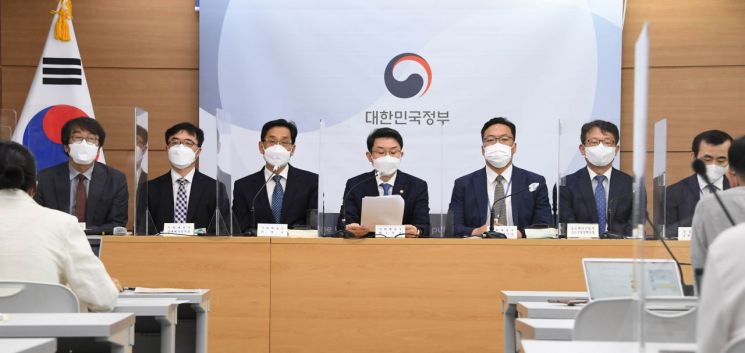 Lee Ok-won, Vice Minister of Strategy and Finance, is delivering opening remarks at the "2021 Second Half Economic Policy Direction Inter-Ministerial Detailed Briefing" held at the Government Sejong Complex on the afternoon of the 25th. From the left: Kim Yoo-jin, Labor Market Policy Officer, Ministry of Employment and Labor; Lim Ki-geun, Economic Budget Review Officer, Ministry of Strategy and Finance; Han Hoon, Deputy Vice Minister, Ministry of Strategy and Finance; Lee Ok-won, Vice Minister, Ministry of Strategy and Finance; Kim Byung-hwan, Director of Economic Policy Bureau, Ministry of Strategy and Finance; Byun Tae-seop, Director of Policy Office, Ministry of SMEs and Startups; Lee Se-hoon, Director of Financial Policy Bureau, Financial Services Commission.
To increase consumption again in the previously contracted cultural, arts, performance, sports, and dining sectors, additional consumption coupons and vouchers will be issued. Existing consumption coupons will also be newly issued or usable for dining, sports, movies, exhibitions, performances, and sports viewing coupons when the first dose COVID-19 vaccination rate reaches 50%, and for accommodation, tourism, rail, and bus coupons when it reaches 70%. The government expects the vaccination rate to reach 50% by August and 70% by around September.
Next, the Korea Sale Festa, which has become a large-scale discount event, will be held, inviting not only large department stores and marts but also small and medium-sized distribution and manufacturing companies. To stimulate consumption of small business owners and traditional markets that have difficulty participating due to limited discount capacity, special sales of local love and Onnuri gift certificates will also be conducted. The volume of local love gift certificates will increase from the existing level of about 800 billion KRW to 2.3 trillion KRW, and the discount rate for Onnuri gift certificates will be doubled from 5 percentage points (p) to 10 p.
Starting from July, a travel bubble with safe countries will be promoted, developing no-landing sightseeing flight products with different departure and arrival airports. During the second half of the year, the '2021 Travel Month' will be operated, promoting sales of discounted rail and express bus tickets and various regional events. Through the 'Travel Month' event, 120,000 rail fixed-amount tickets will be sold, and express buses will also sell 25,000 discounted tickets in four types (3, 4, 5, and 7-day passes). The 'car camping' related system, which has rapidly emerged as a non-face-to-face tourism trend, will also be organized.
In addition, the three major consumption packages promoted since the beginning of the year?▲10% additional income deduction on increased credit card usage ▲30% reduction of individual consumption tax on passenger cars ▲purchase refund for high-efficiency home appliances?will continue in the second half. To expand consumption capacity for the elderly, the government plans to expand subscription to farmland and housing pensions, lowering the subscription age for farmland pensions from 65 to 60 years old and improving the subscription requirements for housing pensions.
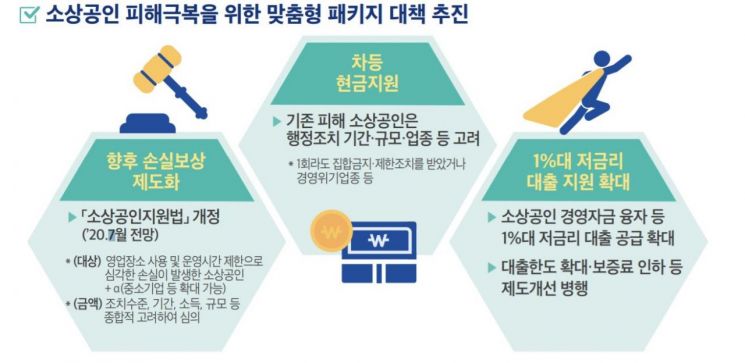
◆Legislation of small business loss compensation... Accelerated price management= Along with this, the government will prepare package measures through supplementary budgets to ensure no blind spots in support for small business owners affected by COVID-19 and expand low-interest loans at around 1% to stabilize their management. The previously announced 500,000 KRW re-challenge support fund payment will continue until the end of the year, and bridge guarantees will be expanded to allow existing loans to be repaid in installments even after business closure.
The 'Good Landlord' tax support program, which provides tax benefits when landlords reduce rent considering COVID-19 circumstances, will add closed small business owners as beneficiaries, and the Commercial Lease Protection Act will be amended accordingly. To improve cash flow for small business owners and SMEs who have accumulated losses due to COVID-19, the government will extend the retroactive deduction period for SME losses and pilot a 'local-based win-win' crowdfunding where residents directly invest in local small business owners to revitalize neighborhood commercial districts. This method selects small business owners through local credit guarantees, collects investment funds, and loans them.
Furthermore, to prevent price instability caused by expanded fiscal projects, the government announced customized supply stabilization measures by item. It will increase preemptive stockpiles of agricultural and marine products and extend the emergency tariff quota support period for eggs until the end of the year. It is also reviewing extending the special application period for tax credit limits on duty-free agricultural product purchases from the end of this year to the end of 2023, and will support expedited customs clearance (24 hours) for steel and rebar.
Additionally, the government plans to increase the scale of agricultural and marine product coupon support through supplementary budgets and improve the payment method to reduce food expenses. It will also reduce communication costs by lowering wholesale fees paid by budget phone operators to mobile carriers, pilot an integrated waiting list registration system for public rental housing, and consider relocation support measures allowing tenants to move to larger units.
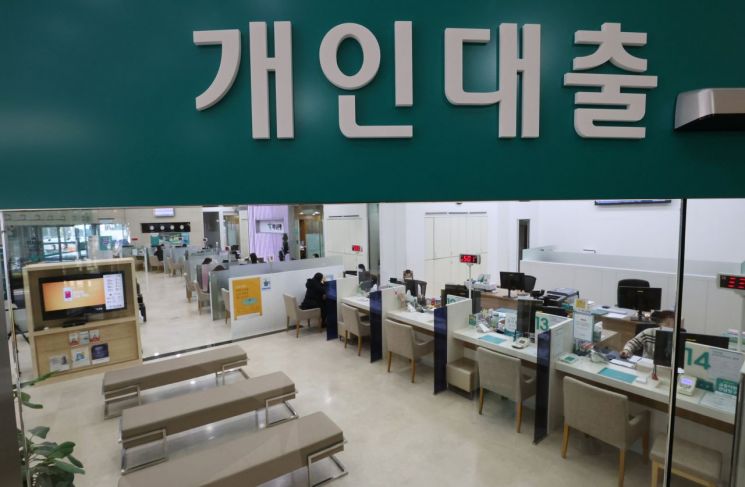
◆ Household debt and real estate risks... Preparing countermeasures= The government is also preparing various measures to preemptively block risks such as household debt and real estate market price increases that may arise during economic recovery.
First, it plans to stably manage the household debt growth rate at 5-6% this year and actively promote measures to alleviate household debt burdens in preparation for interest rate hike risks. In particular, a 'preferential program for low-income earners' will be introduced to the Bogeumjari Loan, allowing low-income households vulnerable to interest rate hikes to refinance existing mortgage loans or obtain new loans at lower interest rates. This applies to 66,000 households with housing prices of 300 million KRW (500 million KRW in the metropolitan area) or less and combined spousal income of 45 million KRW or less, with a 10 basis point (bp) interest rate reduction. For example, a borrower with a 200 million KRW variable-rate mortgage loan would face an annual principal and interest payment increase of about 11.09 million KRW (assuming 30-year equal principal and interest repayment) if the interest rate rises by 1 percentage point, but refinancing with the preferential Bogeumjari Loan would reduce the annual payment to 9.93 million KRW, saving 1.16 million KRW.
In line with the household debt management plan announced in April, the application of the debt service ratio (DSR) at the borrower level will be expanded from July. This means that borrowers who take out mortgage loans secured by houses priced over 600 million KRW in all regulated areas or receive credit loans exceeding 100 million KRW regardless of income will be subject to individual DSR regulations.
On the same day, the government also announced supply expansion policies to stabilize the real estate market. In addition to the 30,000 households planned for the second half of the year, it will actively consider an additional subscription plan for 2,000 households next year, conduct pre-subscriptions for key public housing sites, and quickly implement existing measures such as expanding short-term housing supply to 38,000 households by the second half and a total of 80,000 households by next year. Following the June legislation of the 2.4 measures, the government restructured to ensure no additional tax burden on public housing projects, plans to increase the special supply ratio for first-time homebuyers in private housing from the current 15% public and 7% private to 20% and 10%, respectively, and raise the Didimdol Loan limit from 200 million KRW to 250 million KRW.
Furthermore, as part of supply expansion to stabilize the market, the government will promote short-term housing construction and construction investment. To this end, it will expand the application of modular construction methods that can shorten construction periods by 20-50% for new public rental housing and actively utilize off-site construction (OSC) to shorten construction periods at housing construction sites. To revitalize remodeling of vacant non-residential buildings such as hotels, floor area ratio regulations will be relaxed, and purchase targets will be expanded to include unfinished buildings. Additionally, to address real estate speculation and unfair corruption issues, a 'three strikes out' system will be introduced by November, permanently excluding those caught three times for bribery in redevelopment project contracts from participating in redevelopment projects.
© The Asia Business Daily(www.asiae.co.kr). All rights reserved.



















