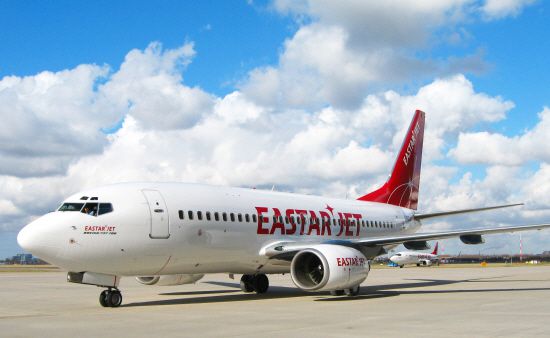
[Asia Economy Reporter Dongwoo Lee] As Eastar Jet embarks on business normalization, a restructuring of the low-cost carrier (LCC) industry is also expected to accelerate.
According to the industry on the 27th, Sung Jung-eun acquired Eastar Jet on the 24th by investing approximately 110 billion KRW. Eastar Jet found a new owner after being shut down for 1 year and 3 months following the failed merger with Jeju Air.
Of the acquisition price, 70 billion KRW is expected to be used to repay public claims such as unpaid wages and severance pay, and 40 billion KRW will be used to repay rehabilitation claims to aircraft leasing companies and oil companies. The investment contract includes a clause to maintain employment for Eastar Jet employees for five years. Eastar Jet plans to reacquire its Air Operator Certificate (AOC) and increase its fleet by 16 passenger aircraft and 3 to 4 cargo aircraft.
A representative from Sung Jung said, "The acquisition of Eastar Jet is a starting point to leap forward as a comprehensive leisure company by attracting golf tourists from China and Japan," adding, "Synergies among aviation, golf, and resorts are expected, and the business outlook is bright."
Along with Eastar Jet’s business normalization, the restructuring of the LCC sector is also expected to gain momentum.
The domestic LCC industry consists of six companies including Jeju Air, T’way Air, Jin Air, Air Busan, Air Seoul, and Eastar Jet, plus three new entrants: Fly Gangwon, Aero K, and Air Premia, making a total of nine companies.
Among them, following the acquisition of Korean Air and Asiana Airlines, their subsidiaries Jin Air, Air Busan, and Air Seoul are expected to merge. The industry analyzes that if Jin Air, Air Busan, and Air Seoul merge, they will surpass Jeju Air, which currently holds the largest market share in the LCC market. Last year, the combined market share of these three companies reached about 45%.
However, some in the industry point out that it will be difficult to generate immediate profitability as domestic routes have reached supply saturation, and the recovery of international routes may be delayed more than expected due to factors such as the recent Delta variant originating from India.
An industry official said, "As the prolonged COVID-19 pandemic has worsened business conditions for LCCs, competition on domestic routes has intensified," adding, "Industry restructuring is expected to proceed in earnest going forward."
© The Asia Business Daily(www.asiae.co.kr). All rights reserved.
![Clutching a Stolen Dior Bag, Saying "I Hate Being Poor but Real"... The Grotesque Con of a "Human Knockoff" [Slate]](https://cwcontent.asiae.co.kr/asiaresize/183/2026021902243444107_1771435474.jpg)















