International Finance Center 'Outlook on the Path of U.S. Monetary Policy Normalization'
[Asia Economy Reporter Kim Eunbyeol] Although the U.S. Federal Reserve's (Fed) monetary policy is entering a normalization phase, an analysis suggests that it is likely to proceed at a gradual pace as long as inflation expectations remain stable. However, volatility in interest rates and risk assets is expected to increase due to liquidity reduction, re-flation trade adjustments, and expectations of a stronger dollar.
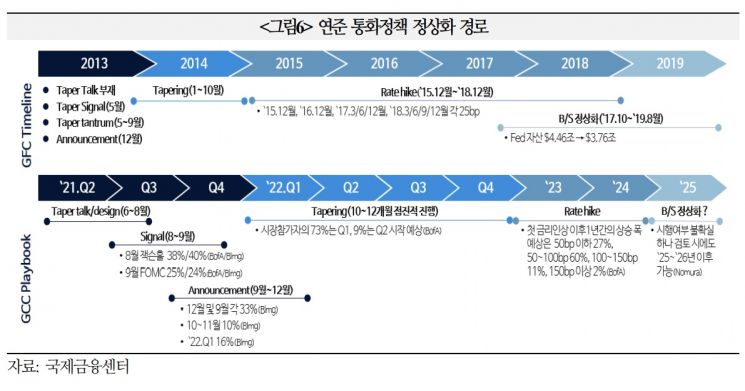
On the 27th, the International Finance Center stated in its report titled "Outlook on the U.S. Monetary Policy Normalization Path" that "(The Fed) is expected to proceed with policy normalization in the order of tapering followed by interest rate hikes, based on experiences from the global financial crisis period," adding, "Tapering will primarily depend on employment, while interest rate hikes will be driven by inflation." Since the market was shocked by rapid tapering after the financial crisis, the Fed is expected to cautiously normalize monetary policy after confirming actual data rather than forecasts on employment and inflation.
Furthermore, the report projected that the normalization path would involve tapering communication in the second half of this year, followed by actual tapering next year. Interest rate hikes are expected after 2023, with balance sheet (B/S) normalization anticipated after 2025?2026.
Regarding tapering, it is expected that consensus will be formed within the Fed around June to July this year, signals will be sent to the market in August to September, and plans will be announced around the end of this year. Messages may come out during the August Jackson Hole meeting and the September Federal Open Market Committee (FOMC) meeting.
For interest rate hikes, since employment must approach or exceed full employment levels, the speed and intensity are expected to vary depending on growth and inflation levels. About 60% of forecasts anticipate that the total rate hike within one year after the first expected increase will be between 50 and 100 basis points (1bp = 0.01 percentage points).
However, the International Finance Center noted that if inflation continues to rise and inflation expectations become unstable, the timing could be accelerated compared to the dot plot (2023). Although hawkish (tightening-preferred) remarks have recently emerged at the FOMC, the fundamental framework of employment focus and average inflation targeting (AIT), introduced in August last year, is expected to be maintained. Kim Sungtaek, head of the Global Economy Department at the International Finance Center, stated, "We believe the Fed will continue to review monetary policy normalization primarily based on the strength of employment recovery rather than inflation for a considerable period."
© The Asia Business Daily(www.asiae.co.kr). All rights reserved.
![Clutching a Stolen Dior Bag, Saying "I Hate Being Poor but Real"... The Grotesque Con of a "Human Knockoff" [Slate]](https://cwcontent.asiae.co.kr/asiaresize/183/2026021902243444107_1771435474.jpg)















