2030 Some Men 'Seated' Lee Jun-seok
'Meritocracy and Competition' Not Agreed by All Youth
Experts Warn "Dangerous Idea Reinforcing Survival of the Fittest"
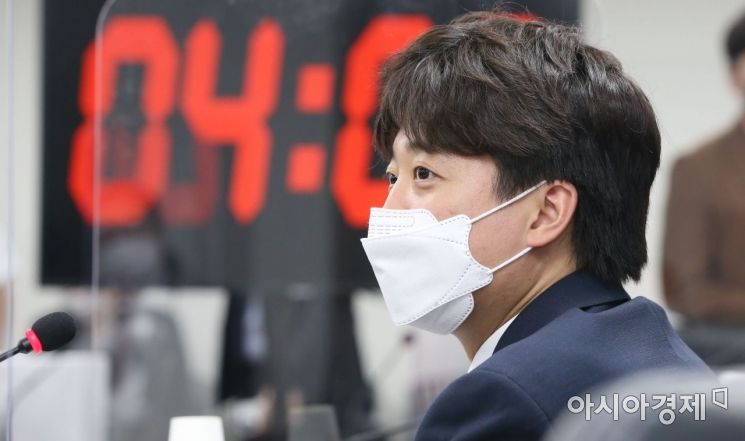 Lee Jun-seok, leader of the People Power Party, is delivering a greeting at the '1st People Power Party Spokesperson Selection Debate Battle - I am the National Representative! with Junstone' held on the 24th at the central party office in Yeouido, Seoul. Photo by Yoon Dong-joo doso7@
[Asia Economy Reporter Park Jun-yi] '75%'. This is the proportion of male candidates who advanced among the successful applicants of the first interview round of the People Power Party's debate battle, which concluded successfully on the 24th. Among the 150 participants who actually took part in the interview process, 70-80% were men. This made the intention of Lee Jun-seok, the leader of the People Power Party, who pledged "to open opportunities to everyone" and promote fair competition, seem hollow.
This is closely related to the recent explosive support Lee and the People Power Party received from men in their 20s. According to exit polls from the April 7 by-election, men in their 20s showed strong interest by giving 72.5% support to Oh Se-hoon, the People Power Party candidate for Seoul mayor. Following this, Lee, who received enthusiastic support from men in their 20s, quickly rose to the top spot in public opinion polls right after announcing his candidacy for party leader in May.
At the time, the political world cheered Lee as the key figure to bring generational change to the party. President Moon Jae-in told Lee in a phone call on the 11th, "You have done a great thing. It is excellent. It will be remembered in our political history." Governor Won Hee-ryong of Jeju Province also emphasized the significance on Facebook that day, saying, "The people and the People Power Party members have chosen young, transformative leadership."
Lee Jun-seok 'Seated' by Male 20s Community
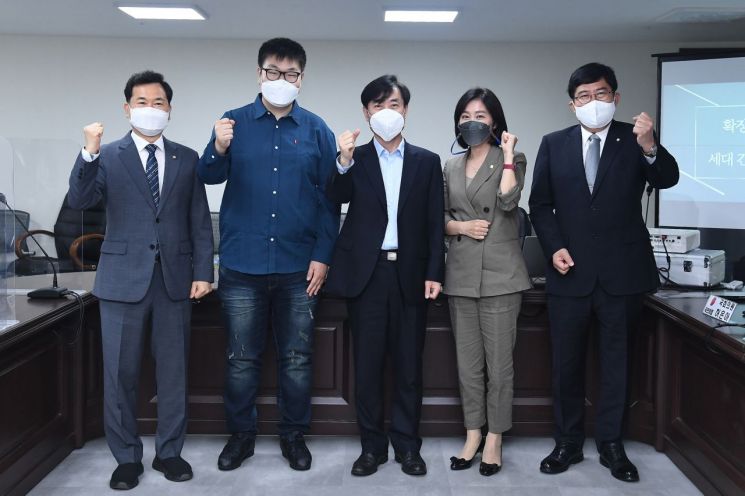 Rep. Ha Tae-kyung and writer Im Myeong-muk attending the People Power Party's freshman study group Photo by Yonhap News
Writer Im Myeong-mook, who gained attention for analyzing politics from the perspective of those born in the 1990s, interpreted this as the 'generational spirit' of men in their 20s and 30s. At the 'Unfailing Conservatism' lecture held at the People Power Party headquarters on the 23rd, Im said, "Lee Jun-seok is a figure symbolizing generational change, and the people who elevated him are young men in their 20s. These community members have long accumulated grievances and have been trained through struggles within the community. This daily struggle then shifted into politics, resulting in the Lee Jun-seok phenomenon."
He added, "Moreover, the Democratic Party of Korea emphasized gender consciousness, instilling a sense of victimhood among men in their 20s and 30s. Lee Jun-seok was 'seated' by young men in their 20s who wanted to have their voices heard."
However, since he represents only part of the youth's views, there are limits to him fully embodying the generational spirit of the 20s and 30s. Among young people, many do not agree with his 'meritocratic fairness' theory. Seo, a female office worker in her 20s, said, "I don't know what criteria he uses to judge 'ability,' and whether only what can be quantified by scores can be called ability." Hong, a male office worker in his 20s, criticized, "I think it is fairness only for those who have already reached a certain position through academic background and exams and want to enjoy rent-seeking with a landlord mindset."
Criticism also followed regarding his call to abolish the 'female quota system.' Kim, a female office worker in her 20s, pointed out, "The agreement on fairness that our society has made over the past 30 years was to create opportunities for women to work in a male-dominated league society. Hearing arguments that reset all the agreements on fairness that have existed in society until now makes my chest feel tight."
Meritocratic Fairness Is Merely 'Exclusive Fairness'
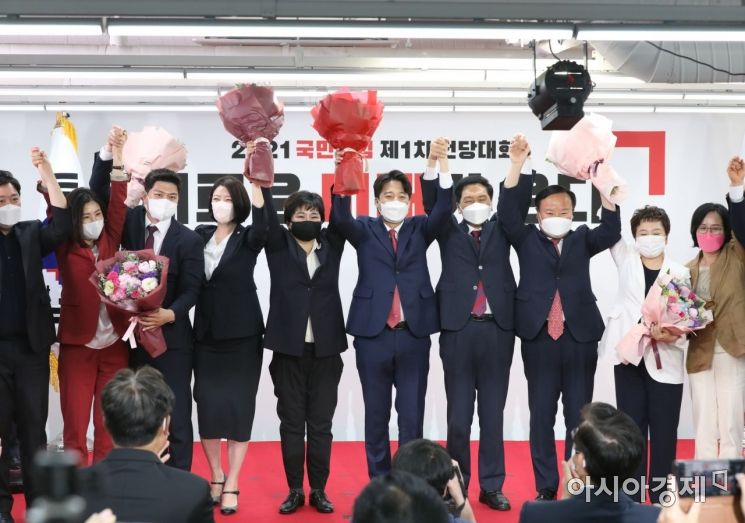 On the 11th, at the People Power Party Central Party Office in Yeouido, Seoul, newly elected party leader candidate Lee Jun-seok and the Supreme Council members are posing at the party convention held to elect the new party leader. Photo by Yoon Dong-joo doso7@
Experts also expressed concerns about interpreting Lee as representing the voice of the entire 20s and 30s generation. Lee Kwang-jae, Secretary-General of the Korea Manifesto Center, said, "Lee is a politician who is good at organizing the dissatisfaction of the youth generation," but "he is more of a trend or tendency rather than representing the entire generation." Furthermore, Lee Byung-hoon, a sociology professor at Chung-Ang University, said, "Those who actively voice their opinions in our society tend to receive attention and are often perceived as representing the entire generation," adding, "Especially, the fairness he talks about is closer to the logic of those in superior positions within the youth generation."
Because of this, there are voices that his fairness theory itself could have a negative impact on society. Professor Lee pointed out, "His fairness risks excluding the existence of a 'tilted playing field' where our society is set up to favor someone from the start," and "If people who are not given opportunities are labeled as lacking ability and thus 'not qualified to stand,' it is nothing more than a defeatist and exclusive fairness." Professor Kim Yoon-tae of Korea University’s Sociology Department also emphasized, "Meritocracy is a 19th-century way of thinking that strengthens survival of the fittest and is a dangerous idea that destroys social community justice."
Concerns are also not few regarding the 'abolition of the female quota system.' Professor Kim said, "The basic concept of fairness agreed upon in our society is that opportunities should be given to the disadvantaged," adding, "Women still face structural problems such as leaving work to have children, and calls to abolish the quota system without any alternatives lack persuasiveness."
However, some positively evaluated that the political world had not previously approached issues from the perspective of the 20s and 30s generation. Professor Choi Hang-seop of Kookmin University’s Sociology Department said, "Until now, no government, regardless of party, has failed to talk about fairness, but the problem was that they never approached it from the perspective of the 20s and 30s," adding, "The biggest difference is that he directly empathizes with the problems of the youth generation and is someone who can solve them, unlike the older generation."
© The Asia Business Daily(www.asiae.co.kr). All rights reserved.
![Clutching a Stolen Dior Bag, Saying "I Hate Being Poor but Real"... The Grotesque Con of a "Human Knockoff" [Slate]](https://cwcontent.asiae.co.kr/asiaresize/183/2026021902243444107_1771435474.jpg)

















