Kim Jong-in "Hopeful for Presidential Candidates to Join People Power Party"
Decision for Yoon Seok-ryeol and Others to Join People Power Party Not Easy
Possibility of Main Election After People Power Party Primary Increases Like Seoul Mayor Race
[Asia Economy Reporter Naju-seok] Following the Seoul mayoral election, there is a growing expectation that next year's presidential election will also proceed with a People Power Party (PPP) internal primary, followed by a unification primary with opposition candidates. In the opposition camp, where attention to presidential candidates outside the party is high, the PPP's presidential primary rules are likely to become a major point of contention.
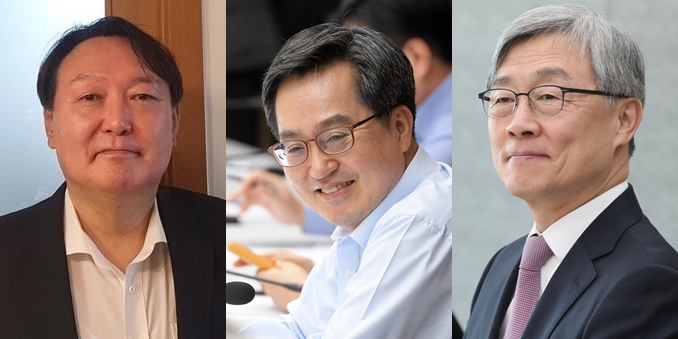
On the 24th, former PPP Emergency Committee Chairman Kim Jong-in said in an interview with YTN, "Within the PPP, there is a hope that everyone who has the potential to be a presidential candidate would join the party and compete in the primary, but this is just the wishful thinking of those within the PPP," adding, "It is almost impossible for presidential hopefuls to simply jump into a group without certainty and compete together."
Kim emphasized, "(The PPP primary rules) give party members about 50% influence in selecting the presidential candidate, so those who have long-standing roots in the party inevitably have an advantage."
As long as the PPP's presidential primary rules, which allocate 50% weight to party members and 50% to opinion polls, remain, it will be difficult for presidential hopefuls outside the party to decide to join the PPP and compete in the internal primary. Kim predicted that the third zone and the PPP will eventually go through a unification process for the opposition candidate.
This would follow a similar path to the April 7 Seoul mayoral by-election, where PPP primary winner Oh Se-hoon and third zone primary winner Ahn Cheol-soo, leader of the People’s Party, went through a unification process.
On the 25th, Kim Jae-won, a senior PPP official, also mentioned the possibility of additional candidate unification after the party primary. Speaking on KBS radio, Kim said, "Even after our party's candidate is selected, we must not neglect efforts to create a unified opposition candidate until the very end." While the presidential candidate should be selected through PPP recruitment, if joining the party does not happen, a separate unification procedure must be held.
In reality, although the opposition's presidential primary has not yet gained full momentum, such prospects cannot be dismissed as mere speculation.
Currently, it remains uncertain whether major opposition presidential candidates such as former Prosecutor General Yoon Seok-youl, Board of Audit and Inspection Chairman Choi Jae-hyung, and former Deputy Prime Minister for Economy Kim Dong-yeon will join the PPP. All of them held key positions during the Moon Jae-in administration and are not affiliated with the PPP.
In particular, Yoon, who leads in opposition candidate support ratings, was once expected to join the PPP before the party convention, but now appears hesitant to do so, as seen in the recent resignation of Lee Dong-hoon, former editorial writer of Chosun Ilbo and Yoon’s spokesperson. Lee had assumed Yoon’s PPP membership was a done deal but resigned a few days later in an unexpected turn of events.
As presidential hopefuls, Yoon and others are likely to pursue a strategy of broadening their support base rather than being confined within the PPP. Yoon’s camp stated, "The general wants to use the phrase ‘overwhelming regime change,’" and added, "To win next year’s presidential election, we must encompass conservatives, centrists, and defected progressives to ensure stable governance after taking office." This suggests a preference for staying outside the PPP initially to gather support. Even if they join the PPP, they are likely to seek ways to increase their political value.
The primary rules are also an issue.
As Kim pointed out, a key variable in the PPP’s presidential primary system is how much party members’ decisions are reflected in the candidate selection process. For those joining from outside with a weak internal support base, a high proportion of party member votes means they risk elimination in the primary regardless of national support. According to current Public Official Election Law, losing the party primary means a candidate cannot run in the same electoral district. Losing the primary effectively ends their presidential bid for that year.
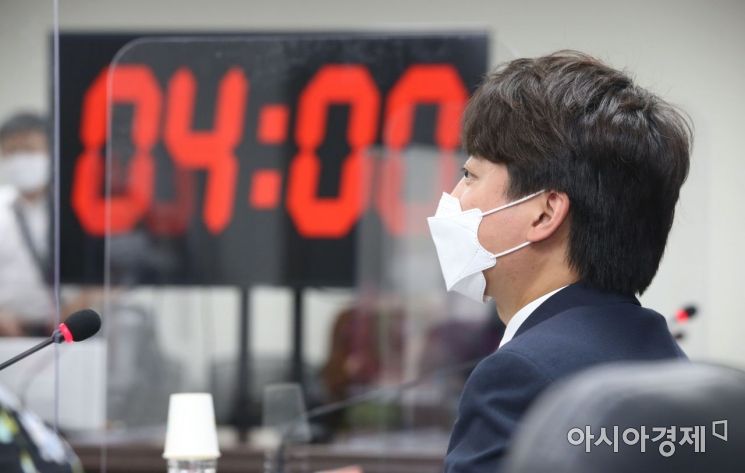 Lee Jun-seok, leader of the People Power Party, is giving a greeting speech at the '1st People Power Party Spokesperson Selection Debate Battle - I am the National Representative! with Junstone' held at the central party office in Yeouido, Seoul on the 24th. Some interviewees are waiting. On this day, Lee served as the chief judge and conducted a pressure interview. The 16 candidates who passed the interview will compete in the round of 16 in a 4-on-4 debate battle format on the 27th. Photo by Yoon Dong-joo doso7@
Naturally, external candidates are highly sensitive to the presidential primary rules. In the April 7 Seoul mayoral by-election, the PPP used a 100% opinion poll method in the main primary. This approach was chosen to recruit Ahn, a leading Seoul mayoral candidate, into the party. Although it did not materialize, the PPP created primary rules acceptable to Ahn.
However, the situation is different for this presidential election. Changing the primary rules is not easy. Among PPP lawmakers, Hong Joon-pyo, who is leading in presidential opinion polls, reacted sensitively to expanding opinion polls. After his reinstatement was confirmed on the 24th, Hong expressed dissatisfaction with the possibility of changing the primary to rely more on opinion polls during a press conference. When reporters mentioned voices calling for a 100% opinion poll primary, he said, "Why bother with direct voting?" and added, "Opinion poll agencies should handle it; it’s a ridiculous idea."
If the proportion of opinion polls and other rules become a battleground between internal and external presidential hopefuls, it will be difficult for the party leadership to revise the primary rules. For external candidates, unless the primary rules change, it will be hard to choose to join the PPP.
© The Asia Business Daily(www.asiae.co.kr). All rights reserved.
![Clutching a Stolen Dior Bag, Saying "I Hate Being Poor but Real"... The Grotesque Con of a "Human Knockoff" [Slate]](https://cwcontent.asiae.co.kr/asiaresize/183/2026021902243444107_1771435474.jpg)
















