The 2nd Public Institution Committee of the Economic and Social Council Launched... Discussions on Improving the Wage Peak System
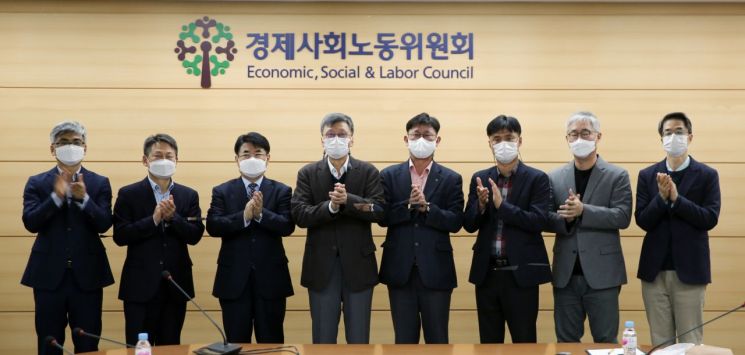 The Public Institution Committee under the Economic, Social and Labor Council (ESLC), a social dialogue body directly under the President, announced the "Agreement for the Sustainable Development of Public Institutions" on November 25 last year. In the agreement, the committee stated, "We will strive to reform the wage system so that objective job values are reflected in wages." The photo shows the committee members. (Image source=Yonhap News)
[Sejong=Asia Economy Reporter Moon Chaeseok] On the 25th, social dialogue to change the public institution wage system from a seniority-based step system to a job competency-based job grade system officially began.
On this day, the Economic, Social and Labor Council (ESLC), a social dialogue body under the direct control of the president, announced that it would reactivate the Public Institution Committee under its jurisdiction.
The Public Institution Committee, launched in November 2019, ended its activity period last November. Accordingly, the ESLC decided to operate the 2nd Public Institution Committee for nine months from this month until March next year.
The 1st Public Institution Committee previously announced major agreements such as the introduction of a job-centered wage system, improvement of the wage peak system, and the introduction of the labor director system. Among these, the agreement on the introduction of the labor director system has been reflected in related bills and is currently undergoing legislative procedures.
The 2nd Public Institution Committee plans to focus on follow-up discussions regarding the introduction of a job-centered wage system and improvement measures for the wage peak system. To this end, detailed agendas such as ▲survey on the current status of public institution wage systems ▲job-centered wage system and personnel management measures ▲survey on the current status of the public institution wage peak system ▲mid- to long-term development plans for the wage peak system have been finalized.
If the Public Institution Committee produces a concrete agreement for the introduction of a job-centered wage system, it could have a significant impact on private companies as well. The job grade system is emerging as an alternative to the seniority-based step system, often called the "iron rice bowl." The seniority system automatically increases wages based on years of service, which inevitably acts as a risk factor in an era of low growth and aging population. It can cause a surge in labor costs for companies and is also cited as a background for severe wage disparities.
However, since the labor sector strongly opposes the introduction of the job grade system, reaching a concrete agreement is expected to be difficult. As the government is the employer of public institutions, the dialogue mainly proceeds between the government and the labor sector. Public interest commissioners, who are experts, play a mediating role. Professor Lee Sang-min of Hanyang University was appointed as the chairman. The chairman said, "The reform of the public institution wage system and improvement of the wage peak system are tasks that cannot succeed without trust and cooperation between labor and management."
© The Asia Business Daily(www.asiae.co.kr). All rights reserved.
![Clutching a Stolen Dior Bag, Saying "I Hate Being Poor but Real"... The Grotesque Con of a "Human Knockoff" [Slate]](https://cwcontent.asiae.co.kr/asiaresize/183/2026021902243444107_1771435474.jpg)















