Fair Trade Commission imposes 234.9 billion KRW fine on 4 affiliates and Wellstory
Former Chief Choi Ji-sung and others prosecuted... FTC and Samsung hold divergent views on key issues
[Asia Economy Reporter Jeong Hyunjin] As the Korea Fair Trade Commission (KFTC) imposed a record-high fine on Samsung over the unfair support issue involving Samsung Welstory, both sides are clashing over key points of contention. Whether Samsung affiliates, including Samsung Electronics, guaranteed profits to Welstory, whether the Samsung Future Strategy Office (FSO) actively intervened in the in-house meal service issue, and whether this ultimately influenced the succession of management rights within Vice Chairman Lee Jae-yong's family?each issue reveals significant differences in positions, suggesting fierce legal battles ahead.
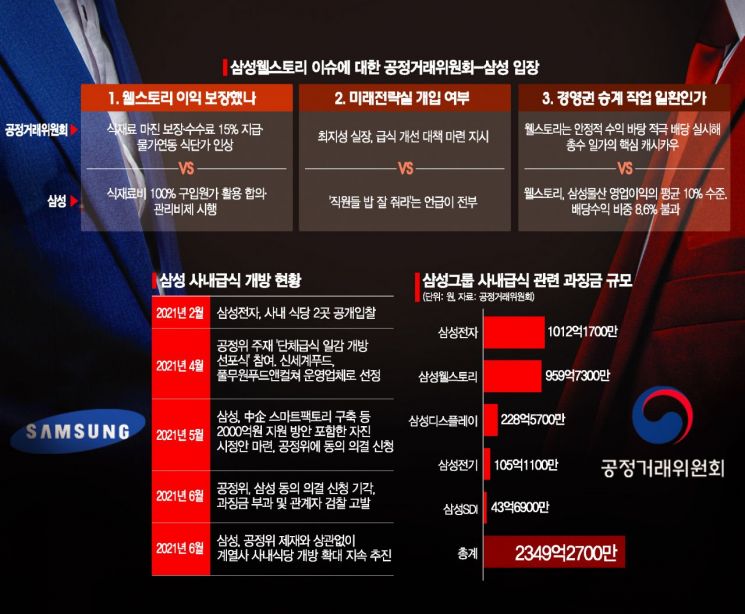
Unfair Profit Support vs. Meal Service Improvement
The KFTC primarily views that Samsung affiliates guaranteed high profits to Samsung Welstory by securing margins on food ingredients and paying an additional 15% outsourcing fee, thereby funneling work to Welstory. This is why fines totaling 234.9 billion KRW were imposed on four companies?Samsung Electronics, Samsung Display, Samsung Electro-Mechanics, Samsung SDI?and Samsung Welstory.
Samsung, however, counters that in 2012, amid employee complaints about meal services, an agreement was made to use 100% of food ingredient costs at purchase price to maintain meal quality. They argue that the ‘management fee system’ adopted by overseas companies like Apple and Google was applied, whereby no profit was made on food ingredient costs but an outsourcing fee was provided instead. The automatic reflection of inflation rates was also intended solely to maintain meal quality, not to compensate Welstory’s profits. A Samsung official stated, "If the intention was to compensate Welstory’s profits, there would have been no reason to urgently inject additional food ingredient costs in November 2012, which caused the direct profit margin to plummet from 22% to 15%."
FSO Full Intervention in Welstory Support vs. Merely Saying ‘Feed Employees Well’
Regarding FSO’s involvement, the KFTC and Samsung hold sharply contrasting views. The KFTC claims that former FSO chief Choi Ji-sung ordered measures to improve meal services and that the FSO systematically intervened in in-house meal services, including meal volume and food ingredient price investigations. They say a meal improvement task force (TF) was established in January 2013, which blocked verification of food ingredient costs used by affiliates and halted competitive bidding for cafeterias.
Samsung, on the other hand, insists that former chief Choi only mentioned ‘feed employees well’ and never instructed to support Welstory. They emphasize that there was no directive to stop price investigations by the FSO and argue that Samsung Electronics currently verifies food ingredient purchasing competitiveness based on objective data. Samsung also states that the suspension of competitive bidding was a managerial decision made in 2017 considering side effects at the time.
Impact on Samsung’s Management Succession?
Ultimately, these differences stem from contrasting perceptions of the ‘support background’ for Welstory by Samsung affiliates. The KFTC views that Welstory accounted for 75% of Samsung C&T’s operating profit, generating stable revenue through internal group meal service transactions, and that Welstory served as a key funding channel for the family of the group’s head. It claims that the family, including Samsung Electronics Vice Chairman Lee Jae-yong (17.48%), the largest shareholder of Samsung C&T, received Welstory’s profits through dividends, as Welstory is a wholly owned subsidiary of Samsung C&T.
Samsung responds that the 75% operating profit share of Welstory occurred during a specific period when other businesses struggled due to a downturn in the construction industry, and that on average, Welstory’s operating profit accounted for only about 10% of Samsung C&T’s total. Samsung also explains that Welstory’s dividend income accounted for only 8.6% of the total dividend income from shares held by Samsung C&T. It is also reported that Samsung once considered selling Welstory internally, which would have been unlikely if it were a core business.
© The Asia Business Daily(www.asiae.co.kr). All rights reserved.
![Clutching a Stolen Dior Bag, Saying "I Hate Being Poor but Real"... The Grotesque Con of a "Human Knockoff" [Slate]](https://cwcontent.asiae.co.kr/asiaresize/183/2026021902243444107_1771435474.jpg)
















