Individual Investors' Net Purchases Reach 62.4 Trillion KRW This Year
Contrasting Foreign and Institutional Selling Pressure
Individual Monthly Trading Volume Also Hits 404 Trillion KRW
Upward Trend Expected Despite Burdens
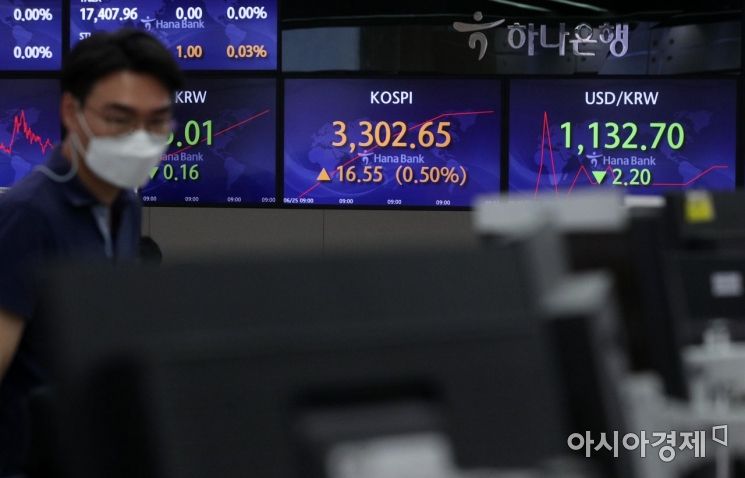 The KOSPI surpassed the 3,300 mark for the first time in history. On the 25th, the KOSPI index opened at 3,289.18, up 3.08 points (0.09%), and extended its gains to break the intraday record of 3,292.27 set the previous day. The photo shows the Hana Bank dealing room in Jung-gu, Seoul on that day. Photo by Kim Hyun-min kimhyun81@
[Asia Economy Reporter Song Hwajeong] The KOSPI surpassed the 3300 mark on the 25th. This is the first time in over five months since it first crossed the 3000 mark earlier this year. Given the favorable domestic and international factors surrounding the market, the stock market's bullish trend is expected to continue for the time being.
The KOSPI has risen 14.36% so far this year. After surpassing the 3000 mark at the beginning of the year, it quickly climbed to the 3200 level within the same month. Although it experienced some corrections in February and March, it has maintained a gradual upward trend since April, setting a total of nine all-time highs this year. Notably, it broke its record four times just this month. The KOSPI's market capitalization also exceeded 2300 trillion won for the first time ever. Considering the KOSDAQ market capitalization of 423 trillion won, the combined market capitalization of KOSPI and KOSDAQ stands at 2723 trillion won, making the 3000 trillion won milestone not far off.
Opening the KOSPI 3300 Era with the Power of Individual Investors
The main driver behind the KOSPI reaching the 3300 level is undoubtedly individual investors. Since the beginning of this year until the day before, individuals have net purchased 62.4196 trillion won in the domestic stock market. In contrast, foreign investors sold 19.8324 trillion won, and institutions sold 38.7581 trillion won during the same period. Individual investors, who led the market's bullish trend with active net buying after the COVID-19 pandemic last year, have already surpassed last year's total net purchase amount of 47.4907 trillion won this year.
According to the Korea Capital Market Institute, the number of active stock trading accounts held by individual investors increased by 8.43 million, from 29.91 million in March last year to 38.34 million in February this year. During this period, the average monthly trading volume of individual investors was 404 trillion won, which is 3.1 times higher than the 130 trillion won average from 2017 to 2019. Kim Minki, a researcher at the Korea Capital Market Institute, stated, "The influx of such a large amount of new investment funds and new investors within just over a year is unprecedented in the Korean stock market," adding, "The sharp decline in the domestic stock market due to the COVID-19 shock, the rapid rebound afterward, and the strengthening of the low-interest-rate environment stimulated individual investors' demand for stock investment."
Will the Bull Market Continue? Despite Burdens, Conditions Remain Favorable
Now, the market's focus is on how much longer the stock prices will continue their bullish trend. If the KOSPI closes higher this month, it will mark eight consecutive months of monthly gains, tying the record set in 2017. According to Heungkuk Securities, since the KOSPI's inception in 1980, there has never been a case of nine consecutive months of monthly gains. If the KOSPI rises in July as well, it will set the longest winning streak. Researcher Byun Junho of Heungkuk Securities said, "2017 was a year of a strong bull market due to unexpected factors such as Donald Trump's election and a weak dollar, combined with economic stimulus measures," adding, "The current situation is also passing through a unique phase of recovery after the pandemic, so unexpected outcomes may occur."
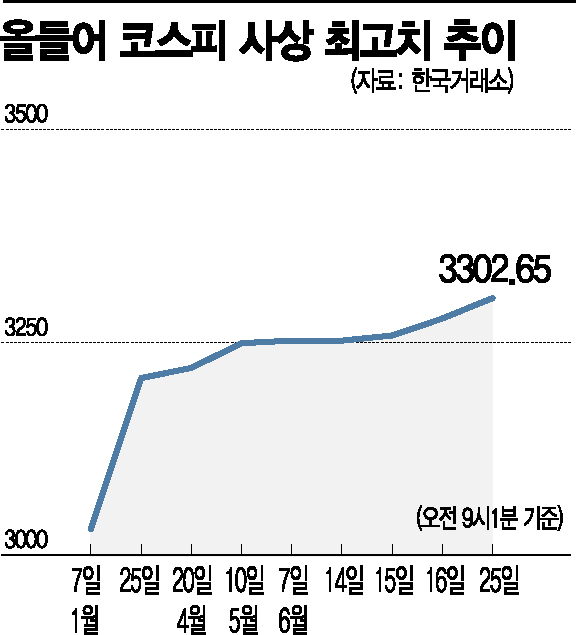
Although the continued rise brings some burdens, the prevailing view is that the upward trend will not change. Park Seokhyun, a researcher at KTB Investment & Securities, said, "There will be no change in the upward trend of the KOSPI, which is hitting all-time highs," adding, "While the economic recovery may slow down relatively in the second half of the year, the possibility of a reversal is low due to solid resilience. Despite debates over policy effects, the Federal Reserve's efforts to stabilize the market, led by Chairman Jerome Powell, are likely to be repeated, so the gradual process of raising the KOSPI's peak can continue on a consistent path, even with some ups and downs."
Even if the rise continues, the magnitude of the increase is expected to be modest. Researcher Byun said, "The fact that the KOSPI has risen for eight consecutive months does not necessarily signal a market crash, but it does increase the rationale for a short-term pause," adding, "Even if the KOSPI attempts further gains in July and August, the extent of the rise is likely to be limited."
There is also an opinion that it is now time to focus on earnings momentum rather than policy momentum. Han Daehun, a researcher at SK Securities, said, "Although the frequency of hawkish remarks by Fed officials is increasing, since the Fed has stated there will be no preemptive rate hikes, it is now time to focus on earnings rather than policy," adding, "Exports increased by 29.5% year-on-year as of the 20th of this month, and considering the number of working days, the increase is 33.7%, showing a strong trend. The fact that exports in the second quarter all increased by more than 30% year-on-year raises expectations for second-quarter earnings." Reflecting the strong exports and expectations for the resumption of economic activities, the estimated net profit of the KOSPI for the second quarter has been revised upward by 26.2%, from 27.5 trillion won at the beginning of the year to 34.7 trillion won currently. Han explained, "Although there is strong profit-taking pressure on rapidly rising stocks like Kakao and Naver, considering the fast-paced rotation market and still abundant liquidity, the support for the index's downside remains solid."
© The Asia Business Daily(www.asiae.co.kr). All rights reserved.
![Clutching a Stolen Dior Bag, Saying "I Hate Being Poor but Real"... The Grotesque Con of a "Human Knockoff" [Slate]](https://cwcontent.asiae.co.kr/asiaresize/183/2026021902243444107_1771435474.jpg)

















