CJ Tender is Transforming into Puradak Chicken
Increasing Demand for Semi-Prepared Products at Workplaces
Costs Decrease and 'Safety' Certification Achieved
Isak Toast Uses Dongwon Richam
Shinsegae Food Operates Dedicated Facilities for Soup and Sauce
[Asia Economy Reporter Lim Hye-seon] The B2B (business-to-business) market for dining out and catering is also experiencing a wave of convenience foods and meal kits. Demand is increasing for semi-prepared and fully finished products instead of raw ingredients.
Supplying Semi-Prepared and Fully Finished Products Instead of Raw Ingredients
According to the distribution industry on the 25th, CJ CheilJedang supplies Ten Touch Barrow to the chicken franchise Puradak. This is the first collaborative product with a dining business since CJ CheilJedang launched its B2B premium brand, Creait. CJ CheilJedang aims to transform the B2B market paradigm through "high-quality, customer-tailored solutions" beyond simple product supply. The company is promoting collaborations with market leaders and startups.
One factor driving the growth of the B2B market is the changing practice in the dining and catering market, where the original manufacturers were not disclosed. Due to consumer demand for safe and trustworthy food, many companies are actively promoting the original manufacturers' brands. A recent example is Isaac Toast including "Double Cheese Richam," which uses Dongwon F&B's Richam, on its menu. The "Spam Certification Mark" introduced by CJ CheilJedang is another example.
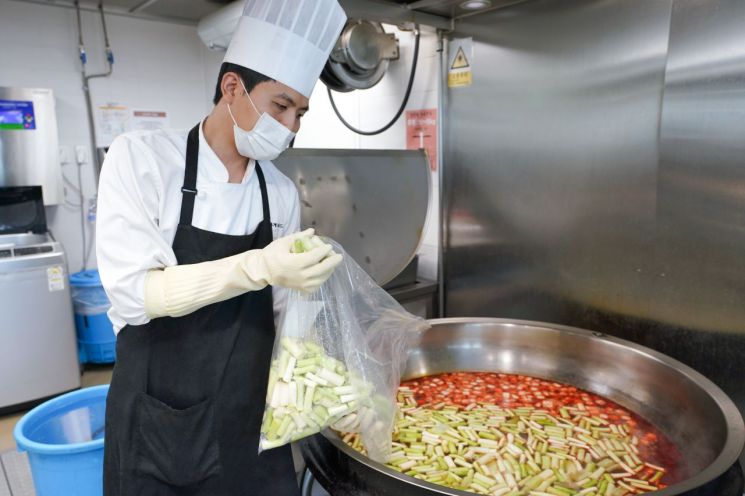
The market-leading company that pioneered the B2B market since 2009 is Shinsegae Food. To standardize the taste of food sold at dining and catering sites, Shinsegae Food started the central kitchen business by producing soup and stew types such as yukgaejang (spicy beef soup), seaweed soup, and soybean paste soup in 5kg units and supplying them to business sites. In 2015, it secured dedicated facilities for agricultural products such as vegetables and fruits at its Icheon plant, and dedicated facilities for soups, stews, and sauces at its Eumseong plant. As demand for central kitchens increased at business sites, Shinsegae Food launched the central kitchen specialized brand "Chef’s Choice" in 2016 and currently operates about 400 items.
The main items currently operated include soup and stew types such as soybean paste soup, seaweed soup, and beef radish soup, as well as sauces, processed meat products like pork stir-fry, beef bulgogi, soy sauce bulgogi, gochujang pork belly, frozen snacks, and noodle and rice cake products. Since 2016, Shinsegae Food has launched the central kitchen specialized brand "Chef’s Choice" and operated about 200 items. Recently, due to the sharp increase in minimum wage and the reduction of working hours to 52 hours per week, the demand from small and medium-sized dining and catering businesses facing labor cost burdens has increased, expanding the number of items to about 400.
B2B Processed Food Market to Reach 50 Trillion Won by 2025
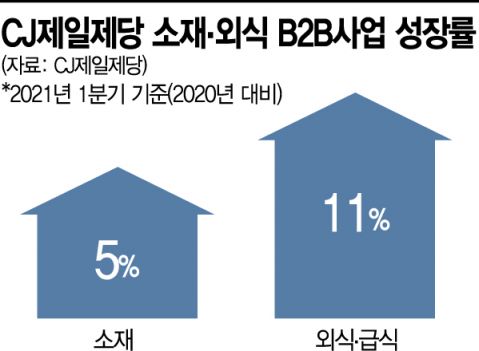
According to the food industry, the domestic B2B processed food market is expected to expand from 34 trillion won this year to over 50 trillion won by 2025. The growth of the dining out market is particularly notable. The dining out B2B market has shown an average annual growth rate of 22.1% since 2017. In the case of CJ CheilJedang, while B2B business sales in the materials sector increased by 5% in the first quarter of this year, food sales including catering and dining out grew by 11%. Shinsegae Food’s central kitchen business scale also increased from about 1,800 tons in 2015 to 10,000 tons last year. The sales of the central kitchen specialized brand Chef’s Choice have also increased by 257% over the past three years.
The background for seeking convenience foods at dining and catering sites includes labor cost and time savings. Since the head chef had to prepare all menus alone, the workload was heavy and working hours were long. However, when using semi-prepared products, cooks can prepare food according to manuals for each menu, allowing the head chef to focus more on the balance, nutrition, and hygiene of the entire menu. Taste differences due to varying daily preferences can also be standardized. Gas and electricity costs previously spent on boiling broth for 2 to 3 hours to make soups and stews can also be reduced. According to Shinsegae Food, it takes 5 hours and 40 minutes to prepare 300 servings of yukgaejang. Using central kitchen products can save 4 hours and 30 minutes.
Initial costs are also reduced as vegetable cutters, washers, and meat processing equipment that had to be installed at catering sites are no longer necessary. Processed meat products only need to be heated, and soups and stews can be easily completed by diluting sauces with water and adding ingredients, making them popular among self-employed business owners as well.
A food ingredient supplier explained, "Recently, as food ingredient prices have surged, more businesses are seeking semi-prepared products," adding, "Since businesses want to provide not only traditional catering meals but also convenience foods suitable for takeout, the supply is expanding from semi-prepared to fully finished products."
© The Asia Business Daily(www.asiae.co.kr). All rights reserved.


















