10 Ruling and Opposition Party Lawmakers Submit Amendment to the 'Electronic Commerce Act'
Strengthening Platform Responsibility... Punishment for Paid Review Writers
Mandatory Warning Phrase 'Punishment for False Review Writing'
Concerns Over Reduced Food Review Activity and Pressure on Companies

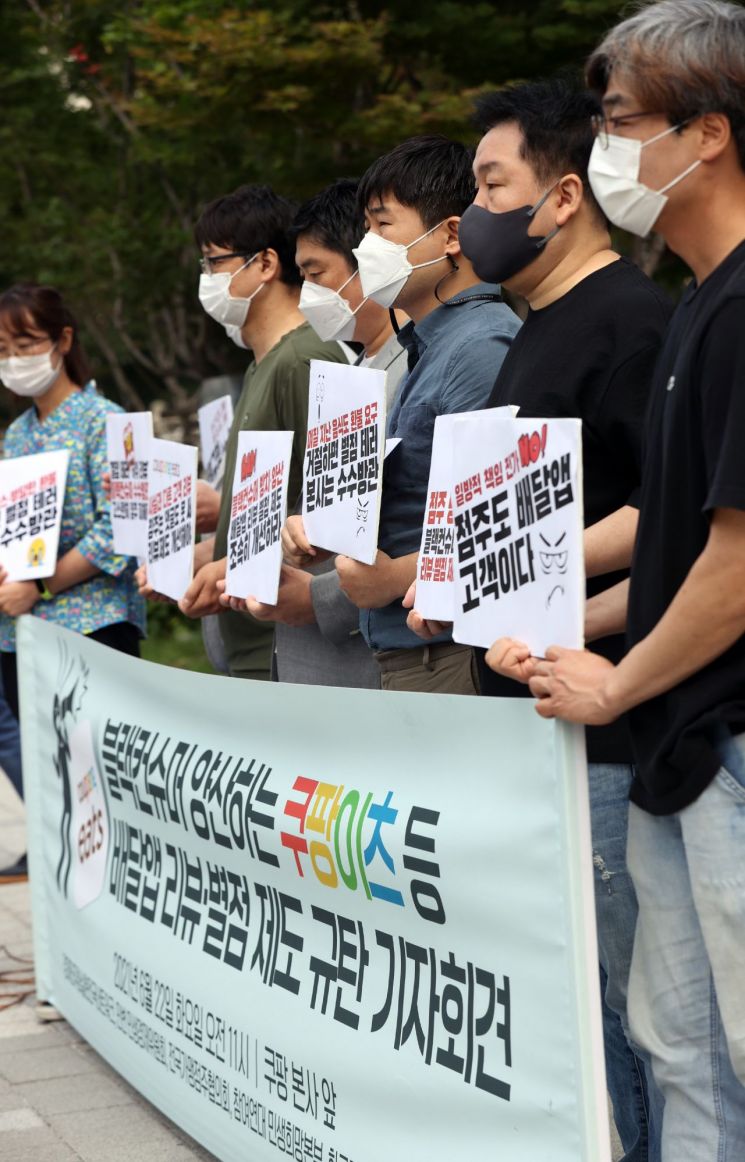
The review system for delivery order applications (apps) is being tainted by power abuse. The recent ‘Shrimp Tempura Power Abuse Incident’ on Coupang Eats clearly illustrates this situation. Self-employed business owners are suffering because users demand services by saying they will write good reviews or write malicious reviews if the service is not provided.
To prevent such abuse of the star rating and review system, a so-called ‘Star Rating Terrorism Prohibition Act’ has been submitted to the National Assembly. It includes provisions to strengthen the responsibility of platform companies to prevent star rating terrorism and to punish those who write paid false reviews. On the 24th, 10 lawmakers from both ruling and opposition parties jointly proposed an amendment to the ‘Act on Consumer Protection in Electronic Commerce, etc.’ (led by Bae Jin-gyo of the Justice Party) containing these provisions.
Representative Bae stated, "False reviews distort information not only for store owners but also for consumers, causing harm to both sides," and added, "A healthy and sustainable platform ecosystem will be established when transparency and fairness in information and transactions are guaranteed."
If this law passes, platform operators must attach warning messages stating that false review writing is punishable. They must also establish preventive measures against false review writing and review brokerage or mediation activities. There is also a clause requiring disclosure of methods for collecting consumer reviews and sorting criteria. Writing paid reviews or demanding compensation for reviews is prohibited, and violators face imprisonment of up to three years or fines up to 100 million won.
According to the ‘Delivery Application Usage Survey’ conducted by the Justice Party’s 6411 Livelihood Special Committee and the Justice Policy Research Institute, 63.3% of self-employed delivery app users reported experiencing damage from star rating terrorism or malicious reviews. Additionally, 74.3% said that star ratings and reviews affect sales.
The platform star rating and review system is a double-edged sword. While abuse can poison the market environment, it is an effective promotional tool for sincere business owners to advertise their stores at low cost. An industry insider pointed out, "Strengthening regulations just because of extreme abuse cases could have the adverse effect of hindering consumers’ freedom to express opinions and their right to choose." There is a possibility that the act of writing star ratings and reviews itself could be suppressed, causing harm to well-intentioned parties.
Also, because it is practically difficult to legally define and punish black consumers (malicious consumers), pressure is being placed on companies by strengthening the responsibility of platform operators.
Platform operators themselves are implementing policies to prevent star rating terrorism and malicious reviews. Woowa Brothers, which operates Baedal Minjok, blind reviews for 30 days if a store owner requests suspension of review postings due to defamation, etc. Last year, they introduced a policy prohibiting review rewriting and a three-day limit on review writing periods. Through dedicated review inspection personnel and artificial intelligence (AI) monitoring, they also detected a gang that earned over 100 million won through false reviews.
Naver has introduced a ‘Receipt Review’ system. To leave a review, users must verify a receipt from the visited location to be able to leave star ratings and comments. Naver plans to abolish the star rating system in the third quarter of this year. Instead of star ratings, AI will extract keywords from reviews left by visitors to a specific place and display them as a tag cloud.
© The Asia Business Daily(www.asiae.co.kr). All rights reserved.
![Clutching a Stolen Dior Bag, Saying "I Hate Being Poor but Real"... The Grotesque Con of a "Human Knockoff" [Slate]](https://cwcontent.asiae.co.kr/asiaresize/183/2026021902243444107_1771435474.jpg)
















