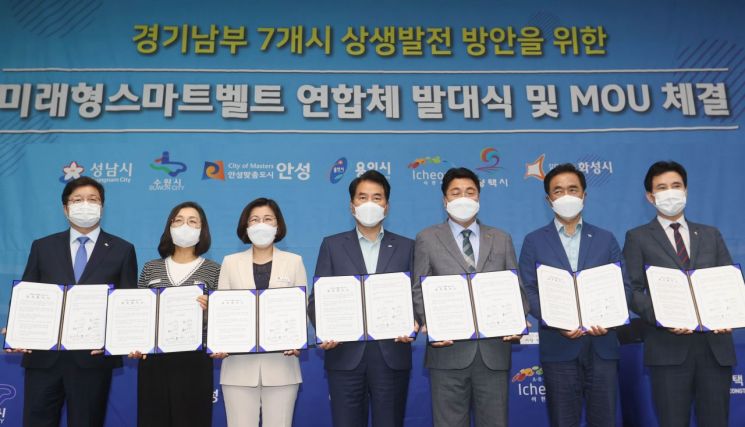
[Asia Economy (Yongin) = Reporter Lee Young-gyu] Seven local governments in Gyeonggi Province?Suwon, Seongnam, Yongin, Hwaseong, Anseong, Pyeongtaek, and Icheon?have formed a council to jointly develop around the semiconductor industry.
These seven local governments announced on the 24th that they signed the "Future Smart Belt Win-Win Development Agreement" at the Yongin City Hall Convention Hall.
The Future Smart Belt is a "local government council" established to foster future industries centered on semiconductors in line with the 4th Metropolitan Area Readjustment Plan, which includes the "Establishment of the Southern Gyeonggi Smart Semiconductor Belt," and the K-Semiconductor Belt construction strategy announced by the government last May, and to actively request support from the central government.
Previously, the government, together with companies, formed the "K-Semiconductor Belt," creating the world's largest and most advanced semiconductor supply chain in Korea. The K-Semiconductor Belt takes a "K-shaped" form, connecting Seongnam Pangyo and the western side of Giheung~Hwaseong~Pyeongtaek~Onyang with the eastern side of Icheon~Cheongju through Yongin.
Within the belt, including the Yongin semiconductor cluster, companies related to manufacturing, materials and parts, advanced equipment, packaging, and fabless sectors are either established or increasing investments. Near Seongnam Pangyo, a new "Korean-style Fabless (Design) Valley" will be created.
The seven local governments, which host semiconductor-related companies, plan to set a joint goal of "strengthening future industries and establishing future cities" and cooperate closely, using the formation of this council as an opportunity.
They agreed to prepare joint policies to support semiconductor companies in stable product manufacturing and to create jobs linked to related industries.
They will also consider enacting joint ordinances to revitalize local businesses.
Additionally, they will actively introduce eco-friendly transportation such as hydrogen and electric trams to improve air quality, while expanding renewable energy distribution and minimizing greenhouse gas emissions as local governments, aiming to create "carbon-neutral eco-friendly cities."
They plan to jointly develop a master plan to ensure these eco-friendly policies are incorporated into the mid- to long-term urban plans of each local government.
Baek Gun-gi, mayor of Yongin and the inaugural chairman, stated, "It is an inevitable relationship to respond together to changes in future industries based on the semiconductor industry," and promised, "We will actively cooperate to discover and implement practical policies that 5 million citizens of the seven cities can feel."
After the agreement ceremony, a seminar attended by about 50 people, including members of the Korea Economic Law Association and officials from the seven local governments, explored ways to revitalize the regional economy, focusing on policy improvements for local currency and strengthening the competitiveness of local businesses and small merchants.
© The Asia Business Daily(www.asiae.co.kr). All rights reserved.
![Clutching a Stolen Dior Bag, Saying "I Hate Being Poor but Real"... The Grotesque Con of a "Human Knockoff" [Slate]](https://cwcontent.asiae.co.kr/asiaresize/183/2026021902243444107_1771435474.jpg)















