Korea Institute of Energy Research Develops Technology for Over 80% Efficient Green Hydrogen Production Using Voltage-Unstable Renewable Energy
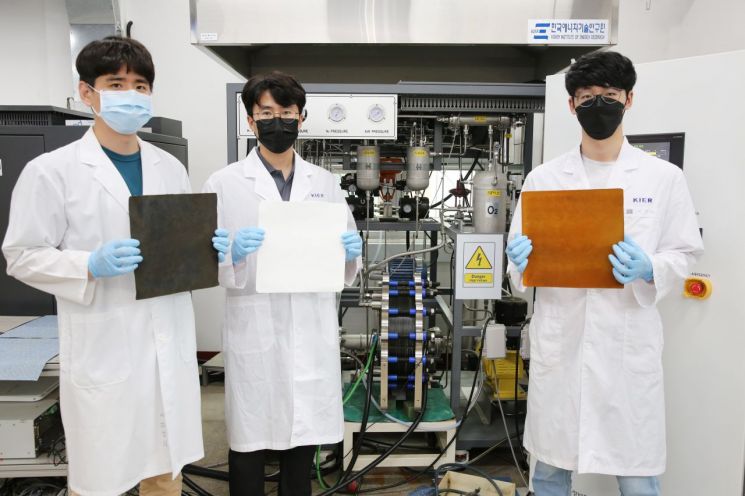 Researchers at the Korea Institute of Energy Technology hold the electrodes and separator used in the 10kW alkaline water electrolysis stack they developed. Photo by Korea Institute of Energy Technology.
[Asia Economy Reporter Kim Bong-su] Korea, which has been evaluated as having inferior production technology compared to hydrogen storage and utilization technologies, has finally caught up with advanced technology levels by developing an eco-friendly green hydrogen production technology that maintains stable high efficiency even when using renewable energy sources with severe load fluctuations such as wind and solar power.
The Korea Institute of Energy Research announced on the 24th that the research team led by Dr. Kim Chang-hee of the Hydrogen Research Division independently developed a "10kW-class alkaline water electrolysis stack" capable of producing green hydrogen at a maximum efficiency of 84% (based on higher heating value) and a production rate of 2㎚3 per hour by electrolyzing water. A water electrolysis stack is a core device where the supplied water is decomposed to actually produce hydrogen. It is made by stacking multiple unit components such as electrodes, membranes, separators, and cell frames from several to hundreds according to the required output.
Last year, the research team developed a "load fluctuation response-type water electrolysis stack design technology" that can stably produce hydrogen at high efficiency despite the severe load fluctuations characteristic of renewable energy sources such as wind intensity and solar power magnitude.
In this study, the team independently developed the core materials and components of the stack and directly manufactured a 10kW-class hydrogen production device. In particular, they tested stability and efficiency by operating it for 1,008 hours, repeatedly turning the power off and on more than 100 times, considering the characteristics of renewable energy with severe power generation fluctuations.
As a result, the research team succeeded in verifying performance and durability by maintaining operation without failure despite frequent voltage fluctuations and especially maintaining a production efficiency of 82%. The 82% efficiency recorded by the team instantly elevated Korea’s technology, which had been weak in the green hydrogen production field, to the level of advanced countries such as Germany, Japan, and the United States. These countries have possessed approximately 80% efficient MW-class water electrolysis stacks and related material and component technologies through about 20 years of related technology development.
However, until now, the efficiency of green hydrogen production technology developed domestically has remained below 70%, showing a significant gap. The research team manufactured and applied porous electrodes of Ni-Al and Ni-Fe series, effective for hydrogen evolution reaction and oxygen evolution reaction, as the cathode and anode of the 10kW-class water electrolysis stack, respectively. The separator, which serves as the pathway for hydrogen and oxygen, was nickel-plated to reduce contact resistance and enhance corrosion resistance. By developing a flow channel shape that reduces leakage current and facilitates electrolyte flow within the stack and applying it to the cell frame inside the stack, they were able to develop a high-efficiency water electrolysis stack where each material and component technology was smoothly linked.
Dr. Kim Chang-hee, head of the division, said, "The currently developed 10kW-class alkaline water electrolysis stack is designed to be expandable up to 100kW by increasing the number of layers, so it can be used as a core technology for developing MW-class water electrolysis stacks." He added, "To prevent the domestic water electrolysis market from being dominated by overseas leading companies, it is essential not to be satisfied with the current technology development but to achieve early commercialization of domestic water electrolysis technology through complementary cooperation with domestic demand companies."
© The Asia Business Daily(www.asiae.co.kr). All rights reserved.
![Clutching a Stolen Dior Bag, Saying "I Hate Being Poor but Real"... The Grotesque Con of a "Human Knockoff" [Slate]](https://cwcontent.asiae.co.kr/asiaresize/183/2026021902243444107_1771435474.jpg)
















