Bank of Korea 'Review of Inflation Target Management in the First Half of 2021'
"Considerable latent factors causing inflation"
Demand-side price pressures persist... possibility of inflation rate exceeding 2%
"Orderly normalization from an appropriate point within the year"
Interest rate normalization aligned with economic recovery considering financial imbalances and inflation
"Not at odds with government supplementary budget, mutually complementary operation"
Fiscal policy should focus on selective support for uneven recovery
[Asia Economy Reporters Kim Eunbyeol, Jang Sehee] Lee Ju-yeol, Governor of the Bank of Korea (BOK), officially announced an interest rate hike within the year while mentioning the possibility of inflation. Previously, the BOK hinted at a possible rate hike in the second half of the year, citing soaring asset prices and skyrocketing debt due to over a year of monetary easing since COVID-19. Since inflation has risen more than expected and is judged to fluctuate around the 2% inflation target, the atmosphere strongly suggests a rate hike within the year by the BOK.
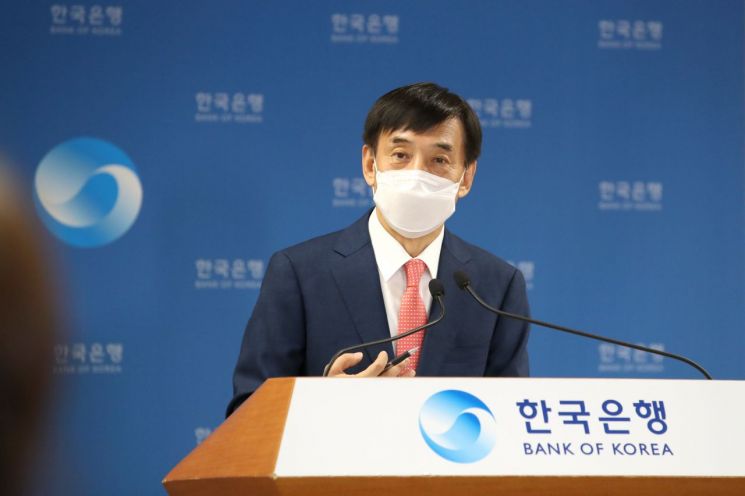
At the '2021 First Half Inflation Target Management Status Review Briefing' on the 24th, Governor Lee said, "From a medium-term perspective, there are considerable latent factors that could cause inflation," adding, "Fiscal stimulus measures and large-scale liquidity supply implemented by governments and central banks worldwide, combined with rapid economic recovery, could further expand inflationary pressures." He also evaluated that "as our economy's recovery becomes clearer, demand-side inflationary pressures are gradually increasing."
Governor Lee also stated, "If labor mobility is restricted and global supply chain recovery slows, bottlenecks may persist longer, and the rise in international raw material prices during the transition to a green economy could also be prolonged." Amid active discussions on whether the recent high inflation is temporary or signals the arrival of an inflation era, Governor Lee emphasized the possibility of inflation rising more than expected. Jerome Powell, Chair of the U.S. Federal Reserve (Fed), testified before Congress that "1970s-style inflation will not come," but also said, "If excessively high inflation persists, we will take action."
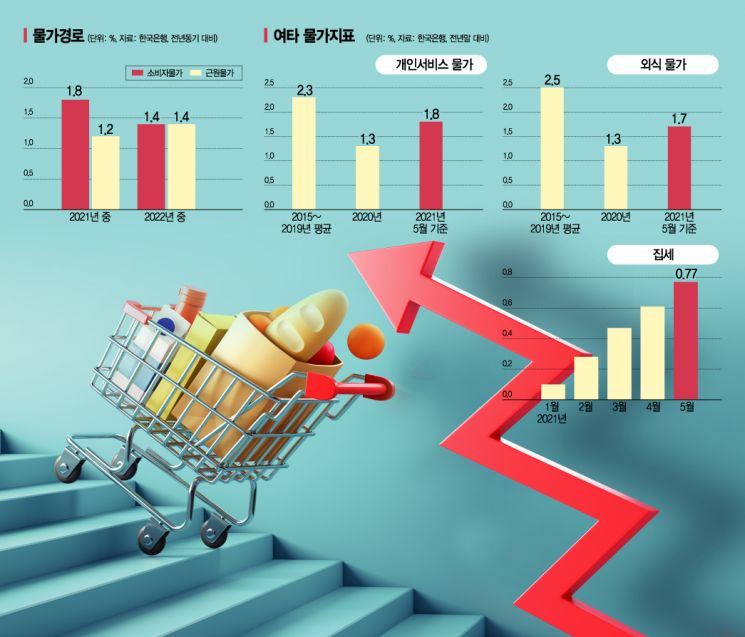
The BOK's forecast for this year's annual consumer price inflation rate is 1.8%. With the economic recovery accelerating, there is a possibility that the inflation rate could exceed 2% depending on circumstances. Governor Lee stated, "If high inflation persists for a considerable period, economic agents' inflation expectations may rise, potentially causing additional inflation."
Governor Lee also firmly expressed the need to raise interest rates within the year, considering financial imbalances and inflation. He said, "Normalizing interest rates in line with the economic recovery is a natural process," adding, "Neglecting to respond to financial imbalances will inevitably have very large negative effects on the economy and inflation in the medium term."
He further said, "We will orderly normalize the current accommodative monetary policy from an appropriate point within the year," and "Normalizing in line with the economic recovery is a natural process." He also mentioned, "Normalization of the base rate should start at a timely point," and "Even if interest rates are raised once or twice, monetary policy remains accommodative."
The inflation expectations of the general public have already far exceeded 2%. The BOK announced that the June expected inflation rate was 2.3%, up 0.1 percentage points from the previous month. The expected inflation rate reflects the forecasted consumer price inflation rate for the next year and was the highest since March 2019 (2.3%).
The government's second supplementary budget (supplementary budget) of 30 trillion won could also be a factor that fuels inflation. Professor Sung Tae-yoon of Yonsei University's Department of Economics explained, "It seems highly likely that this year's annual inflation rate will exceed 2.0%," adding, "Depending on how interest rate policy is handled in the second half, inflation in the first half of next year could also be affected, but adjusting interest rates could ease upward inflationary pressures." He further forecasted, "If face-to-face consumption expands, inflationary pressure will arise. Previously, only supply-side price pressures raised perceived inflation, but as the economy recovers, underlying inflationary pressures will act."
"Inflation fluctuates around 2% in the second half... Core inflation recovers quickly"
The BOK stated at the 'Inflation Target Management Status Review' that "With rapid economic recovery, demand-side inflationary pressures are gradually increasing, so consumer price inflation is expected to fluctuate around 2% in the second half." It also cited ▲ continued rise in raw material and agricultural/livestock product prices ▲ sustained high global inflation ▲ strengthened recovery in consumer demand due to expanded vaccination as factors that could further raise inflation. This implies that depending on the speed of economic recovery, the annual inflation rate could exceed 2%.
In particular, the BOK is focusing on the fact that core inflation, which had remained in the 0% range for the past two years, is expected to stay above 1%. Core inflation excludes items with volatile prices due to temporary external shocks and is an important basis for central banks in deciding monetary policy. As the economy recovers, demand-side inflationary pressures are increasing alongside supply factors such as agricultural/livestock products and oil prices.
In fact, decomposing the contribution of items to the consumer price inflation rate (year-on-year) in April-May shows that agricultural/livestock/fishery products (1.0 percentage point), petroleum products (0.7 percentage point), and services (0.8 percentage point) all contributed significantly. In May, personal services prices rose 1.8%, and dining-out prices rose 1.7%, close to the 2015-2019 average. Accordingly, core inflation excluding food and energy recorded 1.2% last month, exceeding 1% for the second consecutive month, and core inflation excluding administered prices (1.7%) rose to the mid-to-high 1% range. Inflationary pressures on other core items such as public service prices, rent, and industrial product prices are also expected to gradually increase. The BOK diagnosed that the pace of core inflation recovery is faster than in past crises.
Global inflation... Raw material price rise may last longer than expected
Consumer price inflation rates in major countries are also expanding sharply. The U.S. consumer price inflation rate in May this year was 5.0%, the highest since August 2008. This was due to a combination of last year's oil price plunge base effect, economic recovery, and macro policies.
The problem is that the rise in agricultural/livestock products, oil, and raw materials that have driven inflation so far may last longer than expected. Governor Lee said at the briefing, "Not only demand but also supply-side factors such as agricultural/livestock products and international oil prices are rising beyond expectations," adding, "Especially, oil has a significant ripple effect on domestic prices, so the upward risk to inflation could be greater than initially forecast."
He added, "The rise in agricultural/livestock product prices is lasting longer than expected, and recently, international oil prices have exceeded the level expected a month ago, surpassing $70 per barrel."
Some countries have already raised their base interest rates considering inflation. The Czech National Bank raised its base rate from 0.25% to 0.50% on the 23rd (local time). The Czech consumer price inflation rate in May reached 2.9%. The Hungarian National Bank also raised its base rate by 0.3 percentage points from 0.6% to 0.9% for the first time in 10 years to respond to inflation. Virag Vernerbasi, Deputy Governor of the Hungarian National Bank, pointed out, "The risk of continuous inflation rise should not be underestimated." Brazil, Russia, Turkey, and others have also raised rates.
30 trillion won supplementary budget likely to fuel inflation... Lee Ju-yeol: "Not at odds with policy... mutually complementary"
While the BOK prepares to raise the base interest rate in response to inflation risks, the government continues monetary easing. The second supplementary budget size (30 trillion won) is about 1.6% of South Korea's gross domestic product (GDP), and 6.3% based on quarterly GDP. If cashback, disaster relief funds, and additional issuance of local currency are implemented through the supplementary budget, it will stimulate consumption and inevitably fuel inflation.
Recently, as the BOK signals interest rate normalization in response to soaring household debt and inflation, there are criticisms that the government's large-scale fiscal policy conflicts with this. Professor Kim Sangbong of Hansung University's Department of Economics said, "The government is pumping money to stimulate inflation, while the BOK keeps sending tightening signals," adding, "Fiscal and monetary policies appear to be conflicting." He also said, "Considering the current inflation level, the BOK's direction to prevent rapid inflation is appropriate."
When large-scale fiscal spending stimulates inflation, the effect of monetary policy may diminish in the future. Professor Kim explained, "Fiscal policy directly leads to consumption, rapidly raising inflation, while monetary policy works through banks and markets, causing a time lag," adding, "In terms of speed, fiscal effects act faster."
However, Governor Lee explained that this is "not at odds but rather mutually complementary." He said, "Harmonious operation of monetary and fiscal policies can vary depending on the macroeconomic situation," adding, "They do not necessarily operate in the same direction or with similar intensity."
He emphasized, "Monetary policy is operated by observing macro conditions, and the direction it should take is to eliminate side effects of prolonged low interest rates according to the degree of economic improvement," adding, "Fiscal policy should focus on selective support for unevenly vulnerable sectors and sectors that enhance productivity in preparation for the post-COVID-19 era, which is a desirable complementary combination of monetary and fiscal policies."
© The Asia Business Daily(www.asiae.co.kr). All rights reserved.
![Clutching a Stolen Dior Bag, Saying "I Hate Being Poor but Real"... The Grotesque Con of a "Human Knockoff" [Slate]](https://cwcontent.asiae.co.kr/asiaresize/183/2026021902243444107_1771435474.jpg)
















