Attempt to Block Import-Export Transactions Citing Human Rights Violations
Firm Stance Despite Concerns Over Solar Power Expansion Setbacks
[Asia Economy New York=Correspondent Baek Jong-min] The U.S. government has decided to ban exports by American companies to solar panel material manufacturers, including polysilicon, related to human rights abuses against the Uyghur population in Xinjiang, China. The U.S. is also set to soon implement a ban on imports of polysilicon produced in Xinjiang.
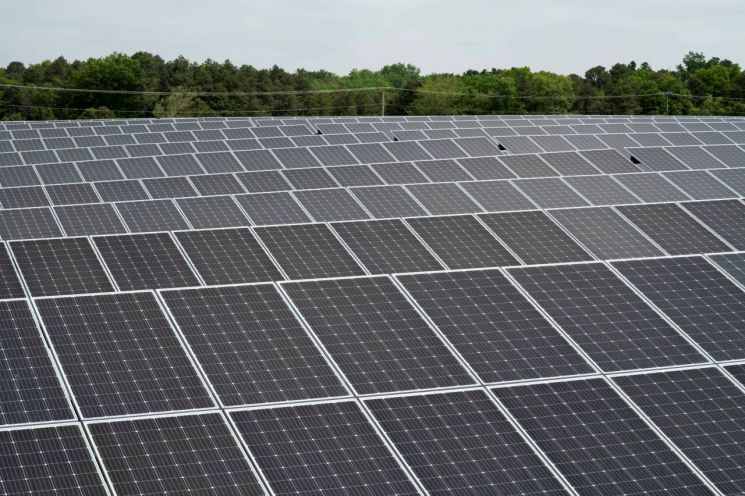
About half of the world's polysilicon is produced in Xinjiang. With the demand for solar panels increasing due to various countries' carbon neutrality policies, this measure is expected to directly and indirectly impact the global solar supply chain.
On the 23rd (local time), the U.S. Department of Commerce added five Chinese companies, including Hoshine Silicon Industry and Xinjiang Production and Construction Corps (XPCC), to the export restriction list known as the "blacklist" for American companies.
According to Voice of America (VOA), four of the five regulated companies manufacture polysilicon and monocrystalline materials used in solar panel production. The cotton company XPCC, which was already subject to import bans under the Trump administration, has now faced expanded regulations.
The U.S. government will also soon enforce import restrictions on polysilicon. Political media outlet Politico reported, citing sources, that the U.S. Customs and Border Protection (CBP) will announce a withhold release order banning imports of polysilicon produced by Hoshine Silicon and others.
Once the measure is implemented, polysilicon produced by Hoshine Silicon Industry will be seized upon arrival at U.S. ports and can only be imported if it is proven not to be linked to forced labor.
The Biden administration, along with the U.S. Congress, has been pushing bipartisan efforts to ban imports of solar power materials produced in Xinjiang. This reflects the U.S. government's intent to sever ties with Xinjiang, which produces about half of the world's polysilicon, despite emphasizing climate change response, due to human rights concerns.
On the same day, the Department of Commerce claimed that the sanctioned companies were involved in human rights abuses and forced labor against the Muslim Uyghur population. The Department of Labor also added polysilicon to the list of goods produced by child labor and forced labor.
White House Press Secretary Jen Psaki mentioned at the daily briefing that there will be announcements soon regarding the import restrictions on Xinjiang-produced polysilicon. She also stated, "We will remove goods produced by forced labor from international supply chains, and supply chain disruptions caused by import restrictions can be resolved alongside climate change goals."
© The Asia Business Daily(www.asiae.co.kr). All rights reserved.
![Clutching a Stolen Dior Bag, Saying "I Hate Being Poor but Real"... The Grotesque Con of a "Human Knockoff" [Slate]](https://cwcontent.asiae.co.kr/asiaresize/183/2026021902243444107_1771435474.jpg)
















